
 Membership
 Network
 Regional Sites & Affiliates


 Events
 Participate
 Resources

 Training
 Credentials
 Government


 Content Channels
 Tools
Tools


 Business Overview




The Greener Good
Saving funds & the environment with upgrades

In Jasper County, South Carolina, students start getting ready for their first day of school. The late August heat makes back-to-school journeys a bit difficult, and the heat stresses classrooms.
Previously, those humid classrooms could make class uncomfortable without high functioning HVAC systems.
But this year, students can look forward to a new classroom environment. Thanks to recent facilities renovations across Jasper County School District, the students enjoyed their first day of school in classrooms filled with cool air and new lighting fixtures, all of which optimize classroom environments by leveraging new green technologies.
Previously primarily reserved for properties like hospitals and larger buildings, smart technology is now reaching facilities of all sizes, particularly in schools and universities across the globe. As seen in Jasper, smart technologies create healthier learning environments, long-term financial savings, and better overall facilities programs. In fact, institutions that choose to utilize smart technology save nearly US$100,000 per year in utility costs, according to a report by Capital E.
Along with implementing smart technologies in facilities, companies have adopted new green commitments (notably reducing carbon emissions by 33 percent by year 2024) due to the multitude of benefits -- lower long-term costs, sustainable output and improving learning environments.
Implementing green technology in facilities programs is no longer a “nice-to-have.” Green initiatives are now a must in maintaining a facilities program built to last.
To stay ahead of the curve, the facilities industry must understand today’s prevailing green technology trends, those trends’ impact and what is next for green technology.
Today’s top green technology trends
Many K-12 and college institutions believe adopting green technology will be more of a financial burden than a long-term solution. Although the upfront cost may be difficult to manage, many green technologies help save overall operating costs in the long-term. For example, Jasper County School District projects to save on average $280,000 per year.
It is important for the facilities industry to become better aware of the top green technologies deployed today.
Below are popular and cost-effective green technologies K-12 and higher education institutions are currently implementing in facilities programs across the U.S.:
Internet of Things (IOT) technology & CO2 monitoring
As IOT technology continues to rapidly expand, the cost of implementing the technologies lowers and can more easily be integrated into other systems. CO2 monitoring in the classroom was uncommon years ago, but as the technology has advanced, the cost of systems dropped and sharing of the data with the HVAC control systems is more standardized. Today, it is becoming more common to see the installation of these systems in the classroom and lecture halls of many educational facilities.
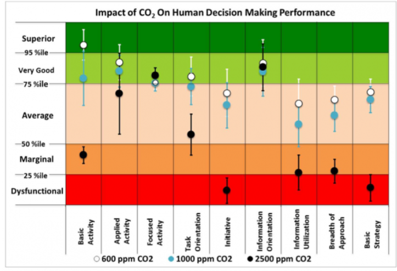 A Lawrence Berkeley National Laboratory CO2 Study found that moderately high indoor concentrations of carbon dioxide (CO2) can “significantly impair people’s decision-making performance.” The report indicated these results were unexpected and may have significant implications for schools and other spaces with high occupant density.”
In addition to ensuring a better classroom learning environment for the students, data from the CO2 system can be used by the HVAC and/or building automation system (BAS) to operate in a more precise manner. Many HVAC schedules operate on pre-programmed occupancy schedules that are often altered and rarely updated. This often may cause the HVAC to cool hot outside air when unnecessary, leading to high system operation and increased utility rates.
Integrating a CO2 system with the HVAC controls allows for a more precise operation while maintaining the integrity of the classroom air environment.
Drones
Drones have become a popular product in the facilities management space to access areas difficult for human beings to reach and troubleshoot malfunctions and help diagnose solutions.
Particularly, the technology’s ability to identify hazards or issues located in areas such as rooftops or chimneys proves invaluable. Along with better visibility and access, drone adoption improves worker safety conditions by decreasing the need to venture to dangerous areas and limiting the need to purchase or rent expensive lift equipment.
Electric lawn mowers
Available as cordless or battery-powered variants, electric lawnmowers are a highly demanded product. These electric tools are easy to operate and maintain since they are lighter and do not require as many tune-ups when compared to typical petrol mowers. Along with being more sustainable and operating fuel-free, electric mowers also produce less noise at an average of 75 decibels - making them more desirable for educational and enterprise institutions seeking to keep the noise down while improving the environment and saving budget on fuel.
Robotic lawn mowers
Robotic lawnmowers, or autonomous mowers, are designed to cut grass without the need for human interaction. Robots receive plenty of attention in today’s media and pop culture, and it is only a matter of time before the technology goes mainstream for facilities.
These smart devices are programmable to operate at any time, making them optimal devices to leverage when available staff is limited. The smart mowers also significantly reduce the time needed to maintain large facilities, saving on average two to four hours per job.
Wireless thermostats
HVAC systems consume the most energy in buildings and are the leading cause of spiking utility bills each month. Implementing wireless thermostats, which allow users to better manage temperature controls from smart devices, such as laptops or smartphones, is one effective way for facilities to reduce energy costs. Jasper County School District is a great example of this.
Additionally, wireless thermostats can collect diagnostic data, giving professionals informed data that can provide actionable insights to better maintain facilities. With this smart thermostat, it is possible to diagnose which room needs air conditioning, preventing the HVAC to work overtime cooling the entire facility where it is only needed in one specific area.
LED lighting
Similar to HVAC systems, lighting is a major factor that contributes to high energy bills. One solution is LED, or light-emitting diode, bulbs. While LED units may be costly initially, the units utilize 75% less energy and last 20 times longer when compared to traditional light bulbs. Along with reduced energy usage and better durability, implementing LED units also decreases the amount of maintenance needed for continued functionality while significantly reducing a facility's carbon footprint.
While it is true these types of technologies can be costly at the beginning, adopting these green technologies will ultimately lead to better financial savings and improved environmental impact.
The impact of going green
Real-world examples of facilities that have already implemented green solutions help understand how to execute a green facilities program. A recent example of how green technology can benefit an institution can be seen through Jasper County School District’s recent facilities renovation project.
Case Study: Jasper County School District’s facilities upgradeJasper County School District (JCSD) is a rural school district located in Jasper County, South Carolina. The district consists of two campuses, a north campus located in Ridgeland, SC and a south campus in Hardeeville, SC. Altogether, there are six schools spanning elementary to high school grade levels. Contending with aging facility infrastructure, JCSD recognized the need for facility retrofitting and facilities equipment improvements. JCSD partnered with SSC Services for Education and CMTA Energy Solutions, a national engineering firm focused on energy savings performance contracting for a solution. JCSD committed to an $8.5 million investment to upgrade its facilities at both its Ridgeland and Hardeeville campuses, which included HVAC, solar panels and general energy system upgrades. Beginning in the summer of 2019, JCSD’s new project replaced nearly all of its rooftop HVAC systems with new, state-of-the-art units designed for improved air quality to combat mold and reduce CO2 impact. Alongside better HVAC systems, JCSD upgraded all indoor lighting to LED units, with corrected indoor lighting temperatures for optimized learning environments. The district also implemented brighter, directional exterior lighting for improved safety while remaining dark-sky compliant, ultimately reducing overall light pollution. Along with major upgrades to the district’s HVAC and lighting systems, JCSD also implemented additional facilities improvements. The district installed smart thermostat controls to allow for temperature scheduling efficiencies in order to reduce costs and maintain optimal learning environments, while also installing a solar array for more green energy productions. Water efficiency upgrades were made as well, which included reduced flow faucets, toilets and urinals, all of which led to better district savings on utility costs. The project is slated to complete in late 2020, and projects to save the district and taxpayers over $250,000 in ongoing annual utility costs. The upgrades will also improve the district’s energy use intensity (EUI) ranking from 67th to 19th place among all school districts in South Carolina. |
While not all companies or institutions have the funds to invest in facilities upgrades similar to JCSD, many local, state and federal governments have grants and other types of investment systems available to help fund these initiatives. With low-interest rates and multiple funding sources, such as Guaranteed Energy Service Contracts, much of the capital-intensive energy projects can pay for themselves in a short period of time if facilities managers can smartly leverage available resources.
Why green technology matters
Why is adopting green technology more prevalent now than ever before? According to the Nature Climate Change, global CO2 emissions are on track to increase exponentially for the first time in years due to increased fossil-fuel burning. Given most facilities companies use gas-powered equipment that produces large amounts of carbon emissions, green-focused solutions need to be implemented to combat this global challenge.
An example of a harmful facilities practice is deferred maintenance, or the act of failing to address maintenance activities until adequate funds, timing or other resources are available. While this “run to fail” is understandable in context, more often than not this method actually costs facilities programs more when compared to routine maintenance.
Although every facility management professional knows to avoid practicing deferred maintenance, these same professionals are strapped to allocating their crews’ time and budget toward vital infrastructure systems (i.e HVAC units) and machinery that require frequent attention and care.
However, there are solutions. Green technology will be a key part of the future for facility management. These technologies provide facilities an opportunity to succeed immediately and for the long-term. The potential is limitless: cost reductions, improved efficiencies and a healthier environment.
It is due time for the facility industry to embrace a greener future.

David Payne, P.E. is a board-certified Professional Engineer with more than 30 years of facility management and plant operations experience in commercial, industrial, government and military environments. He serves as the vice president of Facilities at SSC Services for Education.
References
Top image via Getty Images.
Kats, Gregory, and Jon Braman. “Greening America’s Schools - Costs and Benefits.” Accessed October 23, 2019. https://www.usgbc.org/drupal/legacy/usgbc/docs/Archive/General/Docs2908.pdf
Julie Chao. (2012). “Elevated Indoor Carbon Dioxide Impairs Decision-Making Performance.” Accessed October 23, 2019. http://newscenter.lbl.gov/2012/10/17/elevated-indoor-carbon-dioxide-impairs-decision-making-performance
Peters, G. P., Quéré, C. L., Andrew, R. M., Canadell, J. G., Friedlingstein, P., Ilyina, T., … Tans, P. (2017). Towards real-time verification of CO2 emissions. Nature Climate Change, 7(12), 848–850. doi: 10.1038/s41558-017-0013-9
Read more on Sustainability and Facility Technology & Data Management or related topics Sustainable Facility , Facility Technology and Operational Technology
Explore All FMJ TopicsRelated articles
-
Smart Building Control Systems
The foundation for a grid-interactive buildingBy Andre Marino09.25.2024 -
Smart Building Innovation
Cutting costs & carbon footprints without compromiseBy Andrew Butterworth09.12.2024 -
Chart the Path
Building sustainable cities & a sustainable futureBy Izzat Ali Khan & Aykean Forde12.16.2024