
 Membership
 Network
 Regional Sites & Affiliates


 Events
 Participate
 Resources
 Training
 Credentials
 Government


 Content Channels
 Tools
Tools


 Business Overview




The Readiness Gap
Why FM's talent pipeline needs a rebuild

A candidate arrives with the right credentials. But when an unexpected equipment failure, occupant concern or building systems issue arises, they hesitate to act. They understand the technical concepts. What they have not yet developed is the judgment, confidence and problem-solving ability that comes only from experience. Increasingly, that experience must start well before that candidate ever applies for the job. For a growing number of facility management employers, the talent pipeline now begins in high school.
For many FM leaders, this scenario has become increasingly familiar. As experienced professionals retire and competition for skilled talent intensifies, employers are discovering that the challenge is not simply finding candidates with the right qualifications. It is finding candidates who are ready to apply those qualifications in the workplace.
This is the readiness gap.
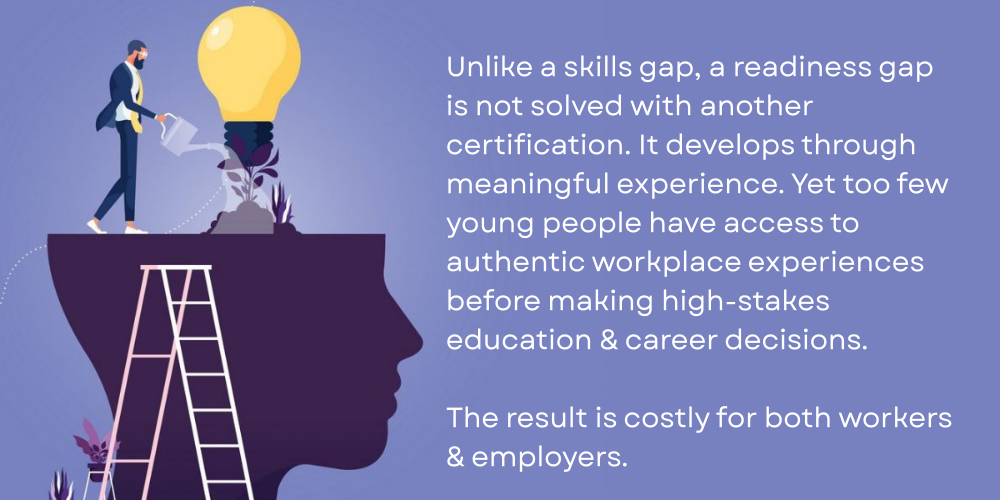
 That disconnect is becoming increasingly visible. Britebound's All Options on the Table report found that parents are more open to programs that combine classroom learning with meaningful work experience. There is growing recognition that traditional routes alone may not prepare students for the workforce. As employers look to recruit differently, those changing expectations are creating urgency and opportunity.
For FMs, this is an opportunity to rethink how talent is developed. Rather than waiting until after hiring to determine whether a candidate is the right fit, employer-embedded education or work-based learning allows organizations to evaluate potential earlier through career exploration, project-based learning, internships and apprenticeships. These experiences build students’ workplace readiness while giving employers something equally valuable: confidence that new hires are ready to contribute.
Work-based learning in practice
Work-based learning is most effective when it is not viewed as a single internship or apprenticeship, but as a progression that allows students to take confident next steps. It is a cycle of exploring possible careers, building high demand skills through workplace training and mentorship, and growing their confidence and readiness over time.
For example...The Larson Company, an HVAC/R distributor, offers one example. Rather than waiting until a position opens to begin identifying talent, the company creates opportunities for high school students to engage with the business. Career fairs, guest speakers, facility tours and job shadowing introduce students to the industry early. Those experiences lead to boot camps and youth apprenticeships that combine paid, hands-on work with post-secondary credentials for interested learners. Employees engage as presenters, tour leads, mentors and supervisors throughout. This program is not community outreach or philanthropy; Larson has treated the program as a long-term talent development strategy. What makes this approach effective is the opportunity to test fit before making a long-term commitment. Students gain a realistic understanding of the profession and their inclination for it, while employers can observe behavior over time. By the time a hiring decision is made, both the employer and the student have a much clearer picture of whether the relationship is likely to last.
The program also helps to promote retention with current employees. Those who served as mentors develop stronger leadership skills, experience pride in sharing their industry knowledge, and feel a greater sense of ownership in preparing the next generation of the workforce for success within the company. New hires from the program stay longer, and current employees have even more reason to stay. |
.svg)
Why it's working
This is not an isolated success story. Businesses across the industry are discovering that engaging with students through work-based learning leads to better hiring outcomes than relying solely on traditional recruitment methods. Riipen's State of the Employer 2025 report found that nearly one in four employers who partnered with students through project-based learning, one of many work-based learning activities, ultimately extended a job offer. Among midsized employers, that number rose to more than 40 percent. Those findings reinforce what employers like Larson recognize: meaningful workplace experiences create a longer, more informed hiring process that benefits employers and students alike.
FM has always been a profession learned by doing. Whether responding to a building systems failure, coordinating contractors during a renovation or balancing occupant needs while maintaining safe, efficient operations, facility professionals rely on judgment as much as technical expertise. Those capabilities are developed through experience, not through classroom instruction alone.
Gallup's State of the Global Workplace 2026 report reinforces another important lesson: building future talent requires investing in the people responsible for developing it. As organizations ask managers to coach, mentor and retrain employees in an increasingly complex workplace, those managers also need the time, training and support to succeed. Mentorship programs should not be viewed as a bolt-on activity; it is an investment in the organization's resilience and future growth.
Getting started
 Start with one authentic experience, then grow from there. Most organizations already have more raw material for this than they realize. For example, a mentor at a worksite who could oversee a job shadow day or a project a high school student could contribute to.
Before scaling anything, take stock of what the organization is already equipped to offer. A quick internal gap analysis of what oversight capacity exists, what safety protocols are already in place, and which staff members have the bandwidth and interest to mentor will tell more about the starting point than any outside benchmark. Track what goes well, share those early wins with leadership and staff, and let that momentum carry the project into the next phase. Waiting for perfect conditions is often the biggest barrier to getting started at all.
Once the internal groundwork is in place, the next hurdle is usually external: the connection to local high schools. This is one of the most common barriers employers run into, largely because most simply do not have those relationships yet. This is not a dead end. Most schools are eager to consider this kind of partnership, and a call from an employer to career and technical counselors offering real career exposure for students is rarely unwelcome.
 There is also a shortcut worth trying first. If the organization already recruits from a technical college or university program, ask that institution's admissions or career services office which regional high schools consistently send them students. Those feeder schools are often already primed for this kind of partnership, especially for lighter-touch activities like workplace tours, job shadow experiences or hosting a career speaker in a classroom.
Finally, remember that employers do not have to build any of this alone. Across many communities, work-based learning intermediaries, education partners, workforce development organizations and the IFMA Foundation help employers connect with schools, design meaningful student experiences and navigate available funding. That kind of support allows employers to engage at whatever level fits their capacity while reducing the administrative lift of building a program from scratch.
The strongest talent pipelines are not found. They are built. As FM evolves, the employers that invest in developing talent earlier will not simply fill today's openings. They will help shape the workforce that their organizations and the profession will depend on for years to come.

Stephanie Loeck is a driven workforce and education advocate committed to advancing economic opportunity and improving community outcomes. Loeck serves as vice president of strategic development at GPS Education Partners, where she leads initiatives driving national growth to foster social impact in work-based learning. She is the co-author of "Make School Work, Solving the American Youth Employment Crisis Through Work-based Learning." In addition to being an active speaker and facilitator for the education sector, Stephanie participates in several national boards. Previously, she served as vice president of partnerships at America Succeeds and has also gained extensive experience working as a consultant with nonprofits, small businesses, and on strategic communications and advocacy campaigns.
References
Top image via Getty Images.
Read more on Leadership & Strategy or related topics Succession Planning and Team Management
Explore All FMJ TopicsRelated articles
-

Artificial Intelligence in FM
The stakeholder’s perspectiveBy Dr. Jake Smithwick & Dr. Kenneth Sullivan & Nneka Ubi05.01.2024 -

Mastering Change in Hybrid Environments
Insights from global operational leadersBy Meg Swanson09.02.2024 -

Plugged In
Solving the data disconnect in real estate and FMBy Amanda Muzzarelli & James Waddell07.01.2024