
 Membership
 Network
 Regional Sites & Affiliates


 Events
 Participate
 Resources

 Training
 Credentials
 Government


 Content Channels
 Tools
Tools


 Business Overview





The Right Path
How climate-responsible is the real estate industry?
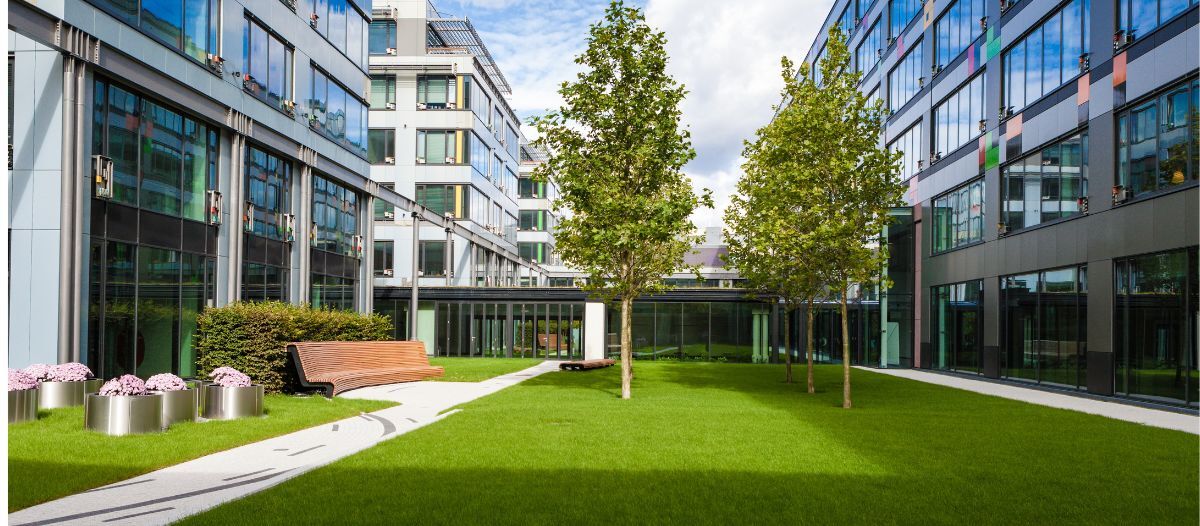
Welcome to the age of responsibility in real estate. Amidst ever-more extreme weather and a continuing pandemic, facility leaders are facing unprecedented pressure from employees, tenants and clients — not to mention society as a whole — to tackle collective challenges like the deepening climate crisis.
Importantly, leading investors and owners are actively rising to this challenge, albeit on different terms and timeframes. Many now see value in climate-responsible real estate strategy and are going beyond the basic carbon emissions reduction efforts of the last decade to fuel a more aggressive race to net zero.
To understand where organizations are in the journey to more responsible real estate, JLL recently surveyed 647 global real estate leaders. In addition to learning what respondents think about climate change in relation to business, the survey sought to understand what companies are doing about it now, and what they perceive are the challenges ahead.
As discussed in the new report, Decarbonizing the Built Environment, the results of this inquiry reveal an industry that sees its potential to contribute to a greener, more sustainable planet — as well as the risks of failing to accept responsibility. To date, a full 83 percent of real estate occupiers and 78 percent of investors think that climate risk poses a financial risk, and the majority of all respondents have set ambitious net zero goals for 2030.
Organizational leaders are responding to the growing hunger for cleaner, more resilient places — an appetite that has only been sharpened amidst COVID-19. They are seeing the inherent wisdom of investing in more sustainable spaces that can better withstand future weather extremes, whether that is fire, flooding or drought.
The mantra that ‘climate risk is financial risk’ has gone mainstream
Investor and occupier communities alike are seeing this decade as the tipping point in decarbonizing real estate. Both groups are making more ambitious sustainability commitments, with many organizations now setting bold net zero goals for 2030. Decarbonization is no longer a mid-century ambition.
This doubling down on climate action may come as a surprise to those skeptics who warned that the COVID-19 pandemic might weaken corporate commitment. Analysts have seen expectations increase for businesses to do the ‘right thing’ to protect employees and their communities.
To compliment this rising market demand, many carbon reduction opportunities are readily available at no- or low cost, thanks to continuing industry investment and adoption. Quick fixes like energy-efficient lighting as well as larger-scale installations like smart building management systems are more accessible than ever and represent game-changing potential for occupiers to boost efficiency as well as financial and operational performance.
Sustainability features have even become a primary consideration when buildings are acquired, fitted out and managed. Case in point: 96 percent of leading occupiers expect to be prioritizing green building credentials in acquisition and occupation by 2025.
For investors, carbon-reduction strategies also present a clear competitive advantage to long-term portfolio viability. Nearly three-quarters of investors say that green certifications like LEED, BREEAM, and WELL fuel higher occupancy, higher rents, higher tenant retention and overall higher value.
Decisive action — powered by data — to flatten the climate curve
Many real estate and FM leaders are creatively and decisively working toward net zero targets, from investing in self-generating renewable energy and purchasing carbon offsets, to including green lease clauses and reducing embodied carbon in new developments.
By the numbers:
-
41 percent of occupiers are self-generating renewable energy. This figure is expected to reach 64 percent by 2025.
-
38 percent of occupiers are buying carbon offsets. This figure is expected to reach 72 percent by 2025.
-
38 percent of investors are using technology to optimize building performance and maintenance. This figure is expected to reach 79 percent by 2025.
-
35 percent of investors are seeking to reduce embodied carbon in new developments. This figure is expected to reach 72 percent by 2025.
-
95 percent of “leading” investors already procure renewable energy (offsite). In contrast, 32 percent of “on the path” and “starting out” investors procure renewable energy, and this is projected to increase to 68 percent by 2025.
-
80 percent of “leading” investors already reduce embodied carbon on new developments. In contrast, 25 percent of “on the path” and “starting out” investors reduce embodied carbon on new developments, and this is projected to increase to 66 percent by 2025.
-
63 percent of “leading” investors already self-generate renewable energy (onsite). In contrast, 20 percent of “on the path” and “starting out” investors self-generate renewable energy, and this is projected to increase to 59 percent by 2025.
To maximize these and other relevant efforts, organizations are turning to one of the most powerful catalysts for green progress: data.
By monitoring and benchmarking energy performance, organizational sustainability leaders can pinpoint areas for improvement in real time, drive transparency, support valuable certifications and ultimately achieve decarbonization program goals faster.
Proactive sustainability teams are also ensuring carbon reduction strategy is a C-suite priority, with clear process and budget for implementation. For instance, 83 percent of investors have a dedicated sustainability person, team or committee, while 89 percent of occupiers affirm that sustainability is increasingly important to corporate strategy.
Yet translating good intentions and innovative strategies into achievable targets is easier said than done.
Overcoming barriers to decarbonized real estate
The road to net zero comes with a unique set of roadblocks, from budget limitations and technology barriers to sheer overwhelm at the enormity of work required to reach and sustain decarbonization for all property types.
According to JLL research, 74 percent of investors cite insufficient technology infrastructure as a barrier to achieving environmental goals, with 25 percent calling it a major barrier. The same proportion (74 percent) also say a lack of consistent and validated data is a barrier, with 26 percent identifying it as a major one. Meanwhile 84 percent of occupiers believe that digital solutions will be critical in fulfilling sustainability goals.
Yet a wide variety of affordable, effective technology solutions do exist to support a range of green strategies. Identifying the technology barriers challenging an organization is a simple first step toward eliminating them.
Another significant barrier: The “no building left behind” clause. To truly achieve a net zero portfolio, real estate leaders will need to invest more resources in retrofitting existing stock — a far more exhaustive undertaking than limiting carbon in new developments.
Beyond supporting carbon reduction targets, retrofitting older buildings also directly supports market value, considering the volume of demand for green real estate currently risks outstripping estimated levels of supply.
One way forward: strong data and analytics can help make the case for executive buy-in for what may seem like a daunting retrofitting project — but that in reality is more than worth the investment in terms of bigger picture financial performance payoff.
The most significant barrier to date, however, may be the fact that no single organization, regardless of industry or sector, has the resources and capabilities it would take to accomplish decarbonization on its own.
Forging effective partnerships will become increasingly imperative in the transition to a low-carbon economy. According to the report, the race to net zero requires forward-looking real estate leaders to pivot toward an all-new partnership approach — one that blurs the traditional lines between public and private sector players, between industry and academia, and between investors and corporate occupiers.
A rich ecosystem of partnership will prove increasingly crucial to accelerating the complex and critical journey to decarbonization in the built environment. Effective partnership can help organizations of all sizes and sectors create scale and plug gaps in resources and expertise.
Real estate leaders resoundingly affirm this finding: our poll revealed 81 percent of occupiers and investors agree that strong partnership between cities, occupiers and investors will be instrumental in pulling off our net zero carbon ambitions.
By diligently participating in this ecosystem, governments, businesses, investors and communities alike can make greater progress as they adopt and scale innovations, together bridging the gap between good intention — and action. Looking ahead, cities’ own levels of commitments to carbon reduction goals could play a more significant role in organizations’ location decisions.
As diverse stakeholders come together to achieve net zero, partnership, transformative thinking, and sustained investment and action will all be key to achieving and sustaining net zero, as well as managing the challenges along the way.
What’s next on the journey to net zero
Different organizations indeed have different levels of commitment and action. But the overall industry momentum toward decarbonization is consistent—and consistently improving. By working collaboratively, corporate real estate teams, real estate investors and city leaders can collectively help affect meaningful, positive change amidst the “code red’ for humanity” that is climate change.
Considering the built environment accounts for about 40 percent of global carbon emissions, it is clear that the real estate industry can play an outsized role in bringing about a sustainable future, especially in cities hardest hit by climate risks.
Those organizations that step up to this climate challenge will not only continue to drive business and deliver quality spaces — they will become a force for good that helps create healthy, green outcomes for people and planet alike.

Cynthia Kantor is chief client value and growth officer of JLL Work Dynamics, responsible for developing and managing contemporary product offerings that blend human, digital and experiential elements to drive enhanced value from clients' workplaces and portfolios. Her deep domain expertise includes services, product management, enterprise-wide strategic plan development, portfolio management, new business growth strategies, restructuring, operations and risk management, innovation and marketing.
References
Top image by Getty Images.
Read more on Sustainability and Real Estate or related topics Sustainable Facility and Asset Management
Explore All FMJ TopicsRelated articles
-

Smart Building Control Systems
The foundation for a grid-interactive buildingBy Andre Marino09.25.2024 -

Smart Building Innovation
Cutting costs & carbon footprints without compromiseBy Andrew Butterworth09.12.2024 -

Chart the Path
Building sustainable cities & a sustainable futureBy Izzat Ali Khan & Aykean Forde12.16.2024