
 Membership
 Network
 Regional Sites & Affiliates


 Events
 Participate
 Resources

 Training
 Credentials
 Government


 Content Channels
 Tools
Tools


 Business Overview





The Shift
Moving from construction to facility management

The facility management industry is rapidly emerging in the Middle East. More professionals are moving from capital projects to operations and maintenance as the construction industry is reaching its maturity level. The region has constructed a very large portfolio with some iconic projects and has now come to the realization that it requires a robust and strategic mindset to sustain and safeguard its value. Many firms are expanding in the FM sector to utilize their resources as well as to keep the business afloat.
This market shift was inevitable. Investment values are not projected at handover, but in operations. FM is no longer a support function adjacent to capital projects. It is the mechanism through which asset values survive.
FM is business enablement
From hospitals to transportation networks and commercial offices, facilities form the backbone of economic activity. Every sector is dependent on FM teams of various scale and capabilities to ensure business continuity, resilience, occupant safety, operational support and preservation of assets: FM as a strategic partner. Core business cannot be sustained without a strategically aligned FM leadership.
Accidental entry vs. strategic leadership
A significant proportion of FM professionals enter the discipline through adjacent technical fields. Many develop deep passion and expertise through experience, mentorship, and continuous professional development and improvement.
Over time, the profession has matured. Associations strengthened, shared language evolved, certifications expanded, and standards such as ISO 41001 became reference points. Key performance indicators (KPIs) progressed from reporting metrics to performance governance tools. Consistency and accountability became defining features of mature FM practice.
However, formal FM education prior to workforce entry remains limited. As a result, it often operates in two distinct modes.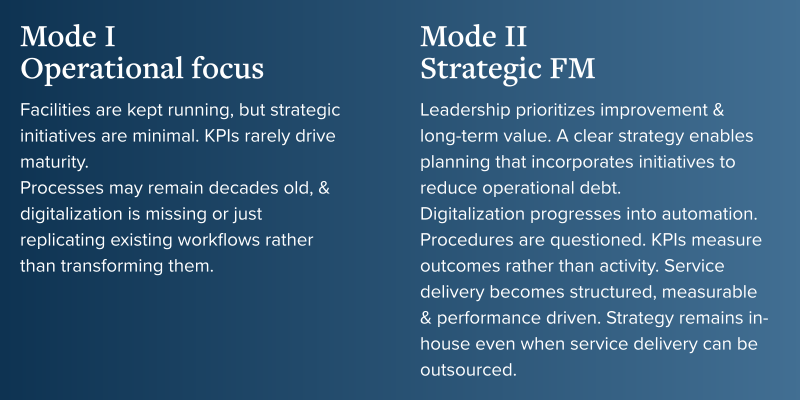
The 20-80 reality
Construction accounts for roughly 20 percent of a building’s life cycle cost. The remaining 80 percent shows up later through operations, maintenance, compliance and upgrades. Strategic FM pulls that 80 percent into the room at the design stage. Deliverability is not enough. Operability and maintainability determine financial defensibility.
When operations are an afterthought, the building starts draining bank accounts early. Eventually, the organization has to fund another massive capital expenditure (CapEx) transformation just to fix things that should have been handled on day one. That second spend is not innovation. It is the repayment of design debt.
The bottom line is that operational teams keep the business running, but strategic thinkers are the ones who keep it successful. These are the decision-makers. They develop the right strategy, find the right talent and protect the organization's success. They do not just work in the building; they protect the investment.
The procurement trap: When contractors become FMs
 Projections estimate Middle Eastern FM will grow from a US$105 billion to US$148 billion market by 2030, with some outlooks suggesting more than US$270 billion by 2034. As construction volume cools down, many firms are pivoting into FM to stay afloat, repackaging legacy O&M clauses as experience to win contracts. The client impact is predictable: low-bid contractors who can keep assets running but rarely add value, improve performance or invest in long-term outcomes.
The leadership gap
A similar pattern plays out in many organizations, especially those with permanent staffing structures and limited hiring. Operations keep running within the same internal circle and when new hires onboard into the organization, they usually get absorbed into existing habits instead of changing them. Over time, it becomes a closed loop: minimal external exposure, minimal evolution and the normalization of practices that were never built for modern facility management.
The result is predictable: what should be an FM function becomes labeled general services or engineering — not from deliberate operating models, but from misunderstood scope. Responsibilities follow familiarity, not industry logic, while managers untrained in FM competencies view it as a reactive maintenance unit led by discipline experts.
This confusion shows up in titles as well. Employees with maintenance engineer job titles are expected to develop five-year business plans, contribute to digitalization, participate in procurement and contract governance, and still prepare preventive maintenance plans or issue routine work orders. The mismatch is not cosmetic. It distorts the entire talent equation and sets up people and teams to fail.
The same gap is apparent in how FM becomes positioned at executive level. When leaders treat FM as merely a cost center, it becomes difficult to speak the right language in senior discussions. FM rarely gets framed in the language of business strategy, risk, continuity, compliance, cost of failure and service outcomes. In that posture, FM stays invisible until something breaks. The organization never hears the underlying truth: if FM is not executed properly, the core business cannot operate, customers cannot be served, and reputational and operational risk becomes inevitable.
An office move exposes the mindset. It is treated as shifting desks, while coordination, IT dependencies, security, accessibility, change management, downtime risk and post-move stabilization are dismissed as extra responsibilities. When time is requested for proper planning, the response is the same: it is simple, just get it done.
The training gap & the Superman mythA clear pattern emerges among IFMA’s Certified Facility Manager credential candidates in the Middle East: many are new to FM and pursue the highest accreditation without foundational grounding. This was crystallized in one conversation. During a CFM preparation session on FM responsibilities, the instructor mentioned security. A participant reacted with genuine surprise: “Does security fall under FM scope too?” The answer was yes. His response was telling: “Wow. Really? Looks like a facility manager should be Superman.” This captures the “accidental FM” mindset — professionals move into FM roles unprepared for the role’s breadth, complexity and accountability. The CFM credential earns its respect through authority. Its exam tests mastery across 10 knowledge domains: It is not a training program; it demands proven professional knowledge and practical experience. Those lacking these skills should first complete facility management trainings like IFMA’s Facility Management Professional program to build foundational FM knowledge. Only then — once that knowledge is applied in practice and real-world experience is gained — should they pursue the CFM. |

Strategic impact: Data & dollars
FM ensures an organization always has the right physical environment. FM assists with budgeting and expenditures. Example: A company generating US$4 billion in turnover while spending US$30 million annually on rent may dismiss the figure as 0.75 percent of revenue. In absolute terms, US$30 million dollars represents portfolio leverage. It is a strategic exposure that demands portfolio discipline, occupancy optimization and active cost governance.
In many organizations, FM is still not expected to present a structured end-of-year performance narrative: what failed, what performed well, what risks emerged and what the forward plan should be. Where FM is represented at leadership level, this becomes standard practice and is one of the clearest ways to shift FM from reactive support to a strategic partner.
The cost of silence
- Burj Khalifa is a symbol of what happens when iconic delivery outpaces enabling infrastructure. There were reports about reliance on sewage tankers. The details are debated, but the risk is not: without early operational planning, assets inherit constraints one does not see on ribbon-cutting day, and those constraints raise operating costs year after year.
- Stadium 974 (Qatar) was presented as dismantlable and transferable. Four years later, it is still on the ground, with holding costs. Plans change. The asset does not disappear because a slide deck said it would.
- The Line by NEOM is not a building. It is a lifetime operating commitment stretched across 170 kilometers, with mirrored walls 500 meters high. That scale forces day-after questions about access, cleaning, replacement cycles, thermal behavior, specialist contracts and failure modes. This vision was planned with operations at its core, making long-term running and maintenance a design driver.
- The same dynamic applies to The Mukaab in Riyadh. It was launched as a signature statement yet reports suggest construction has been paused beyond the early stages for reassessment.
Scaling that governance gap to future megaprojects amplifies exposure.
Despite several suspended projects, the Middle East continues to demonstrate a strong commitment to envisioning large-scale developments — and to pausing them when feasibility concerns arise. Even when projects are halted or placed on hold, they contribute valuable insights and experience to the region’s overall expertise in planning and delivering massive infrastructure projects.
This is when FM becomes strategic.
A strategic FM does not walk into the boardroom to kill the future. They walk in to protect it, and they force the day-after questions into the approval room:
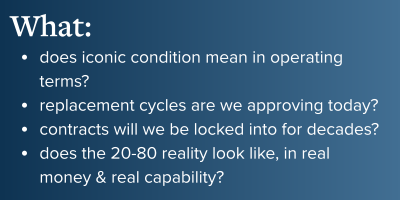 If project selection, design, procurement and execution happen without an FM lens, it is not just an approval of a building. It is approval of fixed obligations that cannot scale down later when the market shifts.
Practical completion is the celebration. Operations are where reality starts. Operationalization is not a phase that can be figured out later; it is capability, with its own cost, risk and governance. Procurement follows the same pattern: something can look cheap at purchase and be expensive forever. Exclude FM early, and the commitments are inherited.
The evolution: Moving the industry forward
Preventive, predictive and condition-based maintenance are baseline competencies. Strategic maturity requires governance, decision ownership and professional depth.
Three mandates define progression:
-
Hiring the right talents: Recruiting skilled professionals into the right roles, supported by continual training, safeguards asset value, elevates operational performance and drives organizational success.
-
Own the decision-making: Strategy cannot be outsourced. The organization and its FM must set their own strategic direction — not delegate it to service providers or reduce it to operational execution. A distinguished FM leader knows that every strategic decision leaves a lasting imprint on the organization’s success.
-
Step up: FM must step up. Qualifications must be earned, trends understood and leadership taken with accountability. At the executive level, the essential question is clear: how can FM best advance the organization’s mission? A visionary FM transforms the workplace into an environment that attracts top talent, empowers employees to perform and drives the organization’s success.
The Middle East has built some of the world’s greatest icons; sustaining them requires leadership equal to their ambition.

Salman ul Moazzam is an FM specialist in Qatar’s utility sector with over 10 years of experience in maintenance and workplace optimization. A civil engineer pursuing a Master’s in Project Management, he focuses on FM’s organizational role, practical digitization, and business continuity.

Martin Ruppe is a facility management consultant and workplace strategist with over 20 years of experience in digital transformation projects for leading financial institutions like Erste Group and UniCredit. As an active IFMA thought leader, he drives innovation in FM through global communities and thought leadership.
References
Read more on Leadership & Strategy or related topics Change Management , Quality Management and Credentials
Explore All FMJ TopicsRelated articles
-

Artificial Intelligence in FM
The stakeholder’s perspectiveBy Dr. Jake Smithwick & Dr. Kenneth Sullivan & Nneka Ubi05.01.2024 -

Mastering Change in Hybrid Environments
Insights from global operational leadersBy Meg Swanson09.02.2024 -

Plugged In
Solving the data disconnect in real estate and FMBy Amanda Muzzarelli & James Waddell07.01.2024
