
 Membership
 Network
 Regional Sites & Affiliates


 Events
 Participate
 Resources

 Training
 Credentials
 Government


 Content Channels
 Tools
Tools


 Business Overview





The Transparency Tipping Point
Why data center disclosure is no longer optional

For decades, data centers operated as the invisible engines of the digital world. Housed in nondescript buildings, these immense facilities hummed with the quiet work of processing, storing and transmitting the data that underpins modern commerce, communication and entertainment. Their primary metrics of success were simple and strictly operational: uptime, security and speed.
Their environmental impact — a colossal and growing energy footprint — was largely treated as an internal operational cost to be managed, not a public matter to be disclosed.
That era is definitively over.
The global data center industry, which consumes an estimated 200 terawatt-hours of electricity annually — roughly 1 percent of global electricity demand — faces unprecedented pressure. With AI’s rise and the exponential growth of the digital economy, projections suggest this consumption could triple by 2030. As the unseen backbone of today's economy, data centers have shifted from being quiet facilitators of digital progress to focal points in the global race toward transparency and sustainability.
Sustainability’s conversation has moved beyond aspiration to rigorous disclosure. A powerful confluence of forces is prying open the black box of data center operations, transforming sustainability reporting from a voluntary, nice-to-have marketing exercise into a mandatory, financially critical component of business strategy. This transformation is driven by three powerful, interconnected global currents: the convergence trend of regulatory standardization, the capital call from investors, and the client's net zero mandate.
Together, these drivers are creating a new reality where transparency is no longer optional but a fundamental requirement for market access, capital acquisition and competitive advantage.
Driver 1: The convergence trend — Regulation becomes the baseline
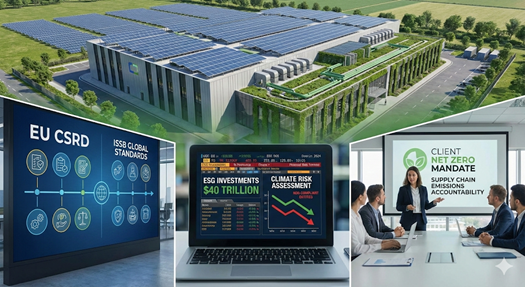
The first and arguably most structural driver is the rapid evolution of the regulatory landscape from a voluntary, fragmented patchwork to a standardized, mandatory regime. For years, corporate sustainability reporting was guided by voluntary frameworks like the Global Reporting Initiative (GRI) and the Sustainability Accounting Standards Board (SASB). While foundational, these frameworks allowed companies to select what to disclose, often leading to inconsistent, incomparable data shaped more by marketing narratives than material risk.
This era of flexibility is ending as a new generation of disclosure laws replaces optional reporting with standardized, enforceable frameworks.
The European Union’s CSRD
Leading the global charge is the European Union’s Corporate Sustainability Reporting Directive (CSRD), which came into force in January 2023. The CSRD represents a seismic shift in corporate transparency, dramatically expanding the scope of reporting to cover approximately 50,000 companies, compared to just 11,700 under previous directives.
Crucially, this includes non-EU parent companies with significant operations or listings within the EU. A global data center provider with facilities in Dublin, Frankfurt or Amsterdam will fall squarely within its purview, regardless of where its headquarters are located.
The CSRD is built on two core principles that fundamentally change reporting obligations:
-
Granular standards: It mandates the use of detailed European Sustainability Reporting Standards (ESRS), requiring deep disclosure on energy consumption, greenhouse gas (GHG) emissions (Scopes 1, 2, and 3), water usage and circular economy principles.
-
Double materiality: Perhaps most significantly, it codifies the concept of double materiality. Companies must report both on how sustainability issues impact their business (financial materiality) and how their operations impact society and the environment (impact materiality). This comprehensive approach forces data centers to examine their entire value chain, from energy sourcing to equipment life cycle management.
The ISSB’s global baseline
Parallel to the EU's regional efforts, the International Sustainability Standards Board (ISSB) is establishing a truly global baseline for disclosure. Established in 2021 and operating under the IFRS Foundation — the same body that oversees financial accounting standards in over 140 countries — the ISSB positions sustainability disclosure firmly within the domain of financial reporting.
The ISSB’s standards (IFRS S1 and S2) consolidate existing frameworks like the Task Force on Climate-related Financial Disclosures (TCFD), focusing explicitly on climate-related disclosures that affect enterprise value. For data centers, this means articulating climate risk in the language of finance, reporting on physical risks to infrastructure, transition risks from carbon pricing and metrics for emissions reduction. As countries including Canada, Japan, Singapore and Brazil move to adopt or align with these standards, a harmonized global system is emerging that reduces the reporting burden for multinationals while ensuring consistency.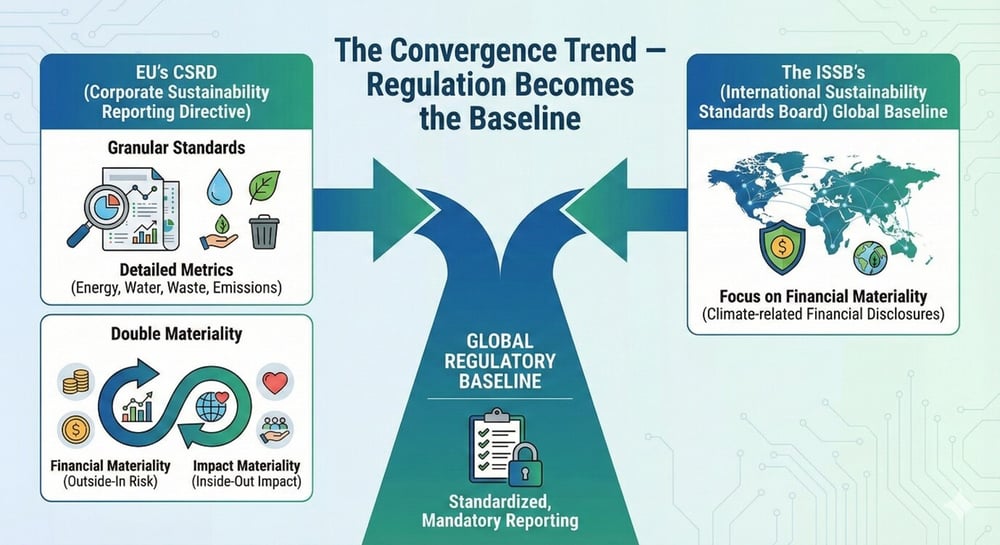
Driver 2: The capital call — Investors demand climate accountability
While governments standardize the rules, global capital markets are enforcing them through the flow of money. The second major driver — the capital call — arises as investors, asset managers and lenders increasingly link finance to sustainability performance. Environmental, social and governance (ESG) investing has moved from a niche concern to the financial mainstream, with global sustainable investment assets reaching roughly US$35.3 trillion. These investors are fiduciaries who increasingly view unmanaged climate risk as a direct threat to long-term financial returns. Data centers, which are capital intensive, energy hungry and dependent on long-term contracts, are particularly exposed to these risks.
The TCFD Framework as the investor's Rosetta Stone
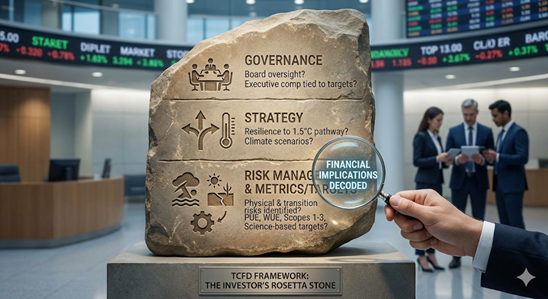 To assess these risks, the investment community has coalesced around TCFD. This framework provides a structured approach to climate disclosure that aligns with investment decision-making processes. Its four pillars require data centers to demonstrate:
-
Governance: Board-level oversight and management accountability for climate issues.
-
Strategy: Analysis of climate scenarios and their potential impact on business models, including resilience to a 1.5 C pathway.
-
Risk management: Processes for identifying and managing physical risks (like floods and heatwaves) and transition risks (like changing energy markets).
-
Metrics & targets: Hard numbers on power usage effectiveness (PUE), water usage effectiveness (WUE) and science-based emissions reduction targets.
Major investors now expect portfolio company disclosures aligned with TCFD recommendations. A data center operator that cannot provide clear, TCFD-aligned answers is increasingly viewed as a high-risk investment, potentially facing less favorable lending terms or higher insurance premiums.
CDP: The public scorecard
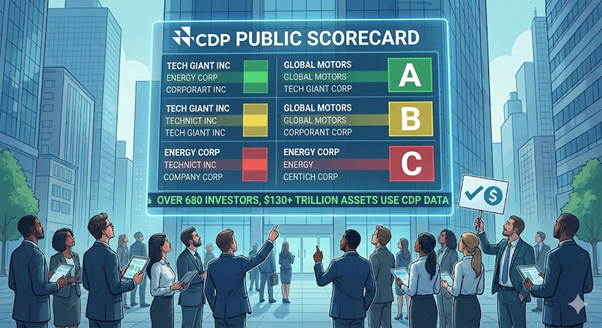
Investor demand is operationalized through platforms like CDP (formerly the Carbon Disclosure Project), which serves as critical infrastructure for climate disclosure. More than 680 investors with US$130 trillion in assets use CDP data to inform investment decisions. CDP's scoring methodology evaluates companies on disclosure completeness and environmental stewardship, grading them from A to F.
For data centers, a low CDP score can result in exclusion from ESG funds and reduced access to green finance instruments. Conversely, a consistent A score acts as a competitive differentiator, signaling robust governance and a firm grip on environmental performance. The capital call is ultimately about financial relevance: investors demand standardized, audited metrics because, in a data center, carbon equals cost.
Driver 3: The client’s net zero mandate — Operationalizing transparency
While regulators and investors exert top-down pressure, the most immediate and relentless driver comes from the bottom up: the customer. The client’s net zero mandate is arguably the biggest operational driver of disclosure today.
The world’s largest corporations — hyperscalers like Amazon, Microsoft and Google, as well as global banks and pharmaceutical giants — have made ambitious public commitments to achieve net zero emissions. More than 3,000 companies have set science-based emissions targets. To achieve these goals, they must account for emissions not just from their own operations (Scope 1 and 2), but from their entire value chain (Scope 3).
The Scope 3 challenge
For technology companies, data center emissions can constitute 50 percent or more of their total carbon footprint. Microsoft, for instance, reports that more than 97 percent of its total emissions come from Scope 3 sources, largely including its supply chain and cloud services. Consequently, the client’s net zero pledge becomes the provider’s mandate. It is no longer sufficient for a data center to simply offer space and power; it must now offer data.
Procurement as a gatekeeper
This pressure is reshaping procurement. Requests for proposals and contracts now routinely include sustainability annexes and require specific environmental disclosures as gating factors. Clients are contractually demanding:
-
Granular emissions data: Reporting on carbon intensity per server rack or kilowatt delivered, rather than just building-level estimates.
-
Third-party verification: Audited emissions data aligned with the GHG Protocol.
-
Renewable energy proof: Verifiable strategies for renewable energy procurement, such as percentages and sourcing methods.
-
Climate risk plans: Detailed management plans for climate resilience and adaptation.
Organizations with data centers lacking credible disclosure face exclusion from major contracts, while those with robust environmental performance gain a significant competitive advantage. Many colocation providers are publishing client-ready ESG dashboards to translate complex reporting into practical business intelligence, proving that disclosure is now essential for customer retention.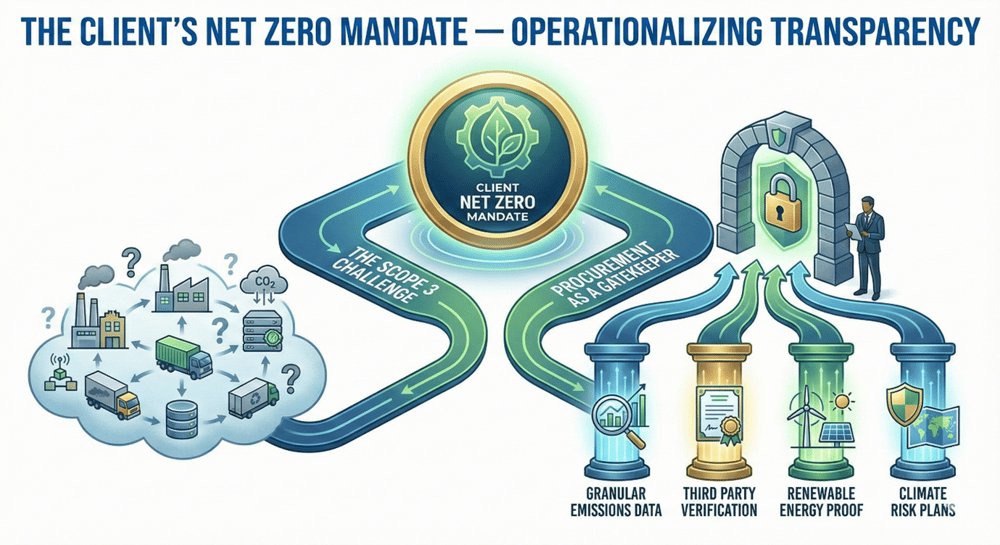
The transformation: Disclosure as a strategic imperative
Responding to this threefold pressure, the data center industry is fundamentally rebuilding how environmental data flows through its operations. Disclosure is transforming from a compliance exercise into a strategic business imperative that drives innovation and efficiency.
Technological integration
Meeting these demands requires a technological overhaul. Manual data collection and spreadsheets are no longer sufficient to deliver the accuracy and granularity stakeholders expect. Forward-thinking organizations are investing in:
-
IoT & sensors: deploying granular sensors for real-time monitoring of power, cooling and environmental conditions.
-
AI & analytics: utilizing AI-powered analytics for emissions forecasting and operational optimization.
-
Blockchain: exploring blockchain solutions for tracking renewable energy certificates and ensuring data integrity.
-
Integrated platforms: building data pipelines that connect utility data, equipment life cycle information and management tools for consistent Scope 1–3 reporting.
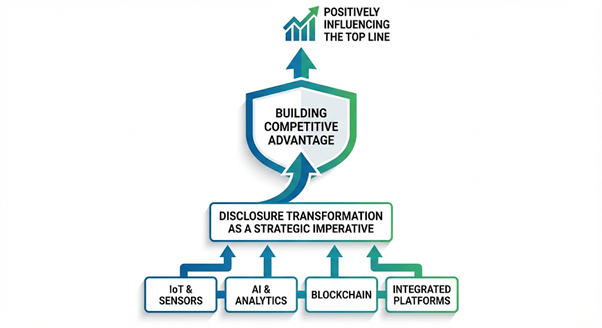
This technology-led approach not only enables compliance but catalyzes broader digital transformation, identifying efficiency opportunities that reduce costs while improving environmental performance.
Building competitive advantage
Leading operators are using disclosure to differentiate themselves in a crowded market. By exceeding minimum requirements and providing industry-leading transparency, they attract sustainability-focused investors, win contracts with climate-conscious enterprises and build trust with regulators. European operators embed CSRD-aligned disclosures into their annual reports, while U.S. hyperscalers tie executive compensation to climate progress indicators.
Challenges & opportunities on the horizon
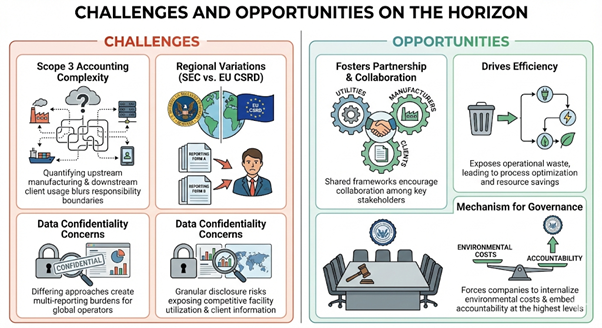
Despite the momentum, the path to full disclosure is fraught with challenges. The complexity of Scope 3 accounting remains a significant hurdle; quantifying upstream manufacturing emissions and downstream client usage helps blur the boundaries of responsibility. Furthermore, despite convergence efforts, regional variations persist — the U.S. SEC’s approach differs from the EU’s CSRD, creating multireporting burdens for global operators. Data confidentiality is another concern, as granular disclosure risks exposing competitive information regarding facility utilization and client distribution.
However, these challenges also present opportunities. Disclosure fosters partnership, as shared frameworks encourage collaboration among utilities, manufacturers and clients. It drives efficiency by exposing operational waste. Most importantly, it serves as a mechanism for governance, forcing companies to internalize environmental costs and embed accountability at the highest levels.
 Conclusion: Transparency is the new currency
The transformation of climate disclosure from a voluntary initiative to a business imperative reflects a broader shift in how markets value environmental performance. The convergence of regulatory standardization, investor requirements and client mandates has created an environment where transparency is essential for market access and competitive positioning.
The era of voluntary, inconsistent and opaque climate disclosure has ended. The future belongs to organizations that recognize disclosure as integral to business success.
The path forward requires investment in technology, processes and expertise, but the returns — in terms of lower cost of capital, secured contracts and operational efficiency — justify the effort. As the digital economy continues its exponential growth, data centers will play a critical role in enabling sustainable development. By embracing transparency, operators do not just comply with regulations; they build the trust that serves as the essential foundation for competitive advantage and sustainable growth in the 21st century.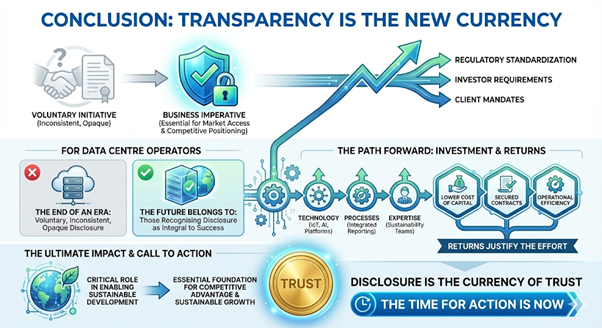

Siddhant Aggarwal is senior manager at LL REMS. Across the real estate life cycle, Aggarwal has carried out the roles of an aggregator, integrator, administrator and coordinator, spanning from design, leasing, fit-outs and operating spaces, whether viewed from the purview of a developer, occupier or tenant. His body of knowledge and exposure that has been earned through PMP, USGBC LEED and engineering in a gamut of varying business environments have catalysed the process of continual improvement, enhancing his overall pedigree.

Dr. Pulak Bhaumik is the CEO, Data Centres – India at Listenlights. In this role, he spearheads all aspects of the organization's data centre vertical in India, driving growth and innovation. An industry stalwart with over 25 years of diverse leadership experience, Dr. Bhaumik is recognized for his thoroughness, attention to detail,and a unique blend of professional rigor with a spiritual perspective — making him an invaluable addition to the Listenlights leadership team. He has successfully led organizations through transformation, operational scale-up, profitability enhancement and high-performing team building, consistently delivering value to stakeholders. Trusted by boards, investors and teams alike, he has been at the forefront of the data centre, corporate real estate and global real estate sectors.

Parvez Kazi serves as the Chief Executive Officer of LL R.E.M.S (Real Estate Management Services), the Integrated Facilities Management and Real Estate Services arm of the LL Group. With more than 26 years of leadership experience in facilities management, business operations, and service transformation, he is responsible for steering the company’s strategic vision, growth agenda, and operational excellence across India. With a leadership philosophy rooted in agility, collaboration, and accountability, Kazi is committed to redefining real estate and facility management as strategic enablers of business productivity, workplace experience and sustainable infrastructure.
References
Top image via Getty Images.
Article graphics courtesy of LLREMS.
Read more on Sustainability and Facility Technology & Data Management or related topics Data strategy and information management and Sustainable Facility
Explore All FMJ TopicsRelated articles
-

Smart Building Control Systems
The foundation for a grid-interactive buildingBy Andre Marino09.25.2024 -

Smart Building Innovation
Cutting costs & carbon footprints without compromiseBy Andrew Butterworth09.12.2024 -

Chart the Path
Building sustainable cities & a sustainable futureBy Izzat Ali Khan & Aykean Forde12.16.2024
