
 Membership
 Network
 Regional Sites & Affiliates


 Events
 Participate
 Resources

 Training
 Credentials
 Government


 Content Channels
 Tools
Tools


 Business Overview





The Triple Collision
Bridging the forensic gap to ensure cross-border lease integrity in global trade corridors

Multinational enterprises managing facility portfolios across borders face a universal challenge: the triple collision of diverging accounting standards, conflicting tax recovery frameworks and incompatible legal systems. Whether navigating U.S.-Canada corridors, the high-volume U.S.-Mexico trade routes, post-Brexit UK-EU operations or German-Polish manufacturing networks, the same three collisions create hidden profit erosion that automated systems consistently fail to detect.
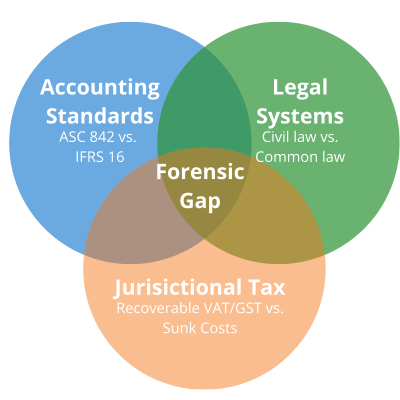 Figure 1: The triple collision framework
An illustration of the "Forensic Gap" occurring at the intersection of diverging accounting standards (ASC 842/IFRS 16), jurisdictional tax recovery and conflicting legal systems.
 The accounting divide
ASC 842 vs. IFRS 16: When dual-model meets single-model globally.
The primary complexity for cross-border entities is reconciling two frameworks: the FASB in the U.S. and the IASB internationally. Under U.S. GAAP (ASC 842), leases are classified as either operating or finance, with operating leases maintaining straight-line expense recognition under ASC 842. In contrast, IFRS 16 effectively abolishes the operating category for lessees, treating all leases as finance leases with front-loaded expense profiles through interest and depreciation.
This accounting collision extends far beyond North America. IFRS 16 has been adopted in over 140 countries including the U.K., EU, Australia and Canada, while the U.S., Japan and Mexico maintain dual-model frameworks. The nature of their divergence from IFRS 16 varies. In the U.S., the collision is one of expense classification (operating vs. finance). In Japan, the friction is often one of recognition (on-balance sheet vs. off-balance sheet). In Mexico, the challenge lies in reconciling local dual-classification with the specific inflationary and statutory requirements of the NIF D-5 standard. When a London-based retailer operates stores across both the U.K. (IFRS 16) and the U.S. (ASC 842), the parent company must reconcile different accounting treatments in consolidated financial statements.
Consider a Toronto-based retailer with a flagship store in Florida paying US$10,000 monthly rent. Under ASC 842, the U.S. subsidiary reports a flat US$10,000 expense. However, the Canadian parent must split that amount into declining interest and asset depreciation. If automated software defaults to U.S. standards, the Canadian parent's consolidated financials suffer immediate valuation drift, causing global debt-to-equity ratios to be materially misstated.
Mexico utilizes its own accounting standard, NIF D-5, which aligns more closely with the U.S. GAAP (ASC 842) dual-model than the IFRS 16 single-model. Multinational parents reporting under IFRS 16 must reconcile these dual-model Mexican leases into a single-model consolidated report. Without manual intervention, companies risk significant valuation drift in their consolidated global debt-to-equity ratios.
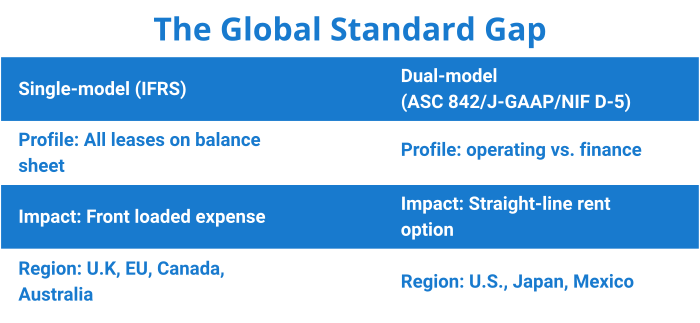 Figure 2: Global accounting standard distribution
  The tax recovery gap
Sunk Cost vs. Recoverable Asset: Navigating the Global VAT/GST/QST Divide
Effective 1 October 2025, the U.S. state of Florida via HB 7031permanently eliminated state sales tax on commercial real property leases. The complexity lies in the Occupancy Period Rule, in which tax is determined by when the tenant used the space rather than when payment was made, creating transitional cut-off errors that trigger state audits.
The economic danger lies in fundamental tax misclassification. In Florida, commercial rent tax was historically treated as a sunk cost: an immediate expense never recovered. Conversely, Canada's GST and Quebec's QST function as recoverable assets: short-term, interest-free loans to the government that businesses are legally entitled to reclaim. When U.S.-based automated systems process a 14.975 percent tax on Quebec leases, they often default to sunk-cost logic, burying recoverable cash in expense accounts leaving 15 percent of their lease budget unclaimed.
This tax recovery gap represents a systemic challenge across global operations. Value-added tax (VAT) and goods and services tax (GST) systems operate in more than 170 countries, with commercial leases subject to standard rates: U.K. (20 percent VAT), Germany (19 percent VAT), Australia (10 percent GST) and Mexico (16 percent VAT). These taxes are legally recoverable as Input Tax Credits. When multinational corporations deploy lease accounting software, a significant risk arises if systems are configured based on U.S. tax logic, where no federal VAT exists.
Without specialized jurisdictional overrides, these systems often default to treating all tax components as permanent expenses. This lack of component separation can lead to the inadvertent capitalization of recoverable assets, such as VAT or GST, effectively burying significant portions of the lease budget in expense accounts.
A London office paying £100,000 in annual rent includes £20,000 in recoverable VAT. If automated systems misclassify this as rent expense rather than a recoverable tax asset, the company forfeits £20,000 in capital. A 20 percent invisible profit drain that compounds across hundreds of global lease locations.
The post-Brexit landscape exemplifies where automated systems fail. Prior to Brexit, VAT recovery was governed by the EU VAT Directive. Post-Brexit, U.K. and EU entities must navigate separate registration and recovery protocols. Legacy software programmed during the EU era often continues applying outdated Place of Supply logic. When 20 percent U.K. VAT on London warehouses is incorrectly categorized as French domestic tax (VAT), that 20 percent remains trapped in ledgers. Without forensic intervention, a silent erosion of lease budgets occurs.
The Forensic Gap is most apparent when software assumes every cost must follow the property's physical location. While a building is anchored to the soil, meaning the tax is strictly tied to the property's physical location, the professional services surrounding it are legally anchored to the recipient. The Forensic Gap occurs when an analyst or software incorrectly codes a service invoice to the property’s physical zip code rather than the recipient’s business location. For example, if an automated system defaults to treating Mexico’s 16 percent VAT as a sunk cost rather than a recoverable asset, the company forfeits 16 percent of their Mexican lease budget.
This context blindness creates a ghost tax burden wherein companies pay a high-rate tax by mistake, only to have the recovery credit denied later because the service was technically supplied in a different jurisdiction. Without jurisdictional synchronization, businesses suffer permanent, invisible erosion of capital.
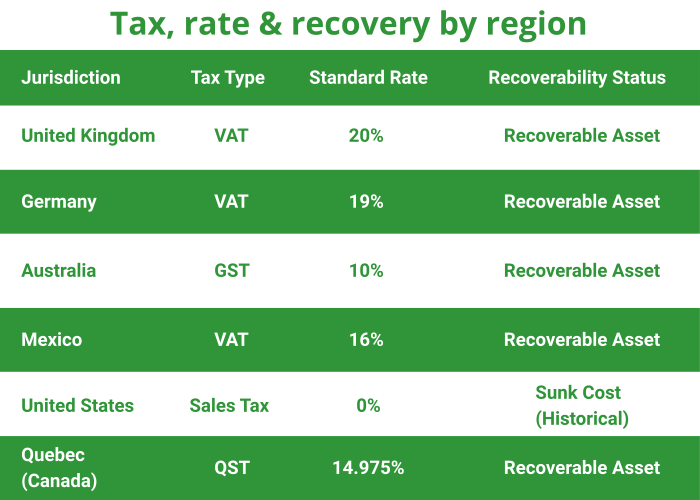 Figure 3: Global tax recovery benchmark
A comparative analysis of VAT and GST rates across key trade corridors, illustrating the percentage of lease budgets vulnerable to ghost tax erosion when misclassified as sunk costs.
 The regulatory divide
Civil law vs. common law: When statutory rights remain invisible to software
Software fails most significantly when it cannot interpret the spirit of law. Florida operates under Common Law: written contract terms are generally final. Quebec operates under the Civil Code of Quebec (CCQ): strict statutory articles apply even when unwritten in individual leases.
Approximately 60 percent of world jurisdictions operate under civil law frameworks including Continental Europe (Germany's BGB, France's Code Civil), Latin America (Brazil's Código Civil) and East Asia (Japan's Minpō), while 40 percent follow Common Law traditions (U.S., U.K., Australia, Commonwealth nations). The fundamental distinction is that civil law systems have embedded automatic statutory protections regardless of written agreements, while common law requires all rights to be explicitly documented.
Germany's Mieterschutzgesetz provides automatic renewal rights and rent increase limitations. When a multinational corporation leases Frankfurt office space, the agreement may be silent on renewal terms. Yet under German Civil Code Article 550, tenants have automatic statutory extension rights. Automated software reading only the contract text calculates lease liability based on the explicit five-year term. In reality, the economic lease term may extend more than 10 years due to the higher likelihood of “reasonable certainty” from statutory protections, materially understating the true right-of-use asset and lease liability.
Similarly, Japan's Minpō includes mandatory notice periods and tenant protections that apply regardless of contract language. For example, if a multinational corporation leases manufacturing space in Osaka for a fixed three-year term, Japanese law may prevent the landlord from terminating the lease without justifiable reasons. This creates a scenario where the economic lease life extends far beyond the contractual term. Without a forensic analysis to account for these statutory differences, the right-of-use (ROU) asset valuation on the balance sheet is fundamentally flawed.
Mexico operates under a strict civil law system, which, like Germany and Japan, provides statutory protections that can override the written lease agreement. If a tenant remains in possession after a lease expires and the landlord does not immediately object, the lease can automatically convert into an indefinite-term agreement under the Mexican Civil Code. Standard software designed for Common Law systems (like those in the U.S.) will see an expired status, while a forensic review identifies a ghost extension that materially impacts the ROU asset valuation.
According to the Quebec Civil Code, if a building is sold in the province, the new owner must respect existing commercial leases if published at the Land Registry. Under Florida Statues, a subordination, nondisturbance and attornment (SNDA) agreement is required for equivalent security. Automated tools may flag Quebec leases as high risk for termination upon sale, when statutory protection actually makes the ROU asset more stable and valuable.
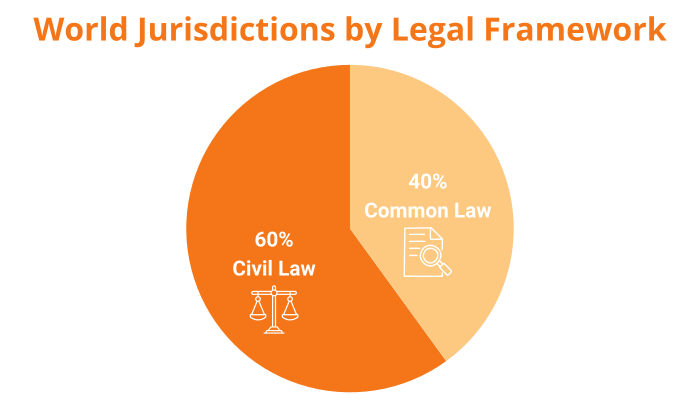 Figure 4: Global distribution of regulatory systems
Approximately 60 percent of world jurisdictions operate under civil law frameworks in which statutory tenant protections apply automatically, while software designed for common law systems (40 percent of jurisdictions) only reads explicit contract terms, creating systematic asset undervaluation in Civil Law markets.
Safeguarding economic integrity across multinational portfolios
Cross-border lease accounting creates a universal economic vulnerability. This complexity is not just regional; it surfaces wherever multinational portfolios collide with differing accounting standards, conflicting tax jurisdictions and incompatible regulatory frameworks. Whether navigating U.S.-Canada corridors, post-Brexit U.K.-EU operations or German-Polish manufacturing networks, the Triple Collision creates systematic profit erosion that goes unnoticed.
In a global marketplace where misclassified VAT/GST can bury 10-25 percent of lease budgets in nonrecoverable expenses, and where unrecognized civil law statutory protections can distort asset valuations by millions, the margin for error has vanished. Automated lease accounting systems provide essential operational scale, processing thousands of leases across dozens of countries with remarkable efficiency. However, the forensic gap lies not in technology itself, but in linguistic, jurisdictional and statutory nuances requiring expert intervention to interpret and validate.
Author's note: The information provided in this article is for educational and informational purposes only and does not constitute legal, tax or accounting advice.

Jenna L. Bajus is a Forensic Lease Integrity Specialist with more than 15 years of experience in commercial lease administration at major organizations including CBRE@Google, Morguard Investments and MasTec Communications. As a forensic lead, she specializes in ASC 842/IFRS 16 reconciliation and authored the 7 Step Forensic Integrity Framework to mitigate profit erosion in complex real estate portfolios. Her work bridges the gap between contractual, accounting and facility management, with a specific focus on bilingual lease portfolios across the US-Canada corridor. Bajus holds AICPA certifications and a Law Clerk diploma, utilizing her expertise to detect linguistic drift and tax recovery opportunities in global trade routes.
Read more on Finance & Business or related topics Financial Analysis and Procurement
Explore All FMJ Topics