
 Membership
 Network
 Regional Sites & Affiliates


 Events
 Participate
 Resources

 Training
 Credentials
 Government


 Content Channels
 Tools
Tools


 Business Overview





The Workforce Blueprint
Bridging the skilled trades gap

Global industries are grappling with a shortage of skilled trade professionals, from HVAC technicians and electricians to controls specialists and facility managers. As a result, talent shortages could leave 85 million jobs unfilled by 2030, leading to as much as US$8.5 trillion in unrealized annual revenue. These shortages are already constraining growth across construction, manufacturing and building operations, and the strain will only intensify as infrastructure ages and sustainability targets grow closer.
Many factors drive the labor shortfall: generational retirements, persistent misconceptions about skilled trade careers and limited access to hands-on training. While macroeconomic forces are complex, the most urgent question for employers and educators today is simpler: what can be done now?
Proven strategies to narrow the skilled trades gap focus on addressing workforce needs by introducing students to trade careers early, beginning in K-12, and supporting lifelong learning through career-connected training and development.
Build & scale vocational pipelines through educational partnerships
One of the most direct and effective ways to close the skills gap is to expand access to hands-on training through partnerships with vocational and technical schools.
 Organizations in the built environment have established training academies in collaboration with technical colleges that combine online instruction with in-person lab work. These models ensure participants are job-ready sooner, accelerating onboarding processes and strengthening employee retention.
Key success factors for these programs include aligning curriculum with real-world employer needs to ensure trainees develop relevant skills. Seamlessly moving participants from training to the workforce hinges on establishing a clear employment pipeline. On top of that, providing mentorship and coaching after job placement helps new employees continue their professional development. Offering financial support like stipends or compensation during training is also key to keeping students engaged by removing financial stress.
When coupled with targeted scholarships and support services, these programs can effectively reach prospects who did not previously consider these roles.
Intensive programs can take place over several weeks and combine classroom instruction with real-world simulation labs, allowing learners to practice and master skills in a supportive environment. Some models also include temporary housing or relocation assistance — practical support systems that help eliminate participation barriers for students who may not live near training centers. When participants complete the program, structured post-hire coaching for the first 12 months further supports retention, helping new hires navigate early challenges and build confidence on the job.
As building systems grow more complex, training is also evolving to prepare technicians for a blend of digital tools and real-world problem-solving. Modern programs now emphasize proficiency with high-tech diagnostic equipment, digital controls and predictive maintenance platforms that help technicians troubleshoot issues faster and more accurately. At the same time, human qualities such as empathy, judgment and adaptability remain essential for problem-solving and making informed decisions in critical environments like hospitals and schools.
Success in these roles requires more than technical knowledge. It takes a combination of digital fluency and hands-on experience to deliver reliable and responsive service. The most effective training programs are designed to build that blend of capabilities.
 Invest in community colleges & local workforce development
Community colleges provide affordable, accessible and regional training that is aligned with local employer demand. Yet many institutions lack the funding or industry partnerships needed to modernize labs, develop curricula or provide wraparound services to nontraditional learners.
Some community colleges face hurdles in scaling skilled trades programs quickly enough to meet industry demand. Instructor shortages, especially in specialized fields like HVAC and energy management, can limit enrollment and slow progress. Meanwhile, equipment and curricula must continue to keep pace with evolving building technologies. Despite these challenges, momentum is building. With sustained investment from the public and private sectors, institutions can expand capacity, modernize training and prepare the next generation of technicians to thrive in a rapidly changing field.
Grant programs that provide multiyear funding for equipment, scholarships and faculty development can create powerful ripple effects across a community. Such investments enable community colleges to enhance curriculum, expand scholarship opportunities and upgrade training facilities, ultimately preparing a larger, more prepared skilled trades workforce. Long-term partnerships that include company involvement in advisory boards, networking events and career-readiness programming build trust and increase sustained impact.
Programs like these help reduce financial barriers for students while equipping colleges to meet evolving technical standards. They create stronger connections between education and employment, allowing employers to engage with regional talent with the job-ready skills needed to meet industry demands.
As key drivers of regional economic growth, community colleges empower local employers to meet specific workforce needs while simultaneously boosting students' career mobility. Through partnerships with community organizations, these colleges can pinpoint underserved groups and deliver training that achieves dual goals of employment and inclusion. Working closely with faculty, particularly on aligning courses with evolving technologies in HVAC, digital controls and building automation, is another high-impact area of investment. These efforts help ensure curricula remain current as building systems grow more interconnected and sustainability focused.
Mentorship is critical to effective community college workforce programs, offering students the guidance and encouragement they need to stay on track and build confidence. In some cases, professionals from the field volunteer hundreds of hours annually to support students through structured mentorship programs, helping learners stay on track, build professional confidence and prepare for job interviews or licensure exams. These efforts improve completion rates and foster meaningful relationships between the next generation of workers and industry practitioners.
To accelerate progress, employers can also help shape curriculum by providing access to emerging technologies and facilitating internships or co-op programs that give students real-world experience while still in school. These experiences often lead to higher post-graduation employment and better on-the-job readiness.
Technicians, often serving as the face of their organizations, help shape customer experiences and uphold service standards. Their work demands technical precision, empathy, creativity and real-time problem-solving, especially in high-stakes environments such as hospitals, schools and data centers. Investing in technician workforce development means equipping them to represent their organizations with confidence, adaptability and professionalism.
Community-driven initiatives also support global carbon reduction and electrification goals, as tradespeople play a critical role in retrofitting buildings, installing smart infrastructure and maintaining complex energy systems.
Reframe skilled trades as a purpose-driven career path
Even with funding and training in place, skilled trades will continue to face shortages unless perceptions evolve. Some students and parents still view technical careers as second-tier alternatives to four-year degrees despite the reality that skilled trades can offer lifelong learning, competitive pay and high-impact work. Skilled trades like HVAC and building automation offer wages ranging from US$50,000 to more than US$100,000, often with benefits and overtime, making them family-sustaining careers with strong advancement potential.
To elevate the perception of skilled trades, organizations should invest in career exploration programs within K-12 schools, including classroom visits, mentorship opportunities and digital career simulations. For many young people, discovering a pathway to skilled trades begins not in post-secondary education but in high school or earlier. Additionally, virtual seminars and industry panels, particularly during national observances like Skilled Trades Day or World FM Day, can engage broader and younger audiences. Storytelling campaigns that highlight diverse trade professionals and demonstrate the tangible impact of their work further help to reshape public understanding and inspire future talent.
These initiatives are vital in reaching Generation Z, whose career decisions are often shaped by values, social responsibility and digital experiences. Students who see trade roles as aligned with sustainability and innovation are more likely to pursue them.
Emerging education models also point to the power of aligning technical programs with sustainability outcomes. Because buildings consume a large share of global energy, technicians maintaining, retrofitting or optimizing their systems directly contribute to emissions reduction. Communicating this environmental impact can reframe technical careers as purposeful and future-facing.
Employers can also reinforce these messages by ensuring advancement pathways, continuing education opportunities and work-life flexibility, benefits that are increasingly expected across all industries and are just as essential in technical roles.
This reframing connects skilled trades to environmental progress, economic mobility and community well-being, which are key motivators for today’s mission-driven workforce.
By highlighting success stories, such as individuals transitioning from entry-level technician roles to leadership or entrepreneurship, we can inspire others and prove the significant upward mobility and long-term viability of skilled trades careers. This helps illustrate that skilled trades are not just jobs; they are launching pads for meaningful careers with purpose, growth and development opportunities.
Looking ahead
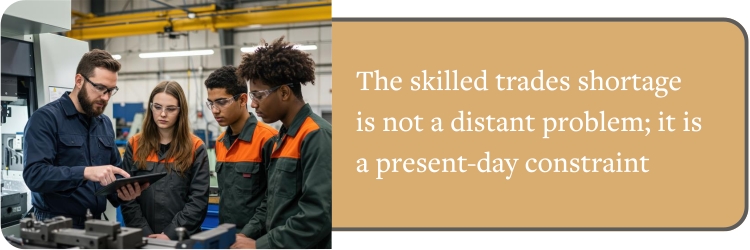
The skilled trades shortage is not a distant problem; it is a present-day constraint on productivity, sustainability and economic mobility. While systemic change in education and workforce policy will take time, organizations worldwide can take immediate steps to build pipelines, strengthen partnerships and reframe perceptions.
These strategies — vocational partnerships, community college investments and purpose-driven branding — offer scalable solutions with proven impact. Solving the trades gap is not just a talent issue for organizations in the built environment. It is a business imperative and a societal opportunity.

Susan Ranft is an accomplished HR executive currently serving as Vice President, Human Resources, Americas at Johnson Controls, with extensive experience advancing HR and talent initiatives. Ranft previously served as Vice President of Global People & Culture at ManpowerGroup, and HR and Talent Leader in Business Consulting Services at IBM.
Read more on Leadership & Strategy , Career Advancement and Emerging Topics or related topics Staffing and Workforce Development
Explore All FMJ TopicsRelated articles
-

Artificial Intelligence in FM
The stakeholder’s perspectiveBy Dr. Jake Smithwick & Dr. Kenneth Sullivan & Nneka Ubi05.01.2024 -

Mastering Change in Hybrid Environments
Insights from global operational leadersBy Meg Swanson09.02.2024 -

Plugged In
Solving the data disconnect in real estate and FMBy Amanda Muzzarelli & James Waddell07.01.2024