
 Membership
 Network
 Regional Sites & Affiliates


 Events
 Participate
 Resources

 Training
 Credentials
 Government


 Content Channels
 Tools
Tools


 Business Overview





Unintended Consequences
What FMs should consider before banning smartphones
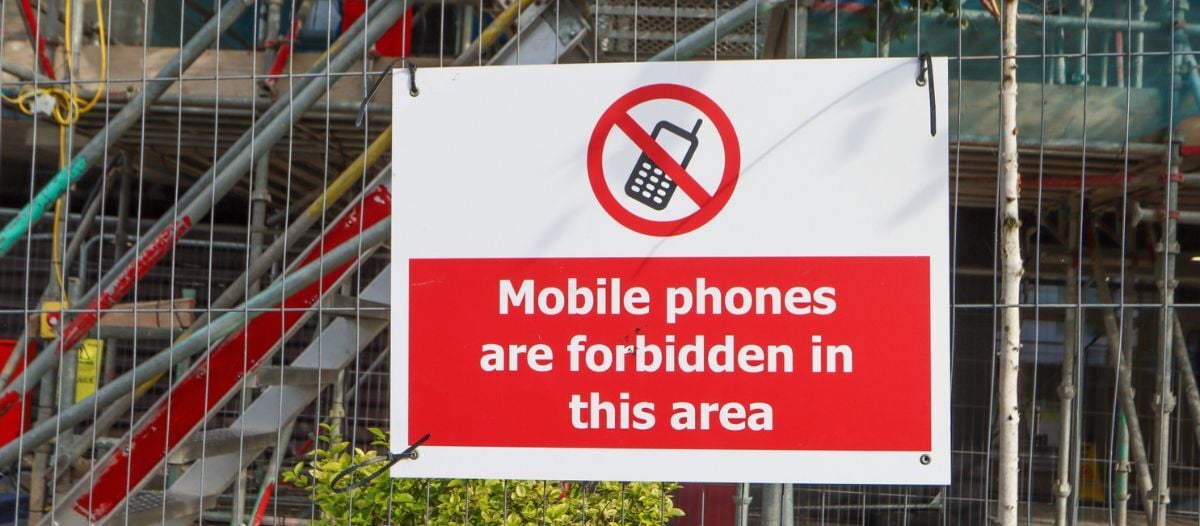
The call came through around 10 a.m. after a worker at one of the company's regional distribution centers had fallen from an elevated platform. In addition to the immediate, obvious medical concern, there was also a logistical dilemma. How long would it take to mobilize the first responders?
In this facility, the organization maintained a strict no-smartphone policy across all operational areas, and only a select few managers were issued two-way radios. The injured employee was still conscious but stunned and unable to call for help. When a colleague found him, they could not call or use a radio for help, so they shouted for someone to find a supervisor with a radio. What should have been an immediate emergency alert stretched into eight minutes before the supervisor and other trained personnel could respond and coordinate medical services. The incident highlighted a persistent issue that facility managers face daily.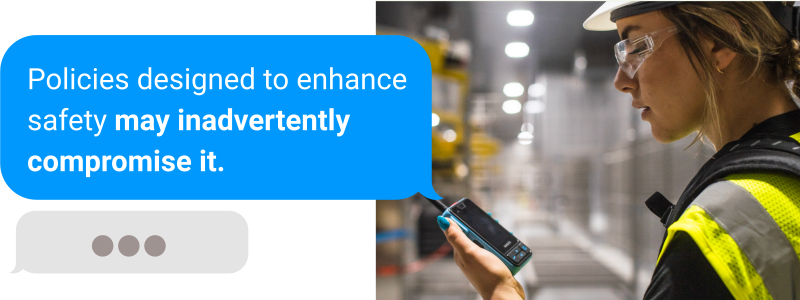
Facility leaders today operate within a paradox. Personal devices have become integral to modern operations, yet the risks associated with workplace distraction remain real. The pressure to choose between communication access and worker protection has become a defining challenge.
Why communication restriction policies exist
The safety concerns are neither theoretical nor trivial. Manufacturing environments, distribution centers, and data centers operate with equipment and processes demanding continuous attention. With an 8,000-pound forklift and other heavy-lift equipment operating in facilities that have the potential to cause damage to structures and severely injury or even kill people, inattention carries severe consequences.
As such, industry leaders have responded with increasingly stringent policies. General Motors restricts smartphone use while walking anywhere within its facilities, a policy that applies uniformly to production line workers and executive staff. The company believes smartphone engagement fundamentally diverts attention from hazards. FedEx has taken similar action, prohibiting personal device use in designated operational zones, particularly around sortation equipment and loading dock areas.
Regulatory bodies acknowledge these risks. The Occupational Safety and Health Administration (OSHA) specifically prohibits the use of smartphones while operating heavy lifting equipment under 29 C.F.R. § 1926.1417(d). First-time violations can result in fines reaching US$16,131, with willful or repeated violations escalating to 10 times that amount. For FMs responsible for regulatory compliance, these constraints feel mandatory rather than discretionary.
Why communication blackouts backfire
The underlying logic for smartphone bans appears sound. Distraction in hazardous environments creates liability, and liability ultimately falls on facility leaders and their organizations. Yet the debate over restrictions often overlooks the operational costs of complete communication cutoffs. FMs discover that comprehensive smartphone bans create efficiency losses that exceed the safety gains they anticipated.
When maintenance teams cannot communicate in real time, equipment failures that could be addressed in minutes stretch into hours. A cooling system malfunction, a spill requiring immediate cleanup, and a staffing shortage needing rapid redeployment all demand immediate coordination. Traditional, limited, analog communication methods cannot match the speed and precision required by modern facility operations.
Multilingual facilities face additional complications. Supervisors fluent in one language may need to coordinate with frontline workers who communicate more effectively in other languages. Without accessible communication tools, facility leaders must depend on translation intermediaries, introducing delays and misunderstandings that cascade through operations.
The most compelling argument against total smartphone bans comes from emergency response. Amazon maintained strict device restrictions until December 2021, when a tornado struck its Illinois warehouse. The failure was not in predicting the storm or issuing an initial alert; it was in reaching workers spread across a massive facility without accessible personal communication devices. Tragically, six employees were killed, and the company subsequently ended its smartphone ban.
Legal exposure extends beyond immediate safety concerns. Policies that restrict communication can create compliance gaps, exposing organizations to regulatory action and liability. Additionally, policies perceived as punitive rather than protective can deteriorate labor relations and raise concerns about whether restrictions disproportionately affect certain worker populations, creating potential discrimination issues.
Multi-site & campus coordination: An FM’s unique challenge
Most policy discussions treat workplace communication as a single-facility problem. In reality, FMs increasingly oversee operations across multiple locations, such as regional warehouses, satellite offices or manufacturing plants in different regions. This distributed environment creates complexities as some organizations maintain different policies across their facility network. When this happens, operational friction multiplies.
A company might restrict personal devices in manufacturing zones of its one facility, while allowing them in administrative areas, or implement smartphone bans at one location while permitting unrestricted use at another. However, those rules may differ in a facility in a different region. For FMs responsible for consistency and standardization, this inconsistency presents profound challenges.
Hybrid environments, where a single facility contains both operational zones (warehouses, production floors) requiring high safety standards and administrative areas (offices, control rooms) where communication demands differ, present particularly acute challenges. FMs must enforce different rules for different workers, sometimes on the same floor. This invites perceptions of unfairness and complicates training.
The compliance landscape further complicates matters. Localized regulations and requirements may differ from state to state. FMs must navigate these jurisdictional differences while creating coherent communication policies across their entire operation.
Forward-thinking FMs recognize that the solution requires deliberate standardization of approaches rather than policies. This means developing frameworks that can be applied consistently across locations while allowing for local adaptation based on specific operational hazards and communication needs. Centralized policy governance with flexible, distributed implementation enables both consistency and responsiveness.
Accessibility & inclusive design: Communication as equity
The smartphone policy debate typically frames the issue around restriction versus access. Yet a more constructive and forward-thinking lens focuses on inclusion, ensuring that all workers, regardless of ability or background, can participate fully in facility operations.
Text-based or visual alert systems are foundational for operational participation for hearing-impaired employees who cannot rely on verbal communication. Workers with mobility constraints may struggle to navigate facilities if they cannot communicate assistance needs remotely. Some people embrace smartphones as essential tools, while others find them overwhelming and prefer simpler communication devices.
Traditional communication policies often fail to account for these populations. A blanket smartphone ban may inadvertently create barriers for workers with disabilities who rely on specialized accessibility features. FMs must recognize that truly defensible policies must be inclusion-focused rather than restriction-focused.
Purpose-built communication tools for facilities can deliver benefits extending far beyond safety. Modern “smart” communications devices offer real-time language translation to serve workers whose primary language differs from facility operations. Visual alert systems benefit hearing-impaired employees while providing backup notification for all workers. Simplified interfaces accommodate populations and workers with varying technical comfort levels.
From an operational standpoint, inclusive communication design improves overall performance. When all workers can access the same tools and receive the same alerts, facility coordination improves. When translation happens in real time rather than through intermediaries, response times accelerate. When diverse workers feel equally equipped, morale and retention improve.
 Creating a decision framework for facility leaders
An effective communication policy requires systematic analysis. Begin with comprehensive facility zone mapping. Different areas generate different communication needs. Production floors may require heightened safety protocols that differ substantially from warehouse operations or office environments. Develop zone-specific frameworks reflecting the actual hazards and communication demands in each area.
Assess communication needs by role. Frontline workers, supervisors, maintenance personnel and management may each require different communication capabilities. Role-based allocation, where devices go to workers who need them or devices with limited functionality reduce distraction, often outperforms uniform policies in both safety and operational effectiveness. However, service-based communications platforms are available to companies that distribute the same device to all employees, providing capabilities tailored to the organization’s needs.
Conduct a cost-benefit analysis, calculating expenses of current communication delays: equipment downtime costs, quality issues from coordination failures and emergency response times. Compare these against technology investments, training requirements, and implementation expenses. FMs are often surprised to discover that a proper communication infrastructure costs substantially less than the operational losses created by restrictive policies.
Pilot programs in specific departments provide valuable data before implementing the facility-wide solution. Gather quantitative metrics, including safety incidents, response times, and communication effectiveness, alongside qualitative feedback from workers and supervisors. This evidence-based approach enables confident scaling across the organization.
The path forward
The most successful facility operations move beyond the false choice of "restrict communication for safety" versus "permit unrestricted device use for efficiency." Instead, leading facility managers implement systems recognizing communication as fundamental to both safety and productivity.
The evidence suggests that broader distribution of appropriate communication tools outperforms restrictive policies. Purpose-built smart radio technology, zone-based policies that reflect operational hazards, and role-appropriate tool allocation create communication environments where workers remain focused on critical tasks while maintaining the connectivity that modern operations demand.
For FMs navigating this landscape, design systems that enhance both safety and communication rather than requiring a choice. Organizations that solve this thoughtfully by recognizing real hazards while acknowledging legitimate communication needs, implementing inclusive technology rather than exclusionary policies, and standardizing approaches across multi-site operations, will build workplaces where people do their best work while remaining genuinely protected.

Read more on Risk Management , Communication and Facility Technology & Data Management or related topics Occupant Safety , Communication Management and Facility Technology
Explore All FMJ TopicsRelated articles
-

A New Approach
Improving business continuity with alarm managementBy Brad Freeman09.09.2024 -

Beware of Growing Cyberthreats
Why it’s time for stronger facility cybersecurityBy Andrew Harris & Eric Headington10.30.2024 -

Going Up?
Keeping elevators safe & compliantBy Dave Myers & Doug Taylor11.06.2024