Membership
 Network
 Regional Sites & Affiliates


 Events
 Participate
 Resources

 Training
 Credentials
 Government


 Content Channels
 Tools
Tools


 Business Overview





Verifying Client Confidence
Using digital proof of service to reshape commercial cleaning
Accountability in commercial cleaning has relied on trust for decades. If a space looked clean and the client did not raise complaints, the job was considered done. But today’s facilities are more complex, and as customer expectations around service quality rise, trust is no longer enough. Clients today want proof of service.
Across the commercial cleaning industry, there is a clear shift toward real-time verification and digital documentation of work performed. According to data from Janitorial Manager, between October 2024 and March 2026, customers completed more than 2.2 million QR code scans, and over the past year alone, monthly scan volume increased by nearly 20 percent.
This data points to increased pressure on cleaning teams to provide proof that work was done. Cleaning teams are managing more facilities, more shifts and more detailed service requirements than ever before, and clients are demanding greater transparency, consistency and responsiveness. The gap between “work completed” and “work proven completed” has become impossible to ignore.
Digital verification tools help close the gap
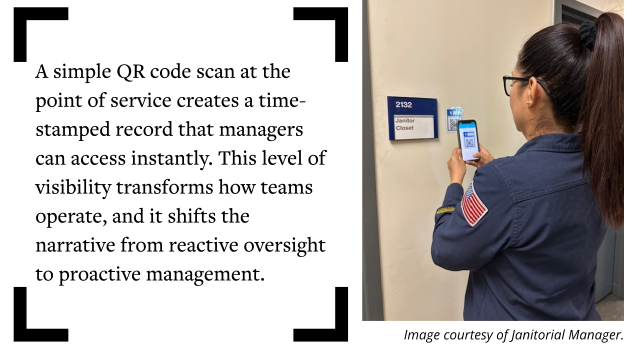
By replacing manual logs, paper checklists and verbal confirmations with real-time, location-based data, cleaning organizations can now document exactly when and where tasks are completed.
But verification is only one piece of the puzzle. The real value emerges when verification is paired with structured inspection data.
Digital inspection tools give supervisors the ability to evaluate performance consistently across sites using customizable templates. They can capture photos, assign scores and document issues in real time to create a detailed record of service quality. Over time, this data builds a historical baseline that supports trend analysis, targeted training and continuous improvement.
In practice, this means fewer surprises, faster issue resolution and stronger alignment between field teams and management. It also reduces the administrative burden that often comes with compliance and reporting. It frees up time for teams to focus on delivering high-quality service.
Employee accountability & consistency
Digital proof of service is also transforming how cleaning organizations manage and support their workforce. Historically, supervisors relied on sporadic site visits or customer feedback to evaluate performance. That approach made it difficult to identify issues early and provide timely coaching.
With digital verification tools, managers get a clearer picture of what is happening across multiple facilities and shifts. They can see completed tasks, potential service gaps and recurring issues. This visibility creates accountability and gives managers the information they need to support employees more effectively.
The benefits extend beyond oversight into training. When employees are aware that expectations are clearly documented and performance is consistently measured, they are more driven to succeed. Inspection data can highlight training opportunities, reinforce best practices and recognize high-performing team members. Instead of relying on assumptions, organizations can use objective data to guide coaching conversations and improve service quality across the workforce.
 Compliance & risk management
Digital proof of service is a valuable tool in facilities where compliance, safety and documentation requirements are front and center. Health care facilities, schools, manufacturing plants and other high-traffic environments often require detailed records to demonstrate that cleaning teams have followed protocol.
When documentation exists only manually or on paper, records can be incomplete, difficult to retrieve or susceptible to human error. Digital systems provide a centralized, searchable history of completed tasks, inspections and corrective actions. This makes it easier for organizations to respond to audits, investigate complaints and demonstrate adherence to internal standards or contractual obligations.
The ability to quickly access historical service records can also reduce risk. If questions arise regarding when a space was cleaned or whether a task was completed, managers have immediate access to time-stamped documentation rather than relying on memory or incomplete records. As organizations place greater emphasis on accountability and transparency, this level of documentation is becoming a business necessity more so than a competitive advantage.
The changing client relationship
When cleaning providers can show clear, verifiable proof of service backed by data rather than assumptions, they build a new level of trust. Clients gain confidence that work is being done consistently and up to their standard. That transparency is a powerful differentiator in the cleaning industry where margins are tight and competition is high.
As adoption of digital verification grows, the organizations that embrace this shift will be the ones best positioned to deliver both cleaning excellence and client confidence.

Archie Heinl is the founder and president of Janitorial Manager, where he has spent more than two decades helping service-based organizations modernize operations through technology. With a background in software development and business systems, Heinl has become a recognized voice in the facility management and commercial cleaning industries, particularly around operational efficiency, workforce accountability, inspections and data-driven decision-making. Heinl worked in the online banking software industry as a software development specialist, where he developed expertise in secure web-based applications and enterprise systems. He holds both an M.B.A. and a B.S. in Information Systems from the University of Toledo.
References
Top image via Getty Images.
Read more on Finance & Business and Project Management or related topics Supplier or Vendor Management and Quality Improvement
Explore All FMJ Topics