
 Membership
 Network
 Regional Sites & Affiliates


 Events
 Participate
 Resources

 Training
 Credentials
 Government


 Content Channels
 Tools
Tools


 Business Overview





Video Anayltics
The next evolution is here

Artificial Intelligence is changing video analytics: raising accuracy levels to new heights, identifying events that once went undetected, and transforming the way facilities can receive these services.
Video analytics, also referred to as Video Content Analysis (VCA), is a generic term used to describe computerized processing and analysis of video streams. Video analytics applications can perform a variety of tasks ranging from real-time analysis of video for immediate detection of events of interest, to analysis of pre-recorded video for the purpose of extracting events and data from the recorded video.
Over the past decade, video analytics has gone from a nice-to-have feature to a must-have monitoring and investigative tool. Some reasons for this change: the exponential growth of security cameras as their prices drop, better image quality making CCTV more useful, more cost-effective storage solutions and the immense quantities of video data generated by those cameras.
Closed-circuit television has long been standard in remotely viewing events in real time. As cameras began to proliferate, video analytics technologies were introduced to solve the problem of human inattention. Computers do not get tired, bored or distracted, and can continuously monitor camera feed. Plus, even the best security operators have limits to attentiveness, and their valuable time could be put to better use.
From the outset, video analytics was employed to detect and display events of interest. But there were challenges. Traditional video analytics applications relied on a rule-based approach that required software configuration -- by a human operator -- for each monitoring camera and each type of alert. Although effective in some cases, this approach was often impractical in large-scale deployments due to the vast amount of manual labor needed to configure, reconfigure and maintain rules.
Rule-based analytics were also unable to detect so-called “unusual” events, meaning behaviors that did not fit the parameters of a given rule. In addition - and most annoyingly - traditional video analytics were prone to significant false alarm rates.
Video analytics gets “smart”
In recent years, however, huge strides have been made in video analytics applications. The new generation of video analytics is based on Artificial Intelligence (AI) - computer simulations of intelligent behavior - and relies mainly on deep learning, meaning algorithms that access data to learn for themselves.
The results of AI applied to video analytics has been equally dramatic. Deep learning has matured to the point where it can now accurately detect and classify targets both in still images and video.
How does it do this? Initially, the deep learning algorithm is fed good-quality image data that is tagged as “car,” “bicycle,” “person,” etc. Over time additional data is collected and tagged, and the algorithm is retrained periodically with the additional data and thus becomes more accurate.
Some real-world examples include an incident in which two men broke into a Dallas tractor dealership lot. The AI-powered analytics software detected the perimeter breach and sent an instant alert to the control room. Remote guards performed audio talk-down and ran the would-be thieves off the property before damage was done.
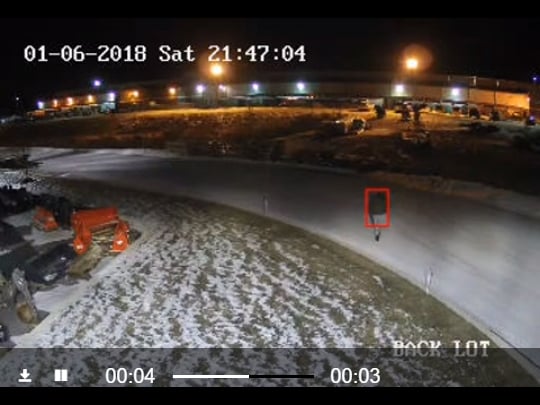 In another instance, an end-user was securing an outdoor installation. Without having configured any rules, the algorithm detected persons wandering around the site after the gates were closed, and immediately alerted the security control center to the intruders.
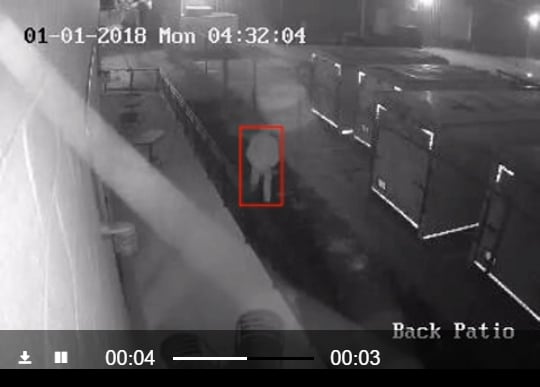 In the case of unusual events, an algorithm for anomaly detection learns the “normal” behavior within a given scene (the camera’s field of view). It then applies these models to video in real-time to detect targets that deviate from the norm. Only those events identified as deviating from the norm – for example, a motorcycle driving in a bicycle lane or a person jumping a fence instead of entering through the gate – will cause the software to generate an alert requiring review by the human guard.
The real costs of AI
These developments come just in time to meet the explosion in unstructured “big data” collected by video management systems. AI offers a solution as to how this data can be effectively used, providing a return on the investment in expensive storage and cameras, and maintaining, lowering and even replacing human capital costs.
Until recently, implementing real-time AI was extremely expensive, sometimes requiring a 1:1 server to camera ratio. Given that security budgets always have been and always will be tight, this put AI-powered solutions out of reach for many facility managers.
The good news is that today, with the rapid increase in GPU/CPU computational capacity and mass market adoption, costs have come down to reasonable levels. With correct implementation, a single server can be deployed to support hundreds of cameras.
The bad news is that bandwidth consumption has remained expensive, posing a major barrier to offering video analytics as a hosted service.
This problem can be solved with a patented architecture that distributes video processing between the edge and the server, thus reducing edge-to-server data transmission. This technique allows the solution to scale to an unlimited number of cameras. The result: video analytics can be provided easily and cost effectively. The federated architecture has also proved ideal for enabling a cloud-based approach.
Moving to the cloud & the cost benefits of SaaS
Over the past few years, there has been a major shift in software product delivery from customer hosted solutions (on-premise installations) to hosted (cloud-based) services. The IT world has already benefited from this change in terms of lower total cost of ownership (TCO), minimal upfront fees, faster product and feature updates, and improved support.
In the security realm, video surveillance software as a service (SaaS) lagged due, in part, to the above-mentioned technical problems associated with real-time transmission of video and video analytics. However, in recent years, the security industry has launched commercially available, cloud-based, AI-powered solutions
As for budgetary constraints, it’s important to note the cost-benefits of a cloud-based SaaS model that effectively enables organizations to use their operating budgets (OPEX) instead of capital budgets (CAPEX). By contrast, in the case of a hosted solution, the host organization bears the expense of hardware processing power, rack space, maintenance, cybersecurity and more.
The SaaS model offers other advantages: software is constantly cyber-secure, solutions can scale to any quantity of cameras, and deployment and management across geographies is easy, with no need for a private network to connect distributed sites. Another huge benefit is the ability to deploy features and bug fixes at a significantly faster pace than on-premise installations. In short: SaaS ensures that customers always have access to the most up-to-date software version.
The next step
The convergence of deep learning for video analysis, advances in AI for fully automated event detection, plus the significant reduction in cost to implement these techniques using SaaS means that the fully automated video surveillance solution is fast becoming a reality.
AI-powered automated video analytics enhances video monitoring by detecting events and issuing alerts with immediate video verification to enable real-time responses in time-sensitive situations and active incident management. The new AI generation of video search is also an ever-more effective tool for video data analysis in post-event investigation and reporting.
Cloud-based SaaS makes solutions like 24/7 remote video surveillance, guarding and concierge services accessible, affordable and, perhaps most importantly, always up to date. In this way, FMs and owners can benefit from what is truly the cutting-edge of video analytics for safety and security.

Zvika Ashani, Chief Technology Officer and cofounder of Agent Video Intelligence, is the chief architect of the company’s solutions, holds several patents for technologies relating to video analysis and cloud-based transmission of video data, and is a recognized authority in the field of machine learning.
References
Top image via Getty Images. Article images courtesy of AVI.
Read more on Risk Management and Facility Technology & Data Management or related topics Occupant Security , Physical Security and Facility Technology
Explore All FMJ TopicsRelated articles
-

A New Approach
Improving business continuity with alarm managementBy Brad Freeman09.09.2024 -

Beware of Growing Cyberthreats
Why it’s time for stronger facility cybersecurityBy Andrew Harris & Eric Headington10.30.2024 -

Going Up?
Keeping elevators safe & compliantBy Dave Myers & Doug Taylor11.06.2024
