Membership
 Network
 Regional Sites & Affiliates


 Events
 Participate
 Resources

 Training
 Credentials
 Government


 Content Channels
 Tools


 Business Overview




We Need a Common Standard for Workplace Safety
Making severe injuries comparable across borders, for the first time

Every year, the U.S. Bureau of Labor Statistics releases a sobering count of workplace fatalities in the United States. In 2024, there were 5,070 fatal work injuries, or roughly 13 families a day coping with the loss of a loved one who never returned home from work. The good news is that number is trending downward, decreasing by 4 percent from 5,283 in 2023.
And yet, overall incident rates are rising.
This phenomenon is not a contradiction so much as a byproduct of organizations getting better at measuring risk across their supply chains. Stronger risk management capabilities are driving earlier identification and tighter controls, which is reducing fatalities; but that same visibility also catches incidents that used to go unreported, and that shows up as a rise in overall reported incidents.
Visibility matters, and the industry still does not have enough of it. Most organizations believe they are managing supply chain risk effectively, but compliance programs alone cannot confirm that, in part because there has never been a shared way to measure severity across regions.
That started to change in January 2026, when ASTM International passed E2920-26, a guide for recording and benchmarking severity-based lagging indicators (SBLIs). This milestone marks the first real move toward a common global language for severe injuries and fatalities.
But because E2920-26 is brand new and industry data against it is still thin, interim metrics like the global severe injury rate (GSIR) are vital to standardize comparisons while the industry catches up to the new standard.
Fixing what gets measured is how the industry will finally get ahead of the annual workplace fatalities reported every year. E2920-26 and GSIR are the first steps in that direction, and the data is already showing the difference visibility makes.
Why traditional safety reporting falls short
Ask safety leaders at 10 different organizations how they define a serious work-related injury, and there will be 10 different answers. Without a shared definition, it is nearly impossible to say with confidence whether performance is truly improving, where to focus limited resources or which practices are working well enough to extend more broadly.
Traditional safety reporting typically breaks down in four specific ways:
- Severity itself rarely gets isolated. Many legacy metrics blend minor and severe incidents into one overall rate, which makes predicting fatalities difficult.
- Fatalities often get folded into the same overall injury rate as everything else. So, thousands of minor, unrelated incidents can dilute a single catastrophic loss.
- Not every legacy rate is normalized against hours worked. So, raw incident counts can make a supplier with more exposure hours look riskier than one with a genuinely worse record — or the reverse.
- Most incident-rate formulas were built around one typical company size. Suppliers at either end of that range, whether much larger or much smaller, end up with numbers that do not reflect their real risk profile.
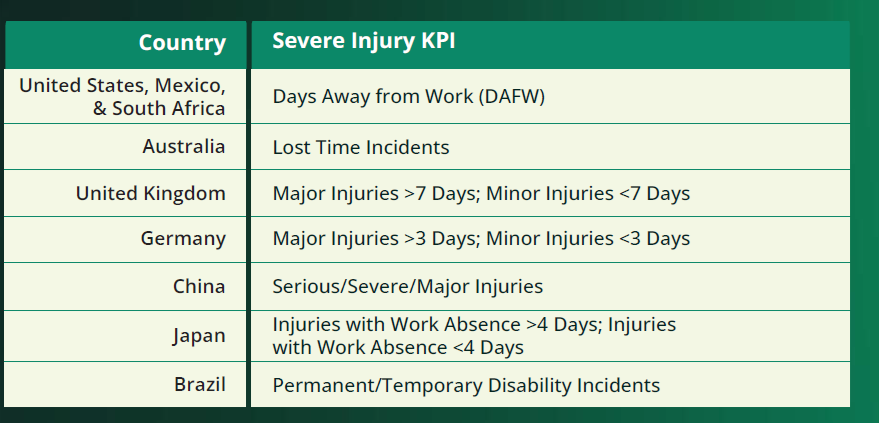
Globally, reporting gets even more complex as every country measures severe injuries differently. This makes it nearly impossible to compare safety performance across a global supply chain.
 Source: Avetta Insights and Impact Report 2026
While traditional safety reporting can help establish a baseline in one region, it often cannot answer if severe injuries are declining, region by region, supplier by supplier, year over year. Closing that gap means redesigning the measurement itself, and that is exactly where the industry is moving.
A new standard emerges with ASTM E2920-26
E2920-26 draws a firm line between two categories of incidents that have long been grouped together: things that go wrong and things that could have killed someone.
That distinction may sound obvious, but it is not how most safety data gets collected today. A workplace can look safe on paper, with a low rate of recordable incidents, and still be one bad day away from a fatality. That is because the conditions behind a scraped hand and the conditions behind a fatal fall often have very little in common. Traditional metrics that only count total incidents, without weighing how severe any of them could have been, were never built to tell the two apart.
Building a standard that considers nuance and complexity requires more than one organization deciding it is a good idea. It only works if enough safety professionals, standards bodies and companies managing large contractor networks agree to measure the same thing in the same way, which is part of why it took years to get here.
Because E2920-26 is brand new, most organizations do not yet have more than a few months of data measured against it. While full adoption will take years, a patchwork of regional definitions that cannot be compared is not sustainable. A shared definition of severity, even an early one, is worth more than a decade of numbers that never meant the same thing.
Bridging the gap with GSIR
While E2920-26 is the final destination, something needs to fill the space before it is fully adopted. GSIR is an example of a globalized standard that can help with benchmarking and reporting in the interim.
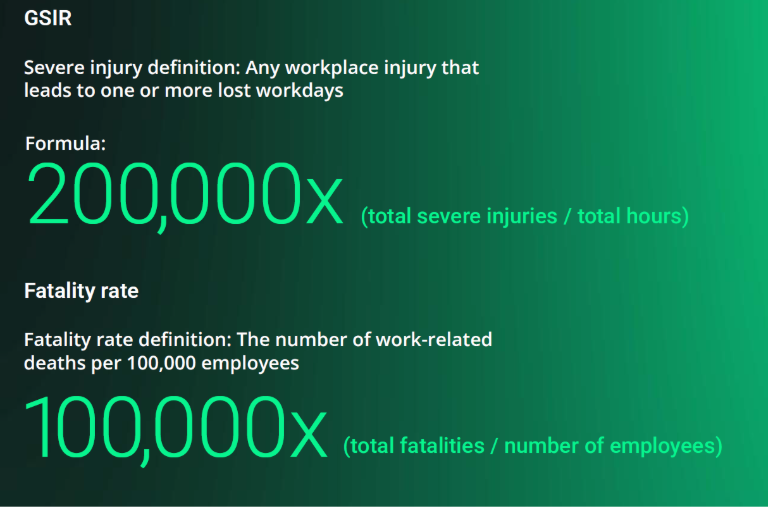
Here, a severe injury is counted as any workplace injury that results in at least one lost workday. That count is normalized to total hours worked, so a site with more people or more logged hours is not automatically penalized for having more exposure.
Fatalities are tracked as their own separate rate, measured per 100,000 employees, and kept apart from the broader injury count instead of folded into it.
 Source: Avetta Insights and Impact Report 2026
Putting these together consistently, across a network large enough and diverse enough for the comparisons to mean something, is the harder part. While GSIR is not the last word on measuring severity, it makes the next few years of data comparable enough to answer if severity is going down, and where.
What organizations can do right now
None of this is worth much if it stays abstract. New standards only matter if they change how an organization operates. Best practices that organizations can implement today include:
- Start with the fundamentals. Prequalification, safety audits, insurance verification, worker management, and worksite scheduling and permissions are foundational work that cannot be skipped.
- Widen the aperture. Safety does not happen in a vacuum. A supplier under financial strain, with a shaky sustainability record or with weak cybersecurity practices all point toward the same underlying risk. Bring business risk monitoring, ESG data, cybersecurity and safety maturity assessments into the same picture to illuminate blind spots.
- Implement continuous improvement. This work is not a one-time project. Organizations should leverage the Plan-Do-Check-Act (PDCA) cycle, aligned with ISO 45001, to ensure they revisit what the data shows on a regular basis, rather than collecting it once and filing it away.
- Start capturing severity-aligned data now. Waiting until the E2920-26 standard is a strict requirement means losing years of baseline data. Organizations can take an important step toward making their workplaces safer by having consistent numbers in hand before this consistency becomes mandatory.
What the data shows when visibility improves
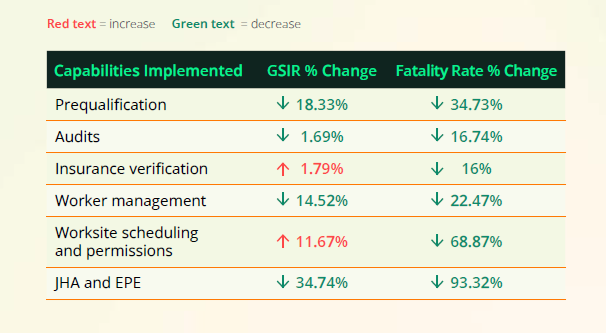
Organizations that implement supply chain risk management capabilities and improve visibility across their networks can achieve workplace fatality rates up to 97 percent lower than their peers.
 Source: Avetta Insights and Impact Report 2026
In fact, prequalification alone is associated with an 18 percent lower severe injury rate on average, and suppliers who complete it report fatality rates more than a third lower. And when suppliers implement job hazard analyses and end-of-project evaluations, fatality rates fall by more than 90 percent.
 Source: Avetta Insights and Impact Report 2026
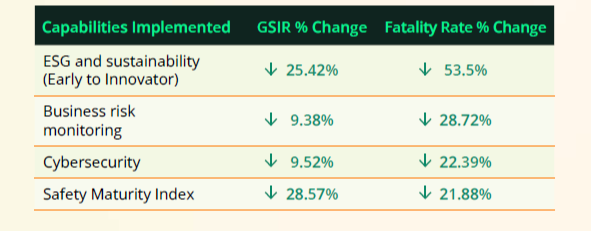
Visibility beyond core safety functions tells a similar story. Organizations that implemented and continued improving their sustainability risk visibility saw, on average, 25 percent fewer severe incidents and nearly 54 percent fewer fatalities. When an organization is generally well-run, financially stable and paying attention, their workers are safer overall.
The clearest pattern emerges when these capabilities are combined rather than used one at a time. For example, one global commerce company with more than 25,000 suppliers across 25 countries put this into practice directly. After layering prequalification, audits, worker management, worksite scheduling, safety maturity assessments and subcontractor oversight together, the company's GSIR dropped by 20 percent globally, with its Asia-Pacific operations improving by 74 percent.
Remember that there is no single silver bullet. Risk in a supply chain rarely comes from one place, and the response should not either.
What gets counted, gets prevented
The new standard cannot change what 5,070 families lost in 2024. But it might help decrease next year’s number — and each year thereafter — if the industry uses them well.
E2920-26 — and GSIR in the interim — create room to see real improvement: to catch the supplier whose numbers look fine until someone asks the right question, and to turn a preventable death into one that gets prevented.
Standardizing how the world measures injury severity will not fix workplace safety on its own. But it is hard to fix something that cannot be measured consistently, and for the first time, the industry finally has a genuine avenue to do just that.

Hind Manou is director of customer insights at Avetta, a provider of intelligent work readiness across global supply chains, where she enables customers to identify safety gaps in their supply chains through advanced analytical analysis.
Read more on Risk Management and Standards or related topics Best Practices , Data strategy and information management , Risk Management and Supply Chain
Explore All FMJ TopicsRelated articles
-
A New Approach
Improving business continuity with alarm managementBy Brad Freeman09.09.2024 -

Beware of Growing Cyberthreats
Why it’s time for stronger facility cybersecurityBy Andrew Harris & Eric Headington10.30.2024 -

Going Up?
Keeping elevators safe & compliantBy Dave Myers & Doug Taylor11.06.2024