
 Membership
 Network
 Regional Sites & Affiliates


 Events
 Participate
 Resources

 Training
 Credentials
 Government


 Content Channels
 Tools
Tools


 Business Overview




What Keeps 300 Workplace Leaders Up at Night?
5 honest concerns from global practitioners
To identify the latest challenges that are reshaping global workplace strategy, HubStar hosted 13 private roundtable discussions in Europe and the U.S. with more than 300 senior workplace leaders from a wide range of industries.
HubStar asked workplace leaders with perspectives from facility management, corporate real estate (CRE), workplace experience, IT, HR, university campuses and health care estates: “What are the biggest challenges you're grappling with? What's keeping you up at night?”
The candid behind-closed-doors concerns raised during these events painted a picture of a profession under increasing pressure.
The results also revealed a major shift.
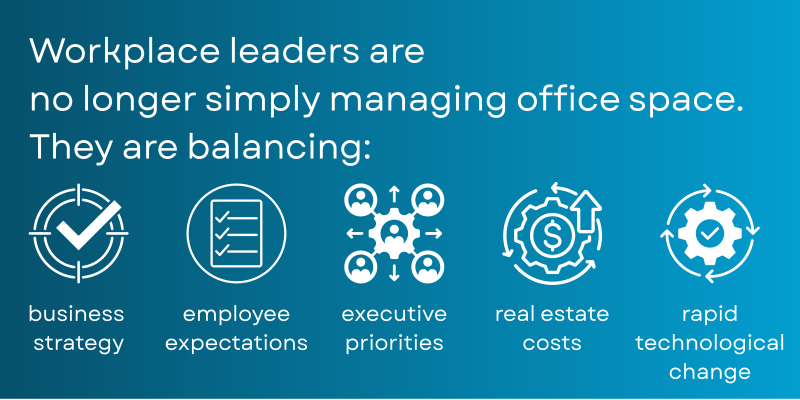
While every organization is different, five themes consistently emerged, indicating where many workplace leaders are likely to be focusing their attention in the coming year.

The roundtable discussions confirmed that the biggest and most controversial challenge keeping workplace leaders awake at night is the ongoing office attendance debate over “mandates versus magnets.”
Many workplace leaders revealed they are responsible for implementing return-to-office (RTO) policies they do not necessarily agree with, placing them in an unenviable position between the executive leadership and employees.
The leaders were aware that the office is competing with the home and had seen how RTO mandates can affect talent retention and result in the loss of good employees. Most attendees said they preferred to give their teams and individual employees the flexibility to decide on their own office attendance.
From these candid discussions, it became clear that many organizations are shifting away from measuring attendance toward creating workplaces that people actively choose to visit (the “magnets” approach).
The gatherings identified an increase in people-centric investment in workplace experience, collaboration spaces, office amenities and use of the office to stage “events” that attract people back into the workplace. This approach looks set to be just as important as attendance policies.
Many of the workplace leaders also acknowledged that the most powerful magnet for drawing people back to the office is often their co-workers and close workplace friends, helped by the latest workplace technology, which makes it much easier for colleagues to coordinate their schedules and plan their days in the office together.

The second conundrum causing workplace leaders sleepless nights is how to measure success, productivity and workplace experience in hybrid work when there are still no universally accepted metrics for this or any means of distinguishing them from concepts like team performance.
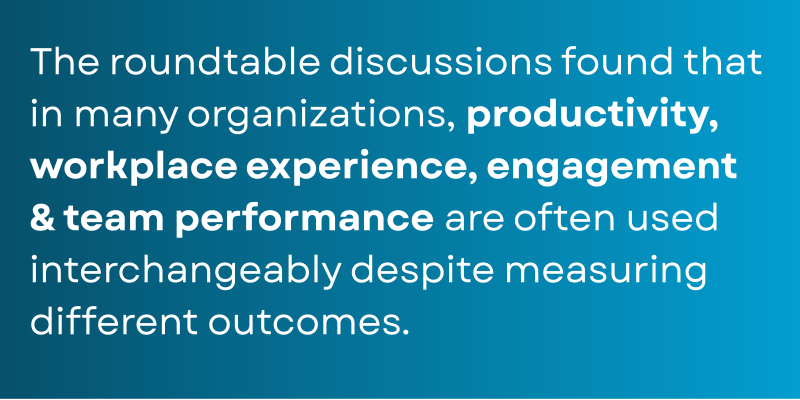
The leaders acknowledged that occupancy data alone no longer tells the full story. They recognized that better and more accurate workplace analytics are now essential for making informed workplace decisions.
Some attendees pointed to workplace flexibility and workplace experience as having the greatest positive impact on team performance. This is leading more organizations to combine their space utilization data with employee feedback, collaboration insights and business performance metrics.
The roundtable gatherings also highlighted the growing recognition of a direct link between workplace experience and productivity. More organizations are appointing someone to act as a “chief experience officer.”
One workplace leader from a well-known brand had an interesting perspective on how to measure productivity in the hybrid age. It involved simply asking all the company’s global employees, “Are you happy?” in a spot poll. The rationale was: if our people are happy, they will be more engaged and productive at work. It was a way of taking a complicated, difficult-to-measure metric, simplifying it down to “Yes” or “No,” then assessing the results globally. Is happiness trending up or down within our organization? Are we improving our employees’ well-being?

The third issue that keeps workplace leaders up at night is the challenge of improving cross-functional collaboration between their FM, HR and CRE teams.
The roundtable discussions indicated that the most successful organizations are those that are bringing FM, HR, CRE and IT together around a shared workplace strategy. Yet only a small percentage of attendees reported that their FM, HR, CRE and IT teams are highly aligned and working together with shared goals.
Many workplace leaders felt collaboration structures are lagging behind significant changes in job responsibilities.
HR has traditionally focused on employee well-being, engagement and retention, while CRE has concentrated on occupancy, cost management and portfolio optimization. However, many attendees admitted that hybrid working has blurred the boundaries between these functions, making better collaboration more important than ever.
There was clear recognition that siloed and misaligned priorities between HR and CRE teams can lead to inconsistent workplace strategies and missed opportunities to improve both employee experience and business performance.

The roundtable discussions revealed that the fourth nightmare for workplace leaders is how to tailor the workplace experience when there are four different generations of employees in the workplace. Today's workplace needs to support Baby Boomers, Generation X, Millennials and Generation Z, with Generation Alpha entering the workforce in the coming years.
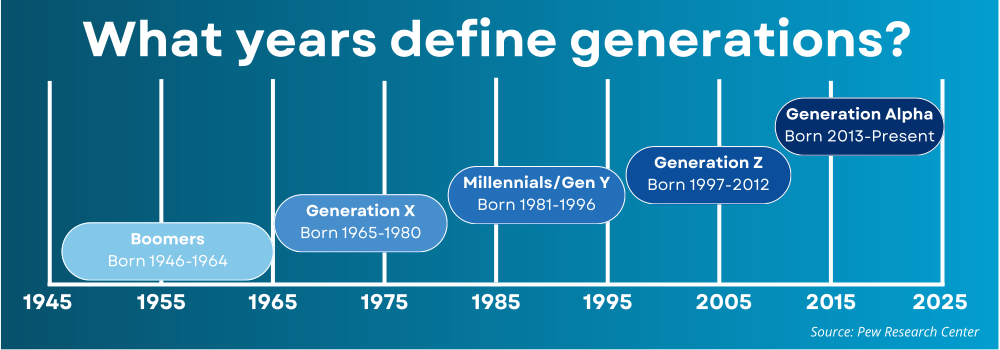
Leaders have found that different generations have different expectations for flexibility, technology, collaboration, learning and office attendance. Because each age group has a different need from the office, it is becoming harder to implement a hybrid work policy that satisfies every employee.
As a result, many organizations are shifting from one-size-fits-all office design toward more flexible environments that provide a mix of collaboration areas, focus spaces, meeting rooms and social settings. However, this shift is creating a new challenge of designing workplaces that can accommodate different working styles without adding unnecessary complexity.

The fifth challenge workplace leaders are grappling with is AI’s impact on workplace design and space allocation in offices. The discussions revealed that AI is not only changing how people work, it is creating new workplace complications that are forcing organizations to rethink how their workplaces need to be structured.
As a result, more workplace leaders are reorganizing meeting rooms, collaboration areas, social spaces and space utilization as AI becomes embedded into everyday work.
For example, the increasing use of voice-enabled AI tools is saving time and making some teams faster, but the sound of spoken interactions with AI is distracting for people in the spaces around them. Some organizations are responding by installing more privacy booths, improving acoustic design and adding soundproofing material around individual desks.
As AI adoption grows, workplace strategy must balance technology, employee experience and the physical office environment.
It is clear that the five biggest challenges that keep workplace leaders awake at night are all closely connected. This reflects a modern workplace that must continue to evolve long after the upheaval caused by the initial shift to hybrid work.
As the interdependent elements of today’s workplace ecosystem continue to change, these five core challenges are likely to remain at the center of workplace strategy for years to come. This means many organizations’ success going forward will increasingly depend on using accurate, real-time workplace data to make informed decisions, strengthen collaboration across departments, and create workplaces that people genuinely want to use.

Stefania Vatidis holds a BS degree in Business and Political Economy from NYU's Stern School of Business. She joined leading workplace solutions provider HubStar as a strategist in 2023 and was recently promoted to Growth Marketing Manager. She is a regular contributor to leading FM and HR publications on key workplace issues.
References
Top image via Getty Images.
Read more on Leadership & Strategy , Facility Technology & Data Management and Facility Operations or related topics Operations , Information Technology , Strategic Planning and Data strategy and information management
Explore All FMJ TopicsRelated articles
-

Artificial Intelligence in FM
The stakeholder’s perspectiveBy Dr. Jake Smithwick & Dr. Kenneth Sullivan & Nneka Ubi05.01.2024 -

Mastering Change in Hybrid Environments
Insights from global operational leadersBy Meg Swanson09.02.2024 -

Plugged In
Solving the data disconnect in real estate and FMBy Amanda Muzzarelli & James Waddell07.01.2024