
 Membership
 Network
 Regional Sites & Affiliates


 Events
 Participate
 Resources

 Training
 Credentials
 Government


 Content Channels
 Tools
Tools


 Business Overview





What Resilience Really Looks Like
Lessons from the pandemic
Since 2020, facility management has been tested in ways few could have predicted. After the COVID-19 pandemic forced buildings to shut down almost overnight, FM teams had to implement new health protocols, reconfigure spaces and manage constantly changing guidance. At the same time, hybrid work reshaped how offices, campuses and public spaces were used.
Even as the pandemic eased, new pressures continued to build. Skilled tradespeople began retiring faster than they were being replaced. Labor shortages stretched FM teams thin. Meanwhile, advances in artificial intelligence and automation have been transforming how buildings are managed, raising both excitement and uncertainty about the future of work.
FM organizations that have thrived in this uncertain, dynamic environment share a common trait: resilience.
1. Work smarter & maximize efficiency with automation
 Automation is often talked about in terms of cost savings, but as FM organizations have learned, how it supports the workforce is equally important. FM staff spend a tremendous amount of time on administrative tasks — logging inspections, documenting maintenance activities, tracking parts inventories, manually updating work orders and more. When these processes are automated, technicians can devote more time to solving problems and less time managing paperwork.
Many organizations are using mobile work-order platforms that automatically generate service tickets based on predefined schedules or system alerts. An FM technician inspecting a rooftop unit, for example, can scan a QR code on the equipment with a mobile device and instantly access maintenance history, operating manuals and prior repair notes. Once the work is complete, the system automatically updates records and inventory levels without requiring separate documentation later.
Automation is also improving how routine building operations are managed. In corporate offices and higher education campuses, building automation systems can automatically adjust lighting, HVAC and ventilation based on occupancy levels. If a conference room or lecture hall is empty, systems reduce lighting and airflow. As people enter a space, the environment adjusts automatically.
Automation applications like these help workers operate more effectively and apply their skills where they matter most.
2. Leverage data & AI for predictive, insight-driven operations
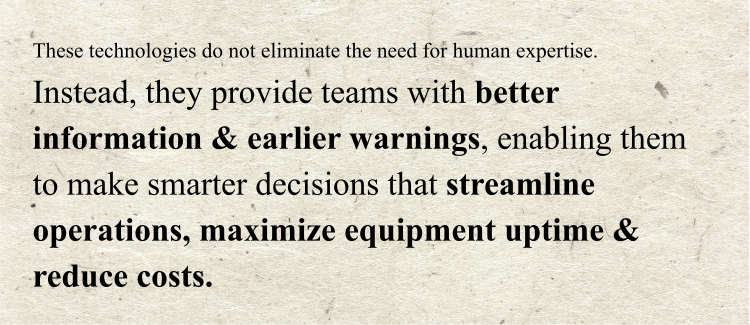
FM teams have always collected large amounts of data — from building automation systems, maintenance logs and energy meters. In the past, much of that information remained underused. Over the past several years, advanced analytics and artificial intelligence have increasingly turned that data into actionable insight.
Predictive maintenance is one of the most critical examples. By analyzing patterns in equipment performance, AI systems can identify early signs of wear or malfunction. FM teams can address issues before they lead to costly breakdowns.
Energy management is another area where data analytics is transforming operations. Large commercial buildings consume enormous amounts of electricity, heating and cooling. AI-driven energy platforms can analyze weather forecasts, occupancy patterns and historical consumption data to optimize building systems automatically. For example, a corporate office complex might use predictive analytics to adjust HVAC schedules based on expected occupancy and upcoming weather conditions. If a warm front is predicted, the system may begin cooling the building earlier in the morning to reduce peak energy demand later in the day.
3. Make health, safety & workplace flexibility permanent priorities
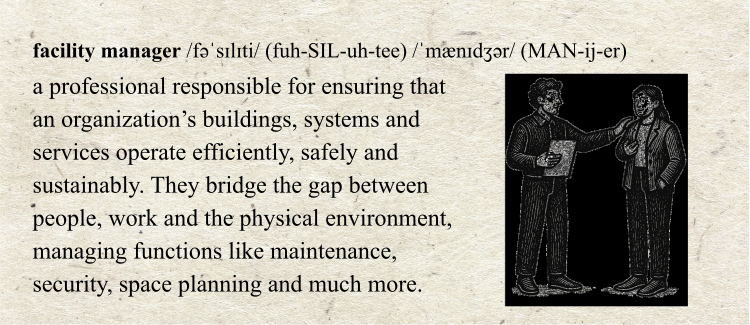 The pandemic permanently changed how organizations think about building health. Indoor air quality, sanitation practices, and occupant health and safety are now central concerns for building operators and top of mind for every person who enters a facility.
During the height of the pandemic, many organizations upgraded their facility’s air filtration systems, increased ventilation rates and adopted more rigorous cleaning protocols. Some deployed sensors to monitor air quality and occupancy levels in real time. While initially introduced as emergency responses, these measures have clearly provided long-term benefits.
For example, many universities use air quality monitoring systems in classrooms and residence halls. FM teams can track carbon dioxide levels, humidity and particulate matter to ensure spaces remain healthy and comfortable. When sensors detect poor air circulation, building systems can increase ventilation or alert technicians to investigate potential issues.
Flexibility has also become a permanent part of building management. Hybrid work means office occupancy fluctuates from day to day. A building that once operated at predictable capacity may now see heavy use on certain days of the week and lighter use on other days. Facilities leaders are responding by rethinking how spaces are used. Some corporate offices are converting underutilized desks into collaboration areas. Others are redesigning meeting rooms to support video conferencing and hybrid collaboration. Smart occupancy sensors also help teams adjust heating, cooling and lighting based on how spaces are actually used, reducing energy waste while improving comfort. FM labor schedules and workforce composition need to be adjusted, often on-the-fly, to accommodate these changes.
4. Adapt workforce strategy to skilled labor shortages
The FM industry has always depended on experienced tradespeople — HVAC technicians, electricians, plumbers and maintenance specialists — whose skills are built through years of hands-on work. With many of these veterans retiring, organizations have been scrambling to fill critical roles. This is made all the more difficult because younger workers are not entering the trades at anywhere near the same pace.
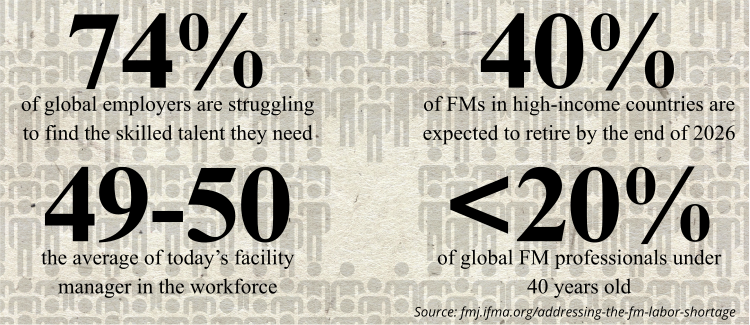
The stats are sobering: 40 percent of the 12 million people in the skilled trades workforce are older than 45, and less than 9 percent of people ages 19-24 are entering the trades. In the U.S. alone, about 400,000 trade jobs are unfilled, according to the Bureau of Labor Statistics. The shortage is especially acute in roles essential to building operations. There is a deficit of roughly 110,000 HVAC technicians now and, during the next decade, about 80,000 new electrician jobs are expected to be generated every single year.
As a result, FM departments are increasingly competing with construction firms, manufacturing companies and government infrastructure projects for the same limited pool of talent. To be resilient, FM leaders must rethink how they recruit, train and utilize their workforce.
Some facility services providers, for example, have partnered with local trade schools to create apprenticeship programs. This allows students to gain practical experience while working alongside experienced technicians. FM organizations get a pipeline of talent that understands their buildings and systems.
Cross training is another strategy gaining traction. Instead of assigning technicians to narrowly defined roles, some organizations train employees across multiple disciplines. A technician who understands both electrical and mechanical systems, for instance, can troubleshoot a broader range of issues.
5. Instill a culture of experimentation & continuous learning
Facility organizations that successfully navigate change generally have a willingness to experiment, a desire to innovate, and a focus on training and developing employees. They stay current on the latest technologies and encourage workers at all levels to learn new skills.
This commitment to continuous learning has never been more essential. Building systems are growing more complex as digital technologies and AI enhancements are integrated into traditional infrastructure, equipment and processes. Technicians who once focused solely on mechanical repairs increasingly need to interact with software dashboards, sensor networks, automated control systems and more.
Forward-thinking FM departments invest in mandated training programs that help employees develop digital skills alongside technical expertise. They also prioritize soft skills such as communication, conflict handling and problem-solving. Not only does this help ensure high-quality service delivery, it also helps boost employee retention, which is critical in this labor market: 18 percent of employees reportedly leave their jobs due to a lack of professional development, with 15 percent also citing limited career growth opportunities.
 Resilience now means building operations that are healthier, smarter and continuously adaptable. It means supporting a workforce that combines practical expertise with digital fluency. It means using automation and AI not as replacements for people but as tools that elevate their capabilities. FM leaders who embrace these lessons will be much better prepared for whatever challenges come next.

Jim Lane is a highly accomplished facilities management professional and business executive with more than 20 years of industry experience. He has a strong track record in ensuring compliance concerning industry regulations, safety procedures and policies. Lane began his career in the services industry in 1999 with Johnson Controls Inc. In 2004, he joined EMCOR Facilities Services Inc. where eventually he went on to lead their North American operations and became senior vice president and general manager. He has extensive expertise built on 24 years of cross-industry experience in areas ranging from life science/pharma, data centers, controls and energy management to complete facilities services and solutions. In 2018, he joined UG2 where he is the executive vice President, engineering & operations.
References
Top image via Getty Images.
Read more on Leadership & Strategy , Facility Technology & Data Management and Occupancy & Human Factors or related topics Workplace Utilization , Wellness and Well-being and Data strategy and information management
Explore All FMJ TopicsRelated articles
-

Artificial Intelligence in FM
The stakeholder’s perspectiveBy Dr. Jake Smithwick & Dr. Kenneth Sullivan & Nneka Ubi05.01.2024 -

Mastering Change in Hybrid Environments
Insights from global operational leadersBy Meg Swanson09.02.2024 -

Plugged In
Solving the data disconnect in real estate and FMBy Amanda Muzzarelli & James Waddell07.01.2024