
 Membership
 Network
 Regional Sites & Affiliates


 Events
 Participate
 Resources

 Training
 Credentials
 Government


 Content Channels
 Tools
Tools


 Business Overview





When Good Enough Holds FMs Back
Overcoming resistance to change & embracing innovation

Innovative facility management processes often face resistance rooted in the belief that “the way we currently do things is good enough.” This mindset reflects the Good Enough Fallacy: the organizational tendency to cling to familiar methods despite evidence of superior alternatives.
The Good Enough Fallacy is characterized by:
-
Complacency-focused thinking: Preferring suboptimal solutions over pursuing improvements.
-
Effort justification: Assuming the work needed for change outweighs the benefits.
-
Minimum standard assumption: Resisting innovation by claiming current processes already meet baseline requirements.
When left unchallenged, these tendencies stall progress, weaken outcomes and perpetuate inefficiencies. To move forward, FM leaders must recognize and address the implicit biases that reinforce the status quo.
The Good Enough Fallacy has repeatedly shaped FM practice. These examples highlight how resistance to change has impeded progress:

These cases show that barriers are often psychological and cultural rather than technical and reinforced by implicit bias.
Understanding implicit bias
Implicit bias consists of unconscious stereotypes or attitudes that shape decisions and actions. In FM, these biases often result in resistance to innovation, favoring comfort and familiarity over progress.
In his book “Thinking, Fast and Slow,” Daniel Kahneman describes two modes of thinking:
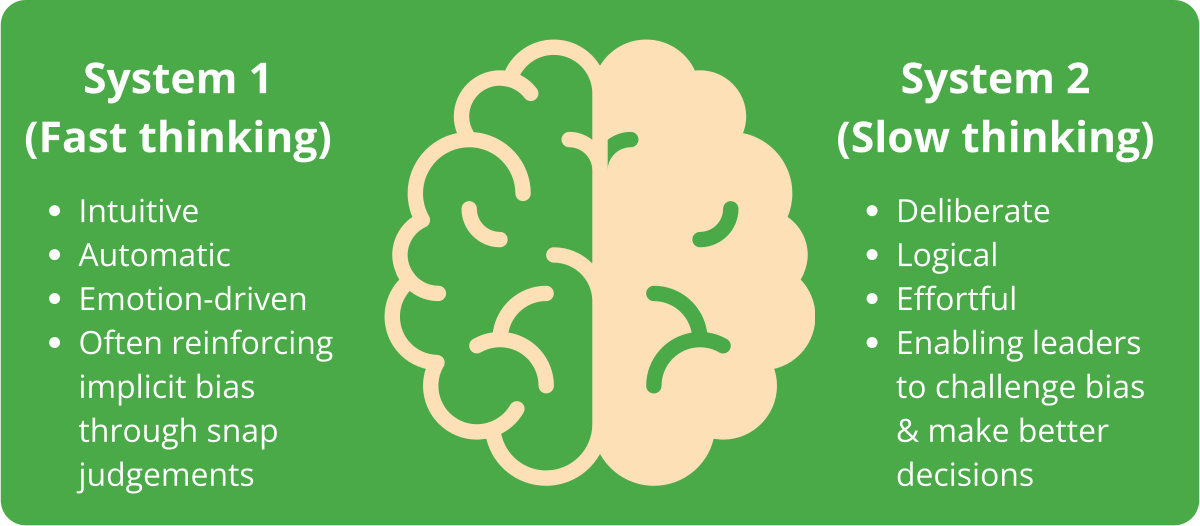 Organizations often default to System 1, avoiding change because it feels risky or unnecessary, even when evidence shows otherwise. In environments where risk-taking is not rewarded, leaders may punish failure rather than treat it as a learning opportunity, further discouraging innovation.
Key implicit biases that sustain Good Enough Fallacy include:
-
Status quo bias: Preferring current practices over change, even when better options exist).
-
Zero-risk bias: Favoring certainty and the illusion of “no risk” over managed improvement.
-
Confirmation bias: Seeking only information that supports existing beliefs while ignoring contradictory evidence.
-
Loss aversion bias: Avoiding losses more strongly than pursuing gains, leading organizations to cling to inadequate methods.
Reconciling Voltaire & Jobs in the facility context
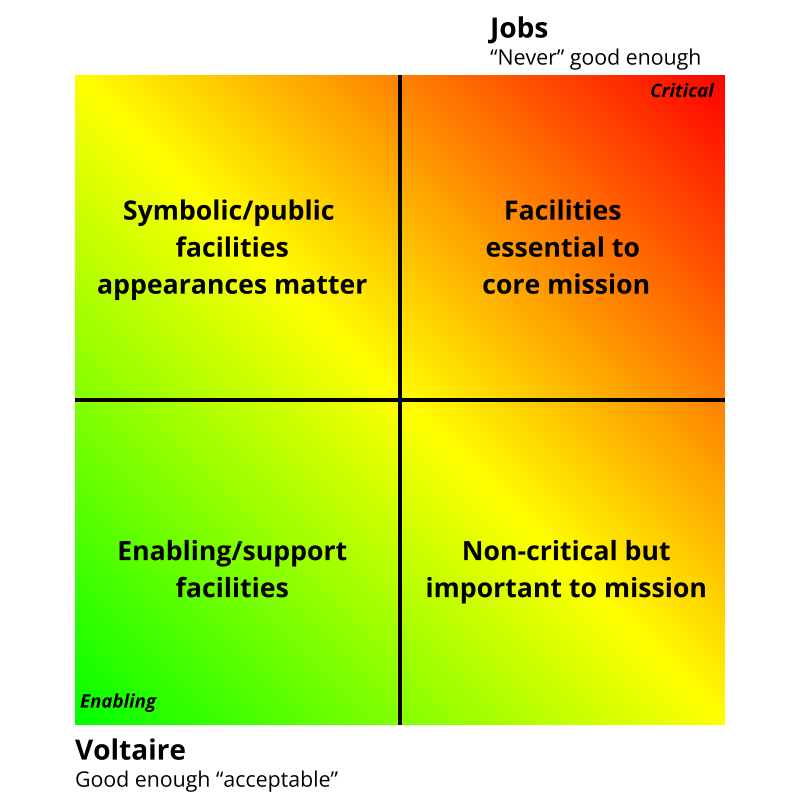 The Good Enough Fallacy is complicated by two opposing philosophies. Voltaire cautioned that “perfect is the enemy of good,” warning against perfectionism that leads to paralysis.
By contrast, Steve Jobs insisted that “good enough is never good enough,” emphasizing the danger of mediocrity and complacency. The phrase “good enough for government work,” often reflects the bureaucratic tendency to settle for suboptimal results, reinforcing the very complacency Jobs warned against. The phrase originally meant high standards, especially during World War II; but by the 1960s–70s, it evolved to imply mediocrity and subpar performance, particularly in bureaucratic contexts.
In FM, both apply, but in different contexts:
-
Voltaire’s warning helps avoid paralysis. Leaders cannot afford to spend years “gold-plating” a warehouse or office when adequate functionality meets the mission.
-
Jobs’ standard applies to mission-critical facilities where failure is unacceptable. Runways, hospitals, power plants and data centers demand excellence.
The key is mission-weighted selectivity. As shown in the diagram, effective leaders balance Voltaire’s pragmatism in managing peripheral facilities with Jobs’s uncompromising vision for core mission assets.
A related challenge is the reliance on ordinal measurements, rankings, codes or Likert 1-5 scales as a “good enough” substitute for quantitative analysis. Ordinal measures show which item ranks higher or lower, but not by how much. Thus, they cannot be combined or calculated in ways that give trustworthy numerical results). In measurement theory, cardinal numbers are values on a ratio or interval scale, meaning they have equal intervals and can be meaningfully added, subtracted, multiplied or divided.
Yet, many facility decision support systems treat ordinal scales as if they carried cardinal weight. For example, the roof condition on the south side of the building scored condition 2, and the roof on the north side scored condition 4 might be averaged to yield a “3” for overall roof condition. But this suggests a meaningful numeric midpoint that does not exist: the difference between 2 and 4 is not necessarily “twice as bad.”
Another example is the use of occupant satisfaction surveys with a 1 through 5 Likert scale (1 = very dissatisfied, 5 = very satisfied). Suppose one building scores an average of 4.2 and another 3.8. Decision-makers may conclude the first building is “10 percent better” in occupant experience. The Likert scale only shows the order (4.2 > 3.8) but not the magnitude of difference. The “distance” between “satisfied” and “very satisfied” is not equal to the distance between “neutral” and “satisfied.” Treating these ordinal responses as cardinal values produces an illusion of precision, which can distort facility investment decisions and mask deeper issues in safety, condition or mission support.
Ordinal data creates the illusion of rigor without enabling the full power of quantitative analysis. By contrast, cardinal data — measurable values that can be added, multiplied and modeled — allow for weighted comparisons, scenario testing and exploration of cascading effects. Leaders must recognize when ordinal measurements are sufficient for context-setting and when mission-critical decisions require the precision of cardinal metrics.
Conclusion
The Good Enough Fallacy holds facility leaders back by reinforcing complacency, bias and reliance on flawed measures. Left unchecked, it wastes resources and weakens mission outcomes. It is the invisible elephant in the room that quietly tramples innovation before it can take root. Overcoming this requires more than innovative technology, it requires challenging implicit biases, shifting from “fast” intuitive thinking to deliberate, evidence-based judgment, and abandoning ordinal scores that create the illusion of precision.
True progress comes from applying the right standard in the right context. Voltaire’s pragmatism helps avoid perfectionism in peripheral facilities, while Jobs’ demand for excellence must guide investment in mission-critical assets where failure is not an option. Failure can result in catastrophic consequences, including:
-
Loss of life
-
Environmental disasters (e.g., Deepwater Horizon)
-
Massive financial costs
-
Long-term operational disruption
By cultivating innovation, continuous learning, and data-driven decision-making, facility managers can know when “good enough” is sufficient and when excellence is essential. The result is stronger alignment between facilities and mission, more defensible decisions and organizations that are equipped not just to keep pace with change, but to lead it.

Albert Antelman is a registered architect and an IFMA member with more than 30 years of experience in federal and defense infrastructure programs. He is co-founder of the Institute of Responsible Infrastructure Stewardship and the developer of the Mission Dependency Index (MDI), a decision-support framework used by the US Defense Department and NASA to assess the operational importance of infrastructure. Antelman's work combines strategic theory, data-driven analysis and facility leadership to strengthen mission assurance and operational resilience across both public and private sectors.
Read more on Leadership & Strategy or related topics Best Practices , Change Management and Influencing
Explore All FMJ TopicsRelated articles
-

Artificial Intelligence in FM
The stakeholder’s perspectiveBy Dr. Jake Smithwick & Dr. Kenneth Sullivan & Nneka Ubi05.01.2024 -

Mastering Change in Hybrid Environments
Insights from global operational leadersBy Meg Swanson09.02.2024 -

Plugged In
Solving the data disconnect in real estate and FMBy Amanda Muzzarelli & James Waddell07.01.2024
