
 Membership
 Network
 Regional Sites & Affiliates


 Events
 Participate
 Resources

 Training
 Credentials
 Government


 Content Channels
 Tools
Tools


 Business Overview




When Knowledge Walks Out the Door
Rethinking continuity in the age of AI & employee turnover

Organizations lose critical facility knowledge whenever an experienced employee leaves. Rebuilding hard-earned insights into vendor history, problem-solving patterns, troubleshooting logic and undocumented processes is costly and time-consuming. Continuity plans are the logical solution but are often met with resistance because employees interpret them as preparation for replacing them.
Implementing weekly pre-meeting summaries that outline key actions and interactions can create a reference log that can be reviewed if an employee is absent or leaves the organization, which helps preserve details that would otherwise disappear.
 While effective, this method depends entirely on consistent enforcement by individual managers, which makes it unreliable at scale. The larger problem remains. Organizations lack a standardized and repeatable method to retain institutional knowledge regardless of leadership style or turnover patterns. This is where AI can provide a structured solution by organizing everyday interactions into accessible reference formats that preserve the experience and knowledge of key employees.
Most organizations attempt continuity through shared drives, SOP binders, inbox delegation or CMMS notes. These systems rarely capture the context necessary to maintain operational momentum. CMMS platforms record work orders, but not the reasoning behind decisions or vendor expectations. Shared folders quickly become outdated. Email forwarding requires the incoming person to guess which conversations matter. Much of the most valuable information, including vendor history, troubleshooting patterns, informal standards and internal expectations, lives only in day-to-day communication. Once an employee leaves, that context leaves with them.
 AI can perform this continuity function by analyzing communication patterns, documents and work responsibilities associated with a departing employee. Instead of relying on scattered emails or personal notes, an AI system can extract operational details such as active vendor discussions, open maintenance issues, pending approvals and routine scheduling patterns.
For example, a refrigeration manager departed the company just as updated engineering specs were issued for multiple new-build supermarkets. Additional refrigerated cases had been added to the designs, increasing the required heat load. Because this key update was not conveyed during turnover, the manufacturer delivered equipment that did not meet the revised requirements. The result was sweating glass doors, temperature instability, elevated energy consumption and approximately US$20,000 in corrective work. A minor communication gap became a major operational problem simply because the knowledge lived in one person’s inbox.
In another example, an organization accumulated more than US$3 million in unforeseen expenditures across thousands of sites. The incoming leader discovered that thousands of work orders had been processed entirely through email rather than the CMMS due to longstanding process gaps. With no centralized record of what had been dispatched, completed or escalated, reconstructing the operational picture required months of manual work. Budget forecasts were inaccurate; vendor performance could not be evaluated and leadership lacked visibility into the true maintenance load.
These were not failures of technical capability — they were failures of continuity.
Had continuity systems been in place, AI could have generated consolidated summaries of project updates, design changes, cost exposures and outstanding approvals. Incoming personnel would have received immediate clarity rather than spending weeks recovering lost context. Privacy safeguards can be applied so the system automatically excludes HR matters, legal communication or personal content, ensuring only operational information is captured.
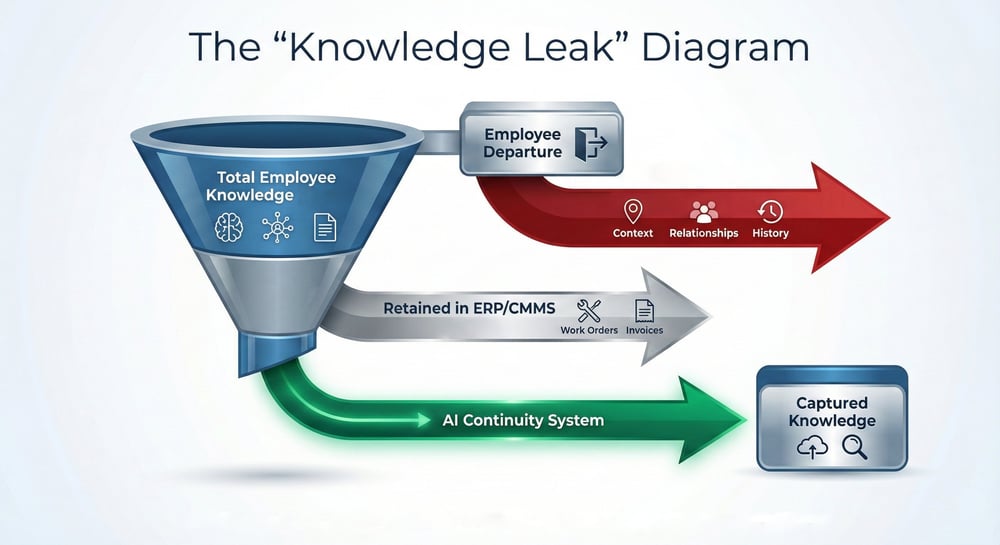
The financial impact of turnover on FM roles is routinely underestimated. Lost communication slows capital projects, increases repair delays, and forces teams to revalidate quotes or rebuild vendor trust. Incorrect orders, warranty complications and compliance risks follow. Across a multisite portfolio, these inefficiencies compound into significant financial and operational drag.
A continuity-focused AI system can do more than summarize communication. It can rebuild fragmented exchanges into coherent narratives, extract deadlines, map relationships between discussions and surface high-risk items that require follow-up. It can identify the vendors an employee interacted with most frequently, the projects that were mid-stream and the issues beginning to escalate. This level of insight is impossible to reconstruct manually once an employee has left.
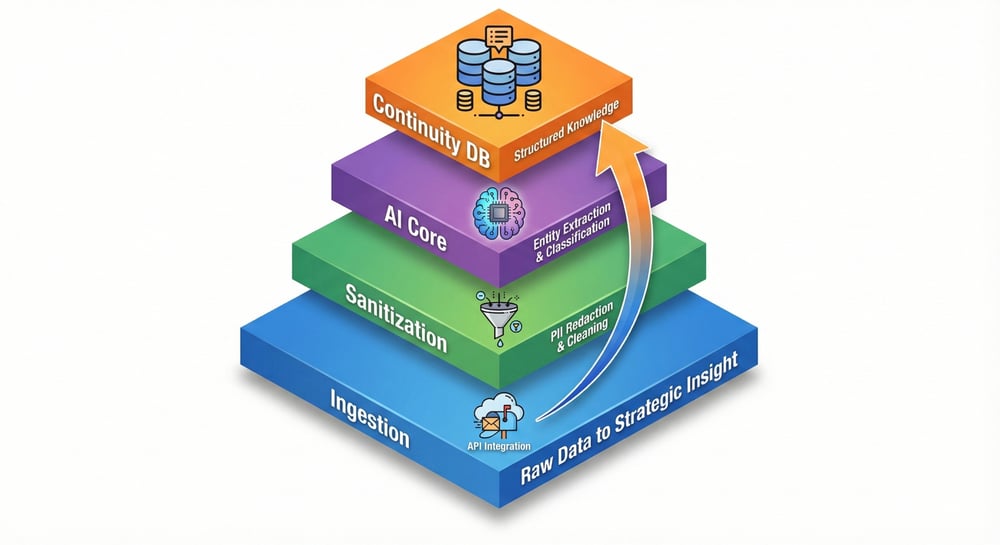
To operate reliably at scale, AI-driven continuity systems are typically structured in distinct layers, each designed to protect privacy while preserving operational context. This separation allows individual components to evolve over time without requiring the entire system to be rebuilt as technology or governance requirements change. The first layer securely ingests in-scope operational communication using enterprise-controlled methods that do not disrupt end users or bypass retention policies.
A second layer sanitizes and prepares the data by removing duplicate content, stripping signatures and reply chains, and redacting personal or nonoperational information before analysis. The intelligence layer then converts unstructured communication into structured operational knowledge by classifying issues, extracting key entities such as assets, vendors and deadlines, and reconstructing related threads to preserve decision context.
Finally, this information is stored in a continuity database that allows leaders to query project history, vendor interactions and unresolved issues without relying on individual inboxes, ensuring knowledge remains accessible even as roles change.
Beyond individual incidents, the broader value of AI-driven continuity is its ability to eliminate the operational blind spots created during turnover. When key employees leave, leadership often spends weeks reconstructing decision trails, re-establishing vendor relationships and discovering unresolved issues. This slows response times, increases the likelihood of repeated mistakes and drives unnecessary spending as teams unknowingly repeat work or restart conversations that already occurred.
By preserving the context behind daily communication, AI reduces this downtime and maintains stability during transitions. Leadership gains immediate visibility into active obligations and next steps rather than relying on partial memory or hoping someone recalls the status of a project. AI’s value extends further when organizations face budget-driven role consolidation.
Budget constraints often require responsibilities to be redistributed when positions remain unfilled. Leaders frequently depend on limited information or personal familiarity to decide which team members can absorb additional duties. This increases the risk of overloading the wrong person. An AI continuity system can map tasks, vendor interactions, project ownership and communication volume for each employee, which provides leadership with an accurate picture of workload and capacity. AI can identify early signs of overload, highlight redundant tasks and forecast workload strain before responsibilities shift. This ensures that new duties are delegated based on accurate data rather than guesswork.
Introducing AI continuity systems requires thoughtful change management. Employees must understand that the system is not designed to evaluate performance or track behavior. Its purpose is to preserve knowledge, prevent disruption and support smoother transitions. Clear communication about what the system captures, what it excludes and how summaries are used prevents misunderstanding. Training managers on how to interpret AI-generated insights ensures consistent adoption.
As organizations depend more on AI for turnover transitions and workload decisions, governance becomes essential.  Employees should understand how their communication data will be used when roles change. Access should be limited to designated leaders. Original emails must remain unaltered and archived for audit purposes. These guardrails, combined with early involvement from HR and legal, ensure that continuity tools protect information without compromising rights.
 Legal alignment is equally important. Original communications must remain intact for retention and audit requirements. AI-generated summaries should be treated as derivative documents with clear traceability back to the source. Retention policies should define how long extracted knowledge is kept, who can access it and when it should be purged. With these controls in place, AI continuity systems strengthen compliance instead of creating new risks.
Organizations planning to adopt continuity-focused AI tools can follow a structured implementation approach.
First, identify which roles create the greatest operational exposure during turnover. Next, map the communication sources used by those roles. Work with HR and legal to establish exclusion rules and privacy protections. Begin with a focused pilot group to refine the model, assess accuracy and identify any false positives. Train managers on how to use the output for onboarding and for reallocating responsibilities. Once stable, expand the system to other departments.
As facility operations grow more complex and organizations face higher turnover and tighter budgets, relying on memory-based knowledge transfer is no longer sustainable. Lost context leads to mistakes, delays and inconsistencies that negatively impact cost, compliance and service quality.
 AI-driven continuity systems will evolve into predictive tools that identify high-risk roles, forecast turnover impact and automatically assemble onboarding packets. They will integrate with CMMS, building management systems, energy management systems and procurement platforms to link communication patterns with asset performance, vendor behavior and spending trends. FM will move from reactive knowledge recovery to proactive organizational intelligence.
By implementing continuity-focused AI tools with clear safeguards, organizations can protect themselves from costly disruption and maintain operational stability amid constant change. The result is a more resilient and informed FM operation — one in which essential knowledge remains with the organization instead of disappearing when an employee walks out the door.

Pablo Velazquez is a senior facilities leader with nearly two decades of experience guiding large, geographically distributed portfolios through operational transformation. He has led enterprise-level initiatives spanning cost governance, service reliability, organizational resilience and responsible adoption of emerging technologies. His perspective bridges facilities operations, financial stewardship and leadership decision-making at scale. Velazquez holds degrees in industrial engineering and philosophy and brings a systems-level approach to strengthening institutional knowledge and long-term operational stability.
Read more on Leadership & Strategy , Facility Technology & Data Management and Facility Operations or related topics Team Management , Succession Planning and Strategic Planning
Explore All FMJ TopicsRelated articles
-

Artificial Intelligence in FM
The stakeholder’s perspectiveBy Dr. Jake Smithwick & Dr. Kenneth Sullivan & Nneka Ubi05.01.2024 -
Mastering Change in Hybrid Environments
Insights from global operational leadersBy Meg Swanson09.02.2024 -

Plugged In
Solving the data disconnect in real estate and FMBy Amanda Muzzarelli & James Waddell07.01.2024