
 Membership
 Network
 Regional Sites & Affiliates


 Events
 Participate
 Resources

 Training
 Credentials
 Government


 Content Channels
 Tools
Tools


 Business Overview





Who Sees the Alert First?
Why visibility matters before problems escalate

Across virtually any kind of building, campus or portfolio, facility leaders are surrounded by more connected systems than ever before. Sensors, dashboards, building automation platforms, environmental monitoring systems, equipment controls, vendor portals and mobile alerts are now part of the modern facilities landscape. Yet one important question remains easy to overlook:
 A facility can have sensors and still leave leadership without clear operational visibility. A system may detect a change in temperature, water presence, vibration, humidity, power, air quality, energy-related conditions or equipment condition, but detection alone does not guarantee awareness. Data may exist, but it may not reach the right person. Alerts may be generated, but they may be routed to a vendor, a department, an equipment provider, a third-party service desk or a platform that only a limited group can access.
In other words, an organization may have technology in place and still remain partially blind.
For facility management teams, this creates a practical operational challenge.
.svg) This issue gains importance as organizations consider new automation investments. Before adding more connected devices, platforms or dashboards, FMs should understand whether existing information is reaching the people responsible for decisions. Automation can improve response, but only when the alert path, access rights, escalation process and documentation expectations are clear. Otherwise, organizations may add more technology without solving the underlying visibility problem.
This issue gains importance as organizations consider new automation investments. Before adding more connected devices, platforms or dashboards, FMs should understand whether existing information is reaching the people responsible for decisions. Automation can improve response, but only when the alert path, access rights, escalation process and documentation expectations are clear. Otherwise, organizations may add more technology without solving the underlying visibility problem.
Sensors are not the same as visibility
One of the most important distinctions in modern facility management is the difference between having sensors and having visibility.
 A sensor may identify a temperature change, water presence, vibration pattern, door status, humidity condition or other environmental signal. But visibility requires more than detection. It requires that information be delivered to the right people, in the right format, with enough context to support a decision. It also requires appropriate access controls, secure data handling and clear governance over who can view, route and act on condition information.
This distinction matters because many organizations already have some form of monitoring in place in their facilities such as HVAC controls, equipment-specific controls, vendor-managed dashboards, environmental sensors, energy management systems or specialized technology platforms. But those systems may not be integrated. They may not be visible to FM leadership. They may not share data across departments. They may not prioritize alerts by operational risk. They may not create a clear electronic audit trail for accountability, verification, trend analysis and future purchasing decisions.
As a result, FM may still discover problems through complaints, inspections, service calls, equipment alarms, visible damage or after-the-fact vendor reports.
That is the blind spot.
A facility can be full of technology and still lack a clear, independent view of changing conditions across critical spaces. A dashboard may exist, but if the right people do not see it, it does not create operational awareness. An alert may be generated, but if it is buried in a vendor portal or routed only to a third party, leadership may remain dependent on someone else to interpret and escalate the issue.
 FMs are often responsible for outcomes: occupant comfort, asset protection, uptime, safety, compliance support, cost control and operational continuity. But responsibility without visibility creates risk. If leadership is accountable for the condition of the built environment, then leadership also needs access to timely information about that environment.
Where FM & IT increasingly overlap
The FM function is also changing as buildings now contain more technology-dependent spaces. Computer labs, server rooms, telecom closets, network rooms, data storage areas, research labs, security rooms, equipment rooms and technology-enabled classrooms often sit at the intersection of FM and IT.
These areas are not purely “FM” and not purely “IT.” They are shared-risk environments.
A temperature issue in a server room may begin as a cooling or mechanical concern, but it can quickly become an IT availability issue. A water leak near a computer lab may begin as a building condition, but it can become an equipment, safety, operational or continuity issue. A humidity problem in a sensitive equipment area may involve facilities, IT, vendors and department leadership. A power fluctuation may affect building systems, technology infrastructure, research equipment, security systems or occupant operations.
In these environments, the question is not simply who owns the equipment. The question is who owns awareness when conditions begin to change. The issue is whether the organization is positioned to act proactively, or whether it remains dependent on after-the-fact reports, service calls, visible failures or vendor interpretations.
Large organizations often have multiple departments managing different spaces, systems, budgets, vendors and escalation paths. A campus may have many FMs and directors across different departments. A hospital may have separate teams for clinical operations, biomedical engineering, IT, FM, compliance and vendors. A municipality may manage older buildings, public safety spaces, pump stations, administrative offices and technology rooms across multiple locations. A school system may have aging facilities, limited staff and technology-dependent spaces that are not continuously observed.
This overlap raises practical questions.
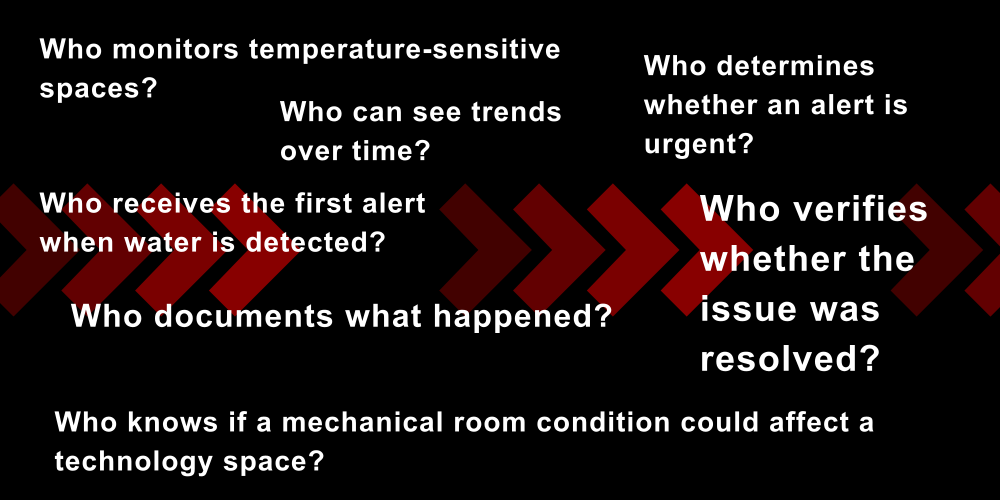 The more complex the environment, the easier it becomes for responsibility and visibility to separate.
Who sees the alert first?
In many facilities, alerts do not follow a simple path.
An alert may go to a vendor. It may go to a building automation platform. It may go to an equipment manufacturer. It may go to IT. It may go to facilities. It may go to a third-party monitoring service. It may go to one department but not another. It may be visible only to the person with access to a specific dashboard.
That may be acceptable in some cases. Vendors and service providers play important roles. Specialized systems may require specialized expertise. Not every alert needs to go to every person.
But facility leaders should understand the alert path before a problem occurs.
If a vendor receives the first alert, does the FM team receive it at the same time? If IT receives the alert, does FM know when a building condition may be involved? If FM receives the alert, does IT know when technology operations may be affected? If a third-party provider receives the alert, how quickly is the organization notified? If multiple parties receive alerts, who owns the response?
These questions matter because alerts are not just notifications. They are part of an operational accountability chain.
When the first alert is routed outside the organization, leadership may not have immediate awareness of changing conditions. When alerts are scattered across separate platforms, teams may not have a shared view. When alerts are not documented, it may be difficult to reconstruct what happened. When alerts are not prioritized, important signals may be treated the same as routine notifications.
The result can be confusion, delay, duplication or unnecessary cost.
FM leadership may receive a service recommendation, repair invoice or emergency escalation without having seen the underlying condition data that triggered the response. In some cases, the organization may be asked to approve action without independent visibility into what changed, when it changed and whether the condition is ongoing.
This does not mean vendors are the problem. It means the visibility structure matters.
FM leaders should know who sees the alert first, who sees it next, who is responsible for evaluating it and whether leadership has access to the information needed to make informed decisions.
Alert visibility questions facility leaders should ask
FMs can strengthen alert governance by asking practical questions before a problem occurs. These questions help clarify whether alerts are creating usable operational awareness or simply adding another layer of disconnected notifications.
-
Who receives the first alert when equipment or environmental conditions change?
-
Who receives simultaneous notice when the condition may affect more than one department?
-
Who owns the initial response?
-
Who verifies whether the condition is still active, worsening or resolved?
-
Is the alert automatically logged?
-
Is the response documented?
-
Can facility leadership view the condition history without relying only on a vendor report?
-
Are recurring alerts reviewed for patterns, root causes or repeated unresolved conditions?
-
Are vendor-managed alerts visible to appropriate internal stakeholders?
-
Are escalation rules documented before an urgent condition occurs?
-
Are alerts prioritized by operational risk or are all notifications treated the same?
-
Is there a clear process for reviewing alerts after an incident, complaint, disruption or repair?
These questions do not require every alert to go to every person. Instead, they help organizations determine whether the right people have timely access to the information needed to understand the condition, coordinate a response and maintain an accurate record. In connected facilities and portfolios, alert visibility should be designed intentionally, not discovered during an emergency.
A practical automation readiness question
As organizations evaluate automation, FM leaders may benefit from asking a simple readiness question: if this system detects a problem, who will know, who will act and who will be able to verify what happened?
That question can reveal whether the organization is prepared to use automation effectively. A connected device may detect a condition, but if the alert is routed to the wrong person, buried in a separate platform or disconnected from the team responsible for the outcome, the value of detection is reduced. Similarly, if alerts are received but not documented, reviewed or connected to a clear response process, the organization may still struggle to understand patterns over time.
Automation should not only increase the number of signals available to an FM team. It should improve the organization’s ability to see, evaluate, coordinate and respond. That requires a visibility structure that connects technology with operational responsibility.
This is especially important in organizations with multiple buildings, departments, vendors and systems. In those environments, the challenge is rarely one missing sensor or one missing dashboard. The larger issue is whether information moves through the organization in a way that supports accountability.

The future is accountable visibility
The next stage of facility management will not be defined only by how many sensors, dashboards or automated systems a building contains. It will be defined by whether those systems create accountable visibility.
As buildings become more connected, FMs should ask not only what systems are installed, but how information moves through the organization. Who sees the alert first? Who owns the response? Who verifies the condition? Who documents the outcome? Who can see patterns over time? Who is accountable when responsibility and visibility do not align?
Organizations still have blind spots when data exists but awareness does not. They have blind spots when alerts are routed away from the people responsible for outcomes. They have blind spots when FM and IT manage shared-risk spaces without shared visibility. They have blind spots when vendors see conditions before leadership does. They have blind spots when alerts become noise instead of actionable information.
The opportunity for facility leaders is to close those gaps.
A more resilient facility is not only one that detects more. It is one that helps the right people see what matters, understand it early and make better operational decisions.
That is the new facilities question: Who sees the alert first?

Angela Cabrera is the Founder and CEO of Alegna Technologies, Inc., a U.S.-based company specializing in IoT-AI enabled predictive maintenance solutions for healthcare, government, education, and critical infrastructure. She leads initiatives that combine smart sensors with hundreds of smart solutions, IoT platforms, and 80+ different types of smart sensors AI-driven for advanced data strategies to reduce critical equipment downtime, extend equipment life, improve compliance and daily operational efficiency. Cabrera collaborates with research institutions such as Georgia Tech and Georgia Southern University to accelerate innovation in FM. She has been recognized by Engineers Outlook, IAOTP and Marquis Who’s Who for her leadership in advancing smart infrastructure.
References
Top image via Getty Images.
Read more on Risk Management and Facility Operations or related topics Risk Management , Operations and Maintenance Planning , Maintenance Processes and Business Continuity
Explore All FMJ TopicsRelated articles
-

A New Approach
Improving business continuity with alarm managementBy Brad Freeman09.09.2024 -

Beware of Growing Cyberthreats
Why it’s time for stronger facility cybersecurityBy Andrew Harris & Eric Headington10.30.2024 -

Going Up?
Keeping elevators safe & compliantBy Dave Myers & Doug Taylor11.06.2024