Membership
 Network
 Regional Sites & Affiliates


 Events
 Participate
 Resources

 Training
 Credentials
 Government


 Content Channels
 Tools
Tools


 Business Overview





Why Operational Cost Control Breaks Down at Scale
A leadership mirror for organizations ready to be honest

Most leadership advice focuses on improving execution. Execution often fails not because teams lack discipline or capability, but because decision authority was never deliberately designed for scale. As organizations grow, operational cost volatility is driven less by frontline efficiency and more by how leaders distribute decision rights and risk across the enterprise.
Organizations lose control of cost when they lose control of how decisions are made. This shift tends to happen gradually and quietly as complexity increases.
At small scale, cost control is largely informal. A small group of leaders understands the assets, the customers, the risks and the tradeoffs. Decisions happen quickly because authority and accountability sit close together. When something goes wrong, it is usually clear who made the call and why.
As organizations grow, that clarity and speed begin to fade.
Authority is intentionally spread across sites, regions and newly created corporate roles to manage growth. Accountability, however, does not spread in the same way. It concentrates higher up the organization and appears later, often in the form of budget reviews, reports or post-mortems. The distance between the decision and its consequences grows wider.
Decades of research on decision rights and organizational design show that outcomes depend as much on who is empowered to decide as on the quality of information available.
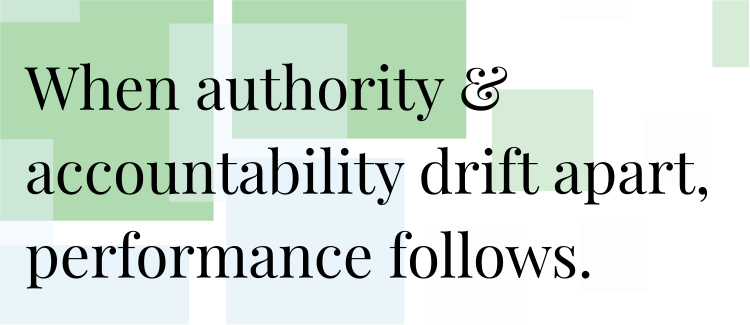
The pattern is familiar. Reporting improves. Processes multiply. Oversight increases. Yet total operational cost becomes more volatile, not less, as the point of decision and the point of impact move farther apart.
This is not a contradiction. It is a warning sign. At scale, operational cost is no longer primarily the result of how efficiently work is performed. It becomes the result of how decision authority is structured, who is allowed to act early, and what personal risk they assume when outcomes are imperfect.
The most expensive operational decisions are rarely approved outright. They happen because no one was clearly responsible for stopping them early. For a COO or CFO, the central question shifts from “How much are we spending?” to “Who, by design, is allowed to prevent this spend before it becomes unavoidable?”
How cost becomes inevitable
As organizations scale, cost overruns do not disappear. What changes is who is expected to act on them.
What was once a single decision made by a clearly identified individual becomes a sequence of consultations. Site input is gathered. Regional teams revisit the issue across multiple meetings. Finance evaluates projections and budget impact. Senior leaders are asked to align. Each step makes sense on its own. Together, they create a system in which cost prevention no longer has a clear owner and instead dissolves into competing perspectives.
This is not simply a management failure. It is a sign that operational governance has not kept pace with organizational complexity. As institutions grow, human behavior adapts. When people believe others are involved, they become less likely to step forward themselves.
Behavioral science describes this as diffusion of responsibility. Classic studies on the bystander effect, beginning with the work of Bibb Latané and John Darley, show that as more people are present, each feels less personal obligation to act, even in obvious emergencies. The same dynamic plays out inside organizations when many people touch a decision but no one owns it.
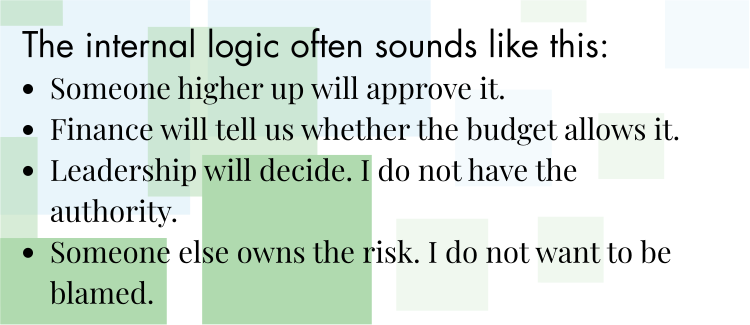
The result is decision drift
Early warning signs appear because developing issues are not addressed at the point of action. Minor failures repeat. Process issues recur because root causes were never resolved. Vendors or internal teams recommend larger scopes of work to stand behind the outcome, recognizing that the problem has moved beyond a temporary fix. Everyone sees the trend, yet action stalls, not because the issue is hidden, but because responsibility for stopping the deterioration belongs to no one in particular.
In these moments, the organization does not choose inaction. It chooses delay, waiting until someone is willing or forced to take ownership.
This pattern appears across operations, maintenance, logistics and technology.
Known infrastructure risks can drive repeated outages, lost revenue and wasted labor hours. Action stalls while responsibility is debated across security, infrastructure and application teams. Meetings focus on who owns the decision rather than whether the decision should be made.
 When reporting improves & control declines
Dashboards become more detailed. Reviews become more frequent. Leaders have more information than ever before. Yet cost volatility increases.
The assumption is often that better data will restore control. In practice, more information without clarity on who decides tends to multiply indecision. As options increase, so do reasons to wait.
Reporting shows outcomes, not authority.
A report can show that an asset failed three times in six months. It can show labor trends and cost curves. What it cannot show is who was empowered to stop the pattern or who would have been supported if that decision turned out to be imperfect.
Research on team decision-making consistently shows that adding information without clarifying decision ownership lengthens decision cycles. Visibility improves. Control does not.
As a result, organizations can know a problem exists for months or years without being structurally able to stop it. Knowledge accumulates while authority remains unclear at the moment prevention is cheapest.
The same dynamic appears in large expansion or transformation efforts. Multiple teams compete for resources. No one wants to slow momentum or say no. Leaders see spending accelerating beyond plan, yet responsibility for intervening remains diffuse. Each group waits for someone else to step in. By the time action is taken, the project has exceeded its original allocation by multiples, not because the risk was invisible, but because no one felt authorized to stop it.
Why reactive leadership becomes the default
Eventually, a developing issue becomes a visible failure. Operations are disrupted. Safety becomes a concern. Delaying is no longer possible.
At that moment, the decision environment changes.
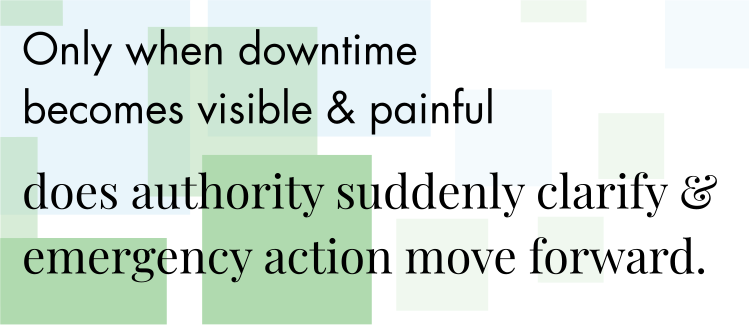
Urgency clarifies authority. Someone must act. Safety, uptime and continuity override optimization. Approval is immediate because no one wants to be the person questioning cost while operations are down and people are waiting. The risk of not acting now outweighs the risk of acting imperfectly.
This is not a failure of discipline. It is the most clearly governed decision path available.
Industry analyses consistently show that reactive maintenance costs roughly 25 to 30 percent more overall than preventive or predictive approaches once overtime, rush parts and unplanned downtime are included. Emergency repairs frequently cost three to five times more than planned work when the full impact of disruption is considered.
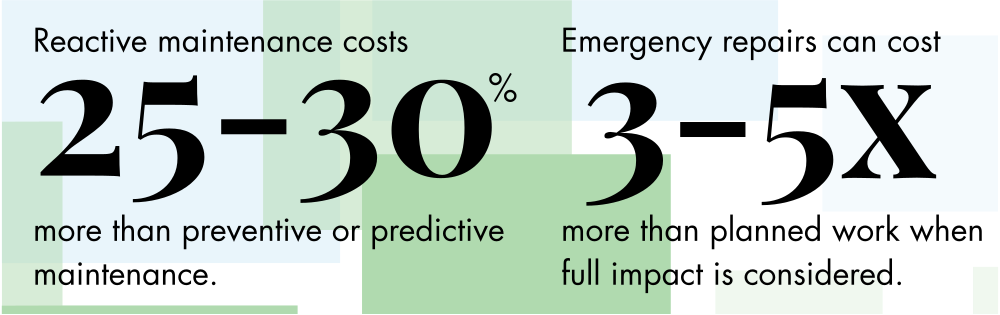 Run to failure may make sense for low-criticality assets. For critical systems at scale, reactive strategies increase total cost, downtime and risk.
Organizations default to emergency response not because they prefer it, but because emergencies are the only moments when authority is unambiguous. When deliberate action feels risky, reactive action feels safe. Over time, what was meant to be exceptional becomes routine.
The role of informal control
In many organizations, the absence of clear decision ownership is masked by experience.
Long-tenured leaders compensate for structural gaps with judgment built over years. They know when to intervene, when to escalate and when to push back. They redirect spend and act early in ways that never appear in formal process documentation.
As long as those individuals remain, cost appears controlled. When they leave, the illusion breaks. Decision-making slows. Institutional knowledge disappears. New leaders hesitate, unsure where authority truly sits. Emergencies increase. Costs rise.
Research on psychological safety shows that when people expect personal or career consequences for imperfect outcomes, they avoid surfacing problems and rely on a few experienced individuals to absorb risk. This is why succession planning and knowledge transfer are not soft topics. They are cost and risk topics.
When responsibility exists without protection
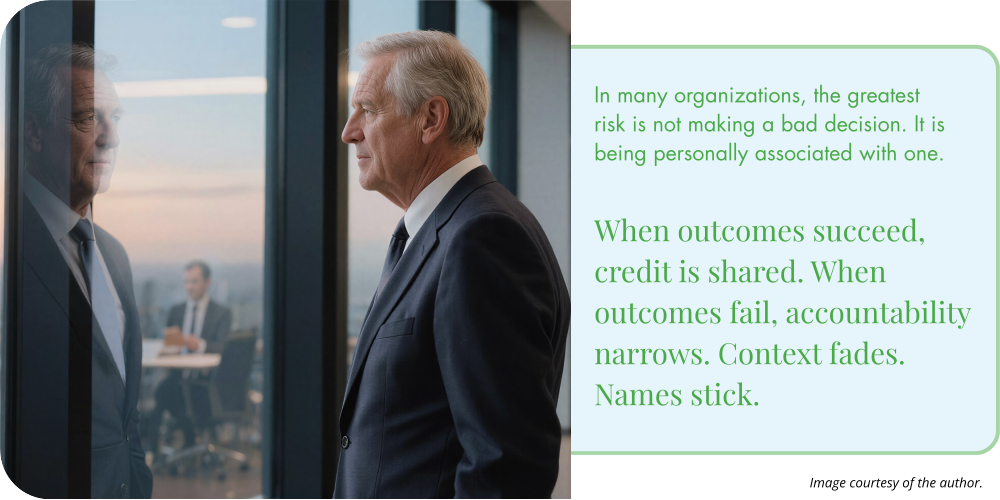
Leaders learn this pattern even if no one states it explicitly. They learn that acting quickly increases personal risk. They learn that delay, escalation and deferral feel safer. Asking for more data is rarely punished. Acting on imperfect information often is.
Research on psychological safety shows that when people expect interpersonal or career harm for being wrong, they rationally avoid initiative. In those environments, escalation and delay are not failures of leadership. They are predictable responses to risk.
Fear rarely announces itself as fear. It shows up as process. More reviews. More alignment. Decisions that never quite close.
During economic uncertainty, this dynamic intensifies. Scrutiny increases. Margins tighten. Self-preservation begins to outweigh long-term stability. Emergencies become the safest decision path.
This is how organizations end up approving high-cost emergency actions more easily than lower-cost preventive ones. The real constraint on cost is not budget, data or talent, but the unwritten rules about who carries risk when a decision goes wrong.
What leaders can do now: Holding a mirror to decision ownership exercise
This evaluation is not an audit, nor is it an employee performance review. It is a leadership diagnostic meant to show how decisions are made inside the organization. The purpose is to surface where authority is clear, where it breaks down and where fear quietly influences outcomes.
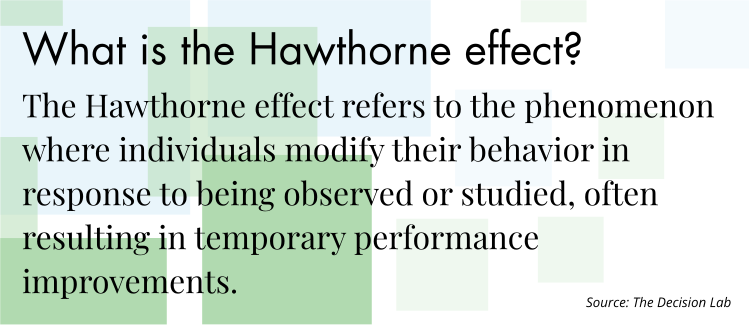
Be intentional about framing before getting started. When people think they are being evaluated, they tend to adjust their answers to sound safe or compliant. Research on the Hawthorne effect shows that behavior can change simply because people know they are being observed. To reduce that distortion, present this exercise to document current operating practices for training, updating contact information and onboarding. Be explicit that there are no right or wrong answers and that the goal is to capture how the process works today.
Step 1: Establish the emergency baseline
Start with a scenario that would immediately disrupt operations and cannot reasonably wait.
Examples include:
-
A high-volume production or retail site going offline with immediate revenue impact.
-
Data center failure that seizes internal communications.
-
A production line shut down after a forklift collision damages critical equipment.
Using the same scenario, ask individuals at multiple levels:
-
Who has the authority to take immediate action to solve this problem?
-
Who is informed about what happened after the decision is made?
-
Who reviews the outcome and the decisions that were taken?
This step shows how decisiveness works when urgency removes ambiguity.
Step 2: Introduce a developing risk
Now identify a known but nonurgent issue that is increasing in severity, requires approval, and cannot be solved with a simple repair.
Examples include:
-
Increasing severity of repeated alarms tied to recurring equipment failure.
-
End-of-life accounting software keeps causing delays in invoice processing and payments.
-
Audits that continue to surface the same failure points year after year.
Ask again:
-
Who can approve of the steps needed to solve this problem?
-
Who must be consulted before acting?
-
What circumstances or departmental approvals can delay the decision?
-
Who would be responsible if nothing is done?
This is where ownership is most often tested, and where it is most often lost.
Step 3: Observe behavior, not titles
Pay attention to how people behave, not what their role descriptions say.
-
Who asks for more information without committing to a decision?
-
Who escalates instead of owning the choice?
-
Who defers by pushing it to future meetings or the next budget cycle?
-
Who closes the loop by deciding, assigning ownership and authorizing action?
Pay particular attention to roles that advise but never clearly approve or deny. Input without ownership is rarely neutral.
Step 4: Compare the decision paths
Compare how emergencies are handled versus developing risk.
Look at speed, number of people involved, clarity of authority and final cost. A hard truth often emerges:
Why is it easier to approve of a higher-cost emergency than a lower-cost preventive action?
Step 5: Identify where fear enters
Fear rarely sounds dramatic. It often sounds reasonable.
-
We do not want to set a precedent for how this is handled in the future.
-
This is not the right time.
-
We should wait for more data to know if this is the right course of action.
-
Leadership should weigh in.
These are not character flaws. They are signals that responsibility exists without protection.
For leaders, the question is not only whether costs can be reduced. It is whether the organization has clearly decided who is allowed to prevent cost before it becomes unavoidable and how that person will be supported when outcomes are imperfect.
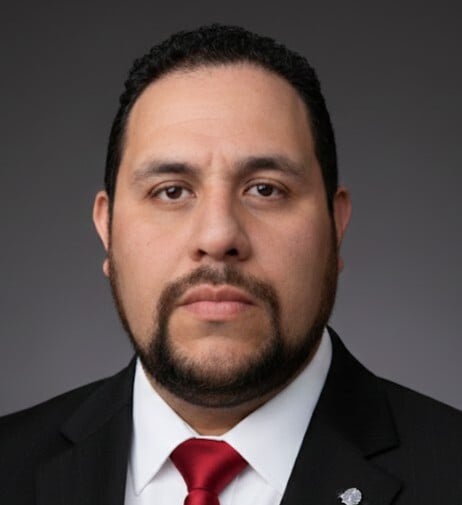
Pablo Velazquez is a senior facilities leader with nearly two decades of experience guiding large, geographically distributed portfolios through operational transformation. He has led enterprise-level initiatives spanning cost governance, service reliability, organizational resilience and responsible adoption of emerging technologies. His perspective bridges facilities operations, financial stewardship and leadership decision-making at scale. Velazquez holds degrees in industrial engineering and philosophy and brings a systems-level approach to strengthening institutional knowledge and long-term operational stability.
References
Top image via Getty Images.
Read more on Finance & Business , Facility Operations , Communication and Leadership & Strategy or related topics Asset Management , Communication Management , Problem Solving and Operational and Capital Budgeting
Explore All FMJ Topics