
 Membership
 Network
 Regional Sites & Affiliates


 Events
 Participate
 Resources

 Training
 Credentials
 Government


 Content Channels
 Tools
Tools


 Business Overview





A Better Online
The data center construction boom

The construction sector is undergoing a fundamental and historic transformation, driven by an unprecedented and accelerating demand for digital infrastructure. Projections now indicate that global demand for data centers will nearly triple by 2030, reshaping the built environment. As artificial intelligence shifts rapidly from experimental phases to fully operational integration across industries, data centers have solidified their status as the most vital asset in the global economy.
The grid sets the schedule
Nevertheless, the infrastructural and resource requirements to sustain this expansion are imposing. Power demands are climbing to extraordinary levels, with global data center power usage expected to increase to 219 gigawatts (GW) over the next five years. To put this load into perspective, that is enough energy to power roughly 180 million U.S. homes.
Currently, more than 2,300 GW of generation and storage capacity are waiting in interconnection queues, and historically fewer than 13 percent of those projects reach completion. Average wait times have passed five years, and in some regions the queue stretches to seven years. The outcome is a building that is finished and fitted out, but unable to power its racks. Power availability has overtaken civil works as the variable that decides time-to-market.
This is not a forecast. Directors working on live projects describe completed infrastructures sitting idle while the utility connection catches up, simply because grid infrastructure cannot keep pace with the construction boom.
This situation creates an urgent reality: the industry is facing a delivery deficit that traditional construction timelines simply cannot resolve. The core problem is no longer about finding customers, but about the physical inability to bring facilities online fast enough to meet these presigned commitments.
Behind-the-meter generation
Behind-the-meter (BTM) power describes generation and storage placed on the customer’s side of the utility meter. Instead of drawing all its electricity through the grid, a facility produces part, or in some cases all, of what it needs on site. The conventional model works the other way: the building connects to the network through dedicated substations, switchgear and distribution, and the operator pays for metered consumption. That arrangement held up well when demand grew slowly and spare grid capacity was easy to find. However, high-density digital infrastructure has changed both conditions.
An on-site configuration places energy assets directly within the site boundary, so the operator controls power availability from the early stages of development. It reduces exposure to interconnection queues, transmission limits and congestion, and it opens a faster route to operation. The grid does not disappear from the picture; it becomes an optional backup rather than the single point of dependency.
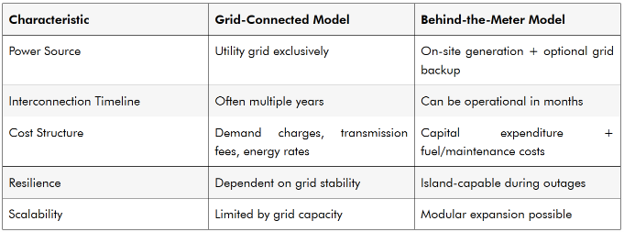 Figure 1. Comparison between behind-the-meter power and grid-connected models. Source: (Hanwha, 2026)
Microgrids
A critical concern when shifting away from the utility grid is the ability to guarantee baseload power: the continuous, 24/7 electricity supply required to keep mission-critical data center operations running without interruption. While the public grid traditionally provides this constant stability, relying solely on isolated, renewable, BTM sources present a reliability gap due to their intermittent nature. To prevent baseload disruptions, a successful BTM strategy is never designed around a single source. Instead, it is architected as a hybrid ecosystem, integrating dispatchable generation with renewable energy and battery energy storage systems (BESS), so developers can create a localized power network that seamlessly replicates the 24/7 reliability of the public grid.
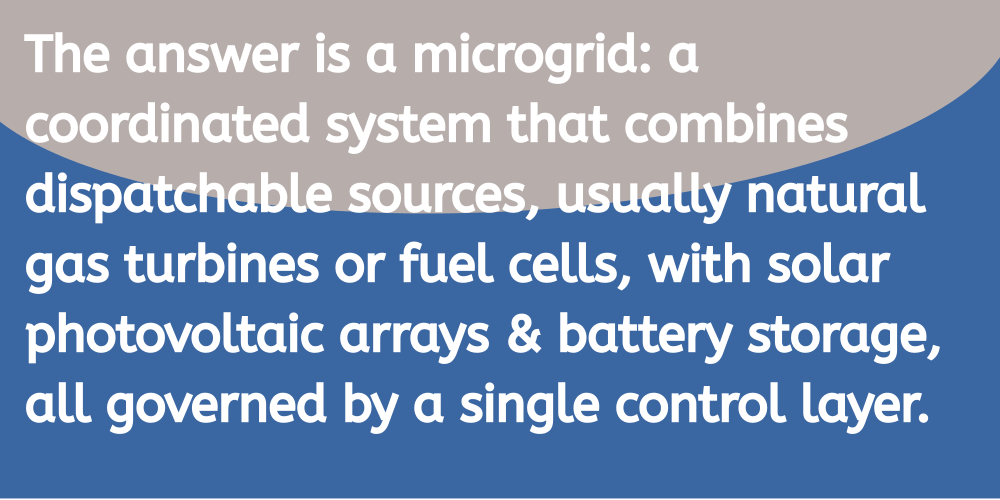
The turbines or fuel cells supply firm baseload power; the solar and batteries trim fuel use and smooth demand peaks; the controller decides moment to moment how each asset is used and when, if ever, to draw from the grid.
A complete data center microgrid usually brings together five parts. Primary generation, from gas turbines or fuel cells, carries the building’s full electrical load. Renewable integration, typically solar, cuts fuel use and emissions. Battery storage stabilizes power quality, absorbs demand spikes and bridges the gap during transitions. An intelligent control layer forecasts load, dispatches generation and governs how the system interacts with the grid. And switchgear with protective relays lets the facility move smoothly between grid-connected and islanded modes. The control layer is what separates a microgrid from a basic backup generator. A simple solar array shuts down for safety when the utility fails. A microgrid detects the failure, disconnects and reconfigures itself to run on local resources without an interruption, then resynchronizes and reconnects once the grid stabilizes.
Configured this way, the microgrid can run in island mode, fully independent of the utility, for as long as fuel and maintenance allow. That capability is what turns on-site generation from a cost-saving idea into a delivery strategy.
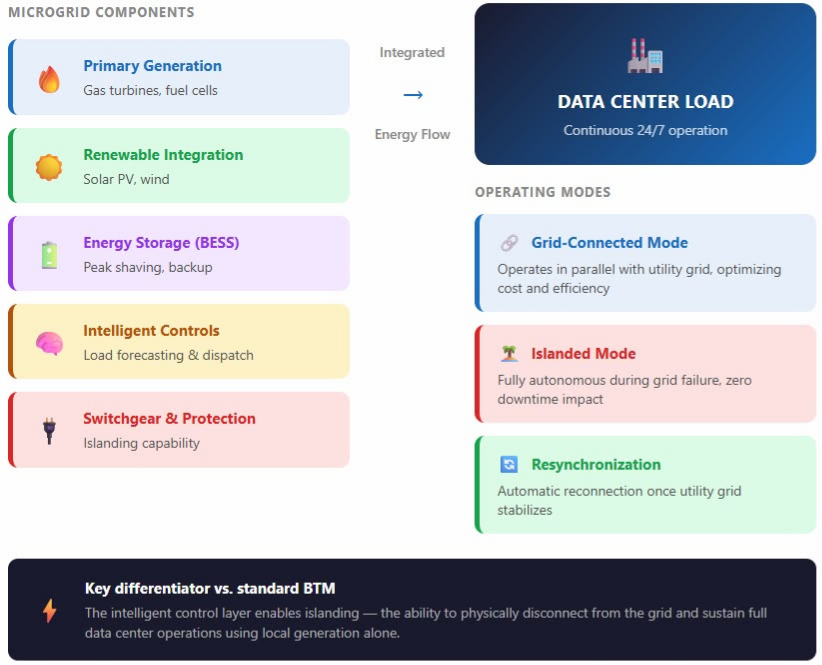 Figure 2. Microgrid architecture for mission-critical data centers.
Energy planning
Instead of trying to figure out the electrical supply as an afterthought halfway through construction, power generation should be treated as one of the cores of the project.
How does this strategic framework become a physical reality on the job site? Translating these plans into an operational facility requires moving away from traditional, step-by-step building methods and adopting a more dynamic, four-phase execution strategy:
-
Define their power and energy consumption needs: forecast the heavy electrical loads driven by AI operations, anticipate future capacity expansions, set strict redundancy standards, and align with corporate environmental goals.
-
Evaluation of the location: analyze spatial limitations, access to existing utility networks, local zoning laws and geographic characteristics to determine what is actually buildable.
-
Match the technological selection to the facility's operational profile: forecast daily usage patterns, regional fuel accessibility, carbon emission limits and the project's overall budget.
-
Execution timeline and proactive risk mitigation: plan a phased rollout so that the data center can activate its initial server halls while the remaining energy infrastructure is still under construction. This strategy also guarantees that the project can keep moving forward even if there are unforeseen disruptions in equipment supply chains or construction schedules.
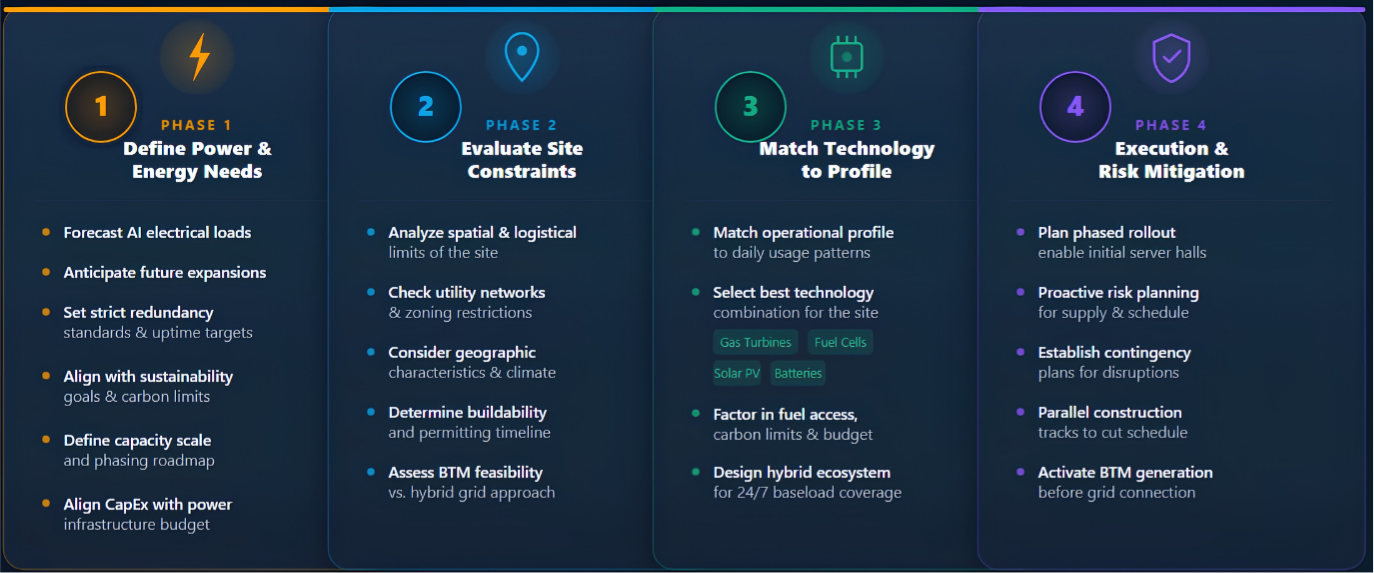 Figure 3. Four-phase energy planning sequence to accelerate data center deployment.
Site selection for power availability
A few site characteristics decide what is feasible. Direct access to a natural gas pipeline is close to mandatory for a facility that intends to run turbines or fuel cells continuously. Staying within reach of major transmission lines is still worth doing even for an independent site, because it provides a backup path and the option to export surplus power. Land is a real constraint, as solar arrays and heavy generation equipment need large plots. Reliable local water supports both cooling and certain generation methods. Local sunlight and wind determine whether renewables make practical sense at all. And the permitting environment governs how fast any of it can be built, which is why a region with abundant gas but a slow zoning process may still be the wrong choice. Screening sites against these factors early is what keeps the energy strategy from collapsing at the first regulatory hurdle.
What this means for facility teams
The numbers behind the schedule case are concrete. The conventional grid-connected path exposes a project to interconnection timelines of three to seven years across major markets. Natural-gas systems built from modular equipment can begin generating in 12 to 24 months. A 500-megawatt (MW) facility that adopts a flexible BTM approach can reach full operation three to five years ahead of the interconnection route. In a market where computing hardware loses value quickly and presigned capacity carries penalties for late delivery, that compression is a direct protection of the investment.
 It also helps to treat the utility connection as a hedge rather than the plan, pursuing it in parallel so that a future grid upgrade adds optionality instead of sitting on the critical path. Power has quietly become the part of the project that takes the longest. Teams that plan for it first will open their facilities while the rest of the market is still waiting in line.

Andrea Gutiérrez Modamio is an Industrial Engineer who holds a bachelor's degree in industrial technologies and economic analysis from Universitat Politècnica de Catalunya (UPC) and Universitat Pompeu Fabra (UPF), in Spain. She is completing her master's degree in industrial engineering, having conducted her final research at the Illinois Institute of Technology. Her work focuses on optimizing data center construction through a 70/30 standardization fast-track model.

Dr. Gurram Gopal, Ph.D., is the department chair and professor of information technology and management at the Illinois Institute of Technology with a keen interest in technology driven sustainable logistics and facilities management. He has published extensively and has presented at academic and industry conferences. He received a Fulbright Scholar Award to teach and conduct research at Galway Mayo Institute of Technology in Ireland in 2011-2012 and recently completed another Fulbright Scholar Award teaching and conducting research at ISM University, Lithuania. Dr. Gopal developed marketing strategies for some of the world’s largest pharmaceutical companies as a strategy consultant and manager for ZS Associates and worked in strategic marketing, supply chain management and strategic quality at Tellabs Inc. He holds a bachelor’s degree in chemical engineering from the Indian Institute of Technology, Madras and master’s and doctorate degrees in industrial engineering from Northwestern University.
References
Berkeley Lab. (2024). Evaluating the increase in electricity demand from data centers. U.S. Department of Energy.
CBRE. (2025). North America Data Center Trends, H1 2025.
datacenterHawk. (2026). Interconnection queue timelines across major U.S. markets.
Hanwha. (2026). Behind-the-meter and grid-connected power models compared.
Orrick. (2025). Fuel cell availability in behind-the-meter data center deployments.
Woodway Energy. (2025). Deployment timelines for modular natural-gas generation.
Top image via Getty Images. Figures 1-3 courtesy of the author.
Read more on Facility Technology & Data Management and Facility Operations or related topics Data strategy and information management and Energy
Explore All FMJ TopicsRelated articles
-

Artificial Intelligence in FM
The stakeholder’s perspectiveBy Dr. Jake Smithwick & Dr. Kenneth Sullivan & Nneka Ubi05.01.2024 -

Don’t Drop the Ball
How a CMMS can make or break an FM organization’s successBy Michael Carmean09.17.2024 -

Beware of Growing Cyberthreats
Why it’s time for stronger facility cybersecurityBy Andrew Harris & Eric Headington10.30.2024