
 Membership
 Network
 Regional Sites & Affiliates


 Events
 Participate
 Resources

 Training
 Credentials
 Government


 Content Channels
 Tools
Tools


 Business Overview





Advancing FM in Kazakhstan
Strategic insight from practice

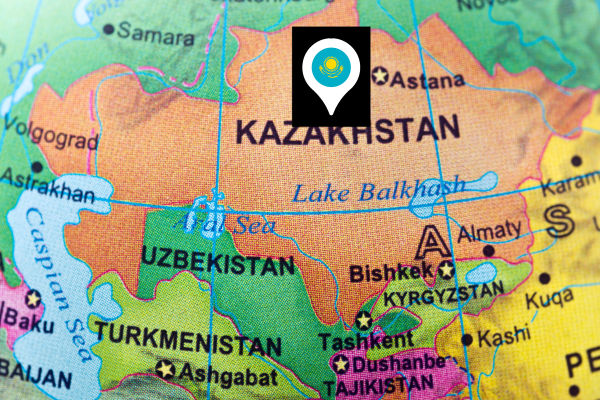
In recent years, Kazakhstan’s built environment - spanning heavy industry, commercial real estate and public infrastructure - has grown in complexity, scale and sophistication. Historically, facility management in the country has focused on keeping the lights on and maintaining critical equipment, especially in the oil and gas sector. Yet, this paradigm is shifting. The rise of sustainability mandates, digital technologies and a more strategic view of asset lifecycle is pushing FM to the forefront of organizational value creation.
Operating in Kazakhstan’s unique environment - characterized by extreme climate, dispersed infrastructure and legacy assets - demands an FM model that is resilient, data-driven and aligned with international standards. Facility leaders who can bridge local realities with global frameworks will be critical to delivering efficiency, risk mitigation and long-term sustainability.
 The state of FM in Kazakhstan
FM maturity trajectory
-
-
Adoption of ISO 41001 (Facility Management) and ISO 50001 (Energy Management) have begun in major industrial and commercial environments, signaling that more organizations see FM as strategic rather than purely operational.
-
Outsourcing of FM services is growing, especially in large industrial clusters and corporate campuses, often through partnerships between local firms and global service providers.
-
Safety and operational integrity remain high priorities, particularly in oilfields and manufacturing sites, driven in part by international operators with rigorous HSE regimes.
-
Market dynamics
-
-
Kazakhstan’s commercial real estate sector is expanding rapidly, with the opening of modern warehouses, logistics centers, and multi-use business complexes. For example, the AIFC reports that more than 256,000 m² of warehouses were commissioned in 2022, with projected additions of 700,000 m² of quality warehouse space by 2024–2025.
-
Despite this growth, local FM capacity remains fragmented. Many organizations still lack a fully developed FM function, or they treat it as a cost center rather than a vehicle for operational optimization.
-
Challenges & strategic responses
FM in Kazakhstan faces several challenges that can be solved with comprehensive, strategic responses informed by industry practice.
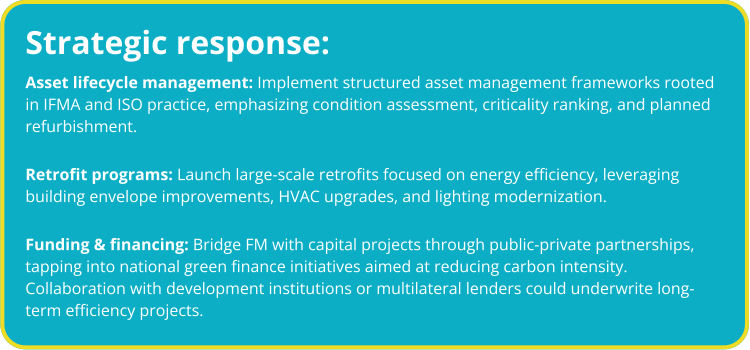
Challenge 1: Infrastructure age & capital deterioration
Many industrial, commercial, and public buildings in Kazakhstan date from the Soviet era. Furthermore, the energy infrastructure - including thermal power plants and district heating networks - is aging: recent national modernization plans cover more than 80,000 kilometers of energy networks, with a goal to reduce asset depreciation from approximately 65 percent to 40 percent over the next five years.
Challenge 2: Energy-intensive building stock
Kazakhstan’s building sector is highly energy-intensive. In Almaty alone, public buildings consume a substantial share of energy: district heating accounts for roughly 65 percent of energy use in public buildings, and electricity makes up another 21 percent.
Residential energy use per square meter is very high compared to European standards: IEA data suggest that average residential buildings in Kazakhstan consume about 270 kWh/m², significantly more than the EU average of 100–120 kWh/m².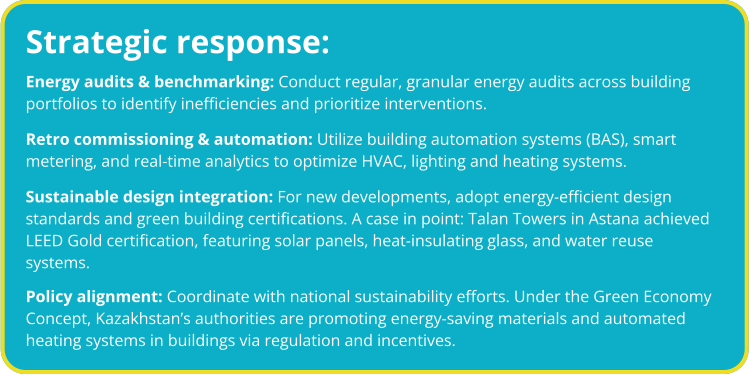
Challenge 3: Workforce skills gap
There is a shortage of FM professionals in Kazakhstan with expertise in digital FM, predictive maintenance and energy management. This gap undermines the ability to move from reactive maintenance to strategic, data-driven facility operations.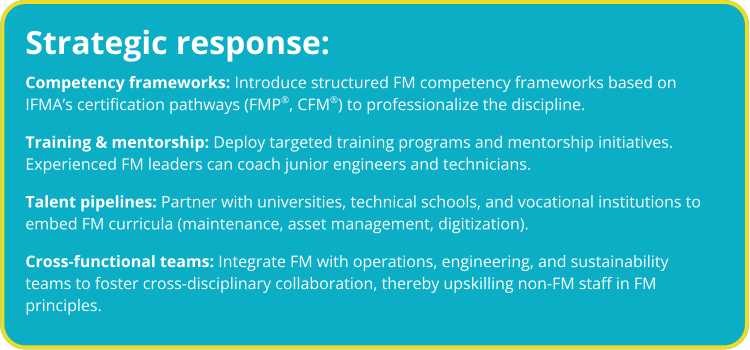
Challenge 4: Remote, distributed & harsh environments
Kazakhstan’s geography includes vast desert oilfields, remote extraction sites, and mountainous regions. Such dispersed facilities pose logistical and operational challenges, especially in harsh climate conditions.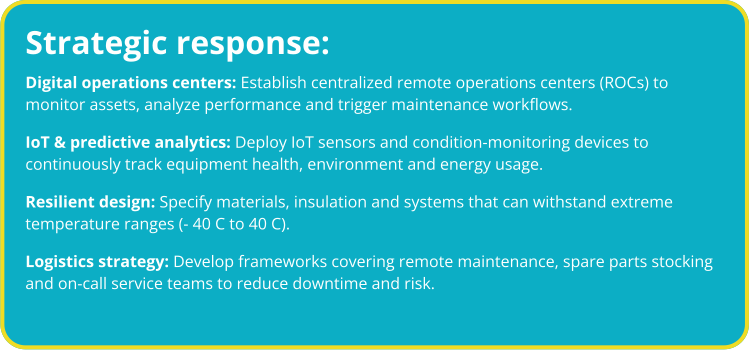
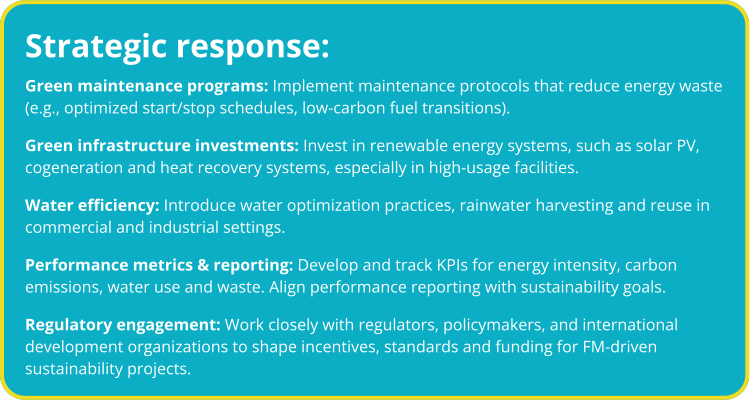
Challenge 5: Sustainable development & carbon ambition
Kazakhstan has committed to achieving carbon neutrality by 2060, placing FM teams at the forefront of enabling the country’s green transition. Yet, progress remains uneven, and large-scale deployment of renewable technologies within building portfolios is still nascent.
Digital transformation as a strategic lever
The convergence of FM & digital technology is a powerful enabler for modernization in Kazakhstan:
-
-
IoT & data analytics: Real-time data collection via sensors enables continuous condition monitoring (vibration, temperature, humidity), which feeds into data analytics platforms to predict failures and optimize maintenance cycles.
-
Cloud-based CMMS: Transitioning from spreadsheets and paper-based logs to cloud-based computerized maintenance management systems (CMMS) centralizes asset lifecycle data and improves transparency.
-
Remote operations: Remote operations centers (ROCs) can provide 24/7 monitoring and centralized decision-making for geographically dispersed assets, reducing response times and enabling predictive interventions.
-
AI & machine learning: Predictive maintenance driven by AI can reduce unplanned downtime, improve safety, and optimize maintenance cost. Emerging global studies show that AI-driven HVAC optimization can reduce energy consumption by 30–40 percent in some settings (which is directly relevant for high-energy buildings in Kazakhstan).
-
Digital energy platforms: National initiatives are underway: in 2024, Kazakhstan launched pilot modules for digital monitoring of subsoil users, licensing, and renewable energy reporting.
-
FM’s role in Kazakhstan’s sustainability agenda
FM is a linchpin in achieving Kazakhstan’s sustainability goals. As the country modernizes its infrastructure and energy systems, FM can influence resource consumption, emissions and long-term resilience.
Institutional alignment
-
-
Energy-intensive companies (e.g., in oil & gas) are already pushing for more efficient operations: a major Kazakh producer reported over 124 million gigajoules in total energy consumption in 2023, down 6 percent year-on-year following efficiency measures.
-
National energy sector modernization plans include upgrading thermal plants and reducing losses, which will intersect with FM-led efficiency and monitoring programs.
-
Building-level impact
-
-
In Almaty, public building energy consumption is heavily skewed toward district heating; improving FM-led controls and metering of heat systems could significantly reduce consumption and cost.
-
According to the United Nations Development Programme (UNDP), retrofitting and investing in energy-efficient construction in residential buildings could require US$15 billion in investment across multi-unit residential blocks.
-
Integrating IFMA frameworks for strategic growth
Adoption of IFMA-aligned practices can accelerate FM maturity in Kazakhstan:
1. Competency certification: Implementing FMP (Facility Management Professional) or CFM (Certified Facility Manager) programs raises the baseline of professionalism and supports technical-skills development.
2. Life cycle asset management: Use IFMA’s asset life cycle models to guide strategic planning, refurbishment and renewal for industrial and commercial portfolios.
3. Strategic facility planning: Embed FM into business strategy - link FM investment to business goals such as cost reduction, risk mitigation and sustainability.
4. Benchmarking & metrics: Establish performance measurement frameworks to track key FM indicators (energy, reliability, downtime, risk).
5. Governance structures: Create FM steering committees or working groups that align facility operations with corporate governance, capital planning and sustainability objectives.
Outlook & recommendations
Scaling digital FM
Kazakhstan’s FM sector should continue scaling its digital infrastructure: more widespread IoT adoption, predictive maintenance and integration of AI tools. This will require investment as well as a cultural shift toward data-driven decision-making. ROCs will be critical, especially for rural and industrial facilities.
Green FM expansion
FM teams must lead large-scale sustainability initiatives, including retrofits, energy audits and renewable energy deployment. Partnerships with global financiers, government programs and multilateral agencies will be instrumental in securing capital for green investments.
Building local talent capacity
Growing FM expertise is essential. Structured certification, training programs and university partnerships will help create a pipeline of skilled professionals able to operate in high-performing, modern FM environments.
Policy & regulation engagement
FM leaders should engage with policymakers to influence regulations for energy efficiency, building codes and sustainability standards. Their operational insight can shape more realistic, effective policies.
FM's future in Kazakhstan
Kazakhstan is at a pivotal juncture in its FM evolution. As built environments become more complex, energy demands grow, and sustainability imperatives tighten, FM is no longer just about maintenance — it is a strategic lever for resilience, efficiency, and long-term value.
By addressing challenges proactively (aging infrastructure, skills gaps, energy intensity), implementing robust digital strategies, and aligning with global frameworks such as IFMA, FM practitioners in Kazakhstan can transform their organizations. The integration of professional standards, data-driven operations, and sustainability orientation will be critical to elevating FM from cost center to a value-creating function that drives national and corporate performance.

Bakytzhan Orazaliyev, MSc, FMP, PMP, CSSBB, is a senior facilities management leader, serving as the head of facilities and technical operations for a major organization in Kazakhstan & Central Asia region. An active advocate for the profession, Orazaliyev is passionate about integrating digital transformation and sustainable operational strategies to achieve high-performance facilities. He focuses on leveraging technology to drive operational efficiency and professional development, thereby advancing the FM industry in emerging international markets and positively impacting organizational success and the workplace experience.
Read more on Facility Operations , Sustainability and Leadership & Strategy or related topics Workforce Development and Operational and Capital Budgeting
Explore All FMJ Topics