
 Membership
 Network
 Regional Sites & Affiliates


 Events
 Participate
 Resources

 Training
 Credentials
 Government


 Content Channels
 Tools
Tools


 Business Overview





Ask the Experts
Why does firefighting become the FM operating model?

Firefighting is often treated as a behavior problem. Leaders are encouraged to delegate more effectively, improve planning, manage time better or hold employees accountable for preventive work. Those interventions may help at the margins. But persistent firefighting signals a fundamental operating-model issue and acknowledging this can help FM leaders feel understood and supported in addressing root causes.
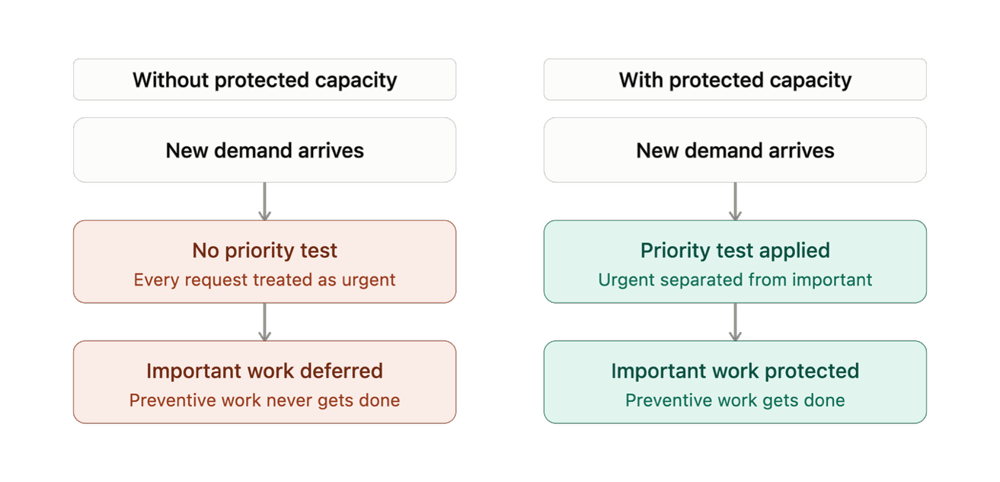
Reactive work expands when the organization has no reliable way to control demand, set priorities or protect capacity for important but non-urgent work. Every interruption may be legitimate. A failed system, a safety issue, an executive request, a late event change or an unexpected project requirement cannot simply be ignored. The problem arises when each exception enters the system independently, and FM is expected to absorb the combined effect without any mechanism to decide what gets displaced.
In that environment, urgent work consistently defeats important work. Preventive maintenance is deferred. Asset information remains incomplete. Procedures are not updated. Supervisors spend their time coordinating exceptions rather than improving the system. Managers become escalation points. Senior leaders are pulled into operational decisions because priorities have not been resolved elsewhere. The daily schedule is written and rewritten by whoever most recently escalated.
Firefighting is not the opposite of the operating model.
In many institutions, it has become the operating model, one urgent request at a time.
The department may appear highly responsive. Employees work hard, solve problems and protect the institution from disruption. Yet that responsiveness can conceal structural overload. Heroic effort becomes the mechanism by which the organization compensates for weak governance. Because the immediate crisis is resolved, the institution receives little signal that the operating model is deteriorating, and the people absorbing the strain are rarely the ones reporting on department performance.
Firefighting also reproduces itself. Deferred preventive work creates more failures. Incomplete planning creates more change orders and schedule conflicts. Constant interruption increases errors and rework. Employees stop trusting plans because plans are routinely displaced. Eventually, reactive behavior is no longer an exception. It becomes the most rational way to operate within the system they have been given, and new hires learn the real rules within their first month regardless of what the process manual says.
The answer is not to eliminate all urgent work. FM exists partly to manage uncertainty and restore service when conditions change. The objective is to distinguish genuine emergencies from unmanaged demand and to prevent every request from acquiring emergency status through escalation. That distinction must be visible day-to-day, not just written into a policy that nobody consults under pressure.
That requires a small number of institutional disciplines: a common intake process, explicit priority criteria, protected capacity for preventive and strategic work, defined escalation pathways and visible trade-offs when new work is added. It also requires leadership above FM to accept that not every demand can be satisfied immediately and that adding a priority must sometimes displace another. Without that agreement at the top, any intake process FM builds on its own will be bypassed the first time someone with enough seniority wants something faster.
Leaders should also examine the signals their own management practices send. When the people who interrupt the system receive the fastest response, while those who follow the process wait, the organization teaches stakeholders to escalate. When every missed expectation is treated as an FM failure, but no one is required to reconcile competing expectations, the institution rewards responsiveness while withholding the conditions needed for disciplined execution. Supervisors who reward the loudest request over the most important one are not managing badly; they are managing rationally inside a system with no other way to set priority.
A useful diagnostic question is: what work is repeatedly deferred because it is important but never urgent? The answer often identifies the capability the organization is slowly sacrificing. It may be preventive maintenance, life cycle planning, staff development, data quality, standardization or long-range capital coordination. Track that list for three months, and the pattern usually explains more than any incident report.
Firefighting is rarely evidence that FM employees lack planning. More often, it shows that the organization has designed a system in which planning has no protected authority. Until the demand and priority mechanisms change, exhorting people to be more strategic asks them to overcome the operating model through personal effort.

Grant Sommerfeld, CFM, has almost 20 years of experience as a chief facilities officer in post-secondary, healthcare and municipal government, with demonstrated skills in managing complex facilities and large facilities management departments. In 2023, he transitioned from practitioner to consultant. He established Executive FM Consulting to support senior FM leaders in understanding, managing, and enhancing the performance of their facilities management operations. Sommerfeld holds an MBA and is a Certified Management Consultant (CMC), Certified Facility Manager (CFM), Certified Educational Facilities Professional (CEFP), and Chartered Facilities Management Surveyor (FRICS).
Read more on Facility Operations or related topics Operations and Maintenance Planning
Explore All FMJ Topics