
 Membership
 Network
 Regional Sites & Affiliates


 Events
 Participate
 Resources

 Training
 Credentials
 Government


 Content Channels
 Tools
Tools


 Business Overview




Barrier Removal as Capital Planning
Turning accessibility compliance into long-term value

 Accessibility upgrades are often categorized as regulatory requirements or risk mitigation measures. Yet in practice, they form a critical part of asset preservation and facility resilience. Treating barrier removal as a strategic capital investment rather than a reactive cost aligns accessibility with facility management’s core goals: operational continuity, occupant safety and sustainable value.
Across commercial, public and institutional facilities, accessibility is not a local issue but a global standard. As more organizations integrate inclusive design into their maintenance and renovation planning, FMs gain the opportunity to transform compliance from an obligation into an advantage.
1. The cost-only mindset
Many accessibility projects begin as a response to complaints, audits or litigation threats. When viewed solely through a compliance lens, barrier removal becomes a discrete, unfunded project rather than an integral part of the facility life cycle. This narrow approach leads to duplicated construction efforts, uncoordinated documentation and higher costs.
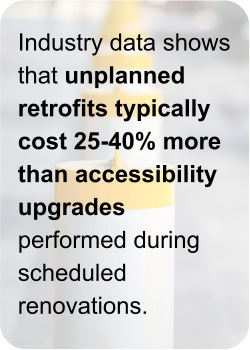
Industry data shows that unplanned retrofits typically cost 25-40 percent more than accessibility upgrades performed during scheduled renovations. Deferred action can also expose organizations to reputational and legal risk, particularly as global standards and public expectations evolve.
2. Integrating accessibility into capital planning
Successful facility programs treat accessibility improvements as part of capital forecasting and preventive maintenance. The following principles help integrate this process:
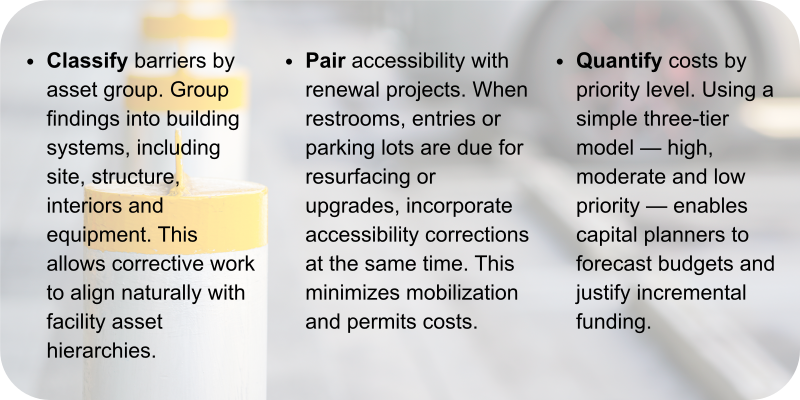
For example, a facility that bundles restroom compliance items with plumbing retrofit work can reduce total project costs by approximately one-third while avoiding additional disruption.
3. Data-driven accessibility planning
Modern FM relies on data to drive decisions. Accessibility compliance data can be treated with the same rigor applied to energy, maintenance or asset-condition metrics.
A practical approach is to assign each barrier an accessibility condition index (ACI) score based on three factors:
- User impact (safety and usability)
- Legal risk (potential violation or exposure)
- Cost of correction
Summarizing these factors yields an actionable dataset for dashboards or FM software. Facilities can then measure progress, forecast return on investment and prioritize interventions with transparency.
4. Quantifying ROI
Although accessibility is driven by regulation, it produces measurable operational gains. Examples include:
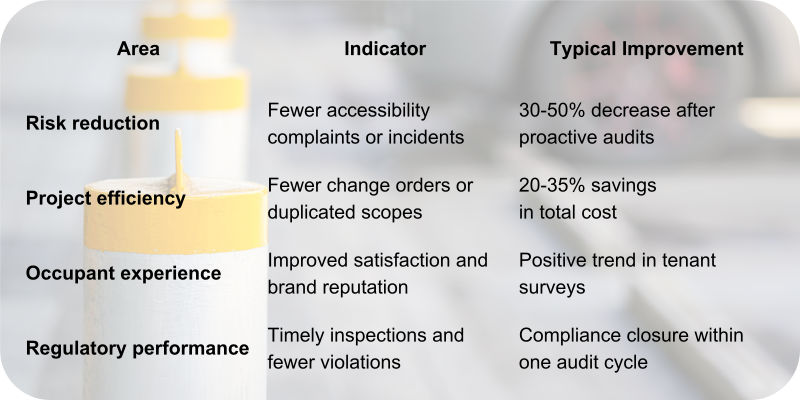
These indicators can be converted into tangible capital-planning metrics, making accessibility part of ongoing performance reporting rather than an isolated task.
5. Implementing accessible maintenance
Preventive maintenance teams are often the first to detect accessibility issues: loose handrails, deteriorated curb ramps or door hardware that exceeds allowable force. Training technicians to recognize such conditions integrates accessibility into everyday operations.
Creating an accessible maintenance checklist within existing facility software can formalize this process. Items such as door pressure tests, ramp surface wear or restroom fixture heights can be tracked during routine inspections. Documenting these results reduces future backlog and promotes continuous improvement.
6. A global framework for inclusion
While specific measurements may vary — such as slope ratios under the Americans with Disabilities Act (ADA) in the United States or ISO 21542 internationally — the principles remain universal. Facilities in Europe, Asia and the Middle East increasingly use access audits to align with sustainability and social-responsibility goals.
Integrating accessibility into capital planning supports multiple global objectives, including the U.N. Sustainable Development Goals and environmental, societal and government reporting frameworks. Inclusive facilities perform better financially and socially, reflecting the organization’s commitment to human-centered design and equitable access.
7. Case insights
Multisite retail and hospitality portfolios demonstrate how proactive planning yields measurable outcomes. In one project spanning 18 locations, consolidating accessibility corrections with scheduled paving and interior renovations resulted in a nearly US$240,000 reduction in overall spending. In another instance, a city government applied a prioritized audit matrix to phase upgrades over three fiscal years, achieving full compliance without requiring emergency appropriations.
Both cases highlight the same lesson: when accessibility is integrated early, costs decline and outcomes improve.
Conclusion
Accessibility compliance is no longer a peripheral task for facility managers — it is a core component of responsible asset management. Treating barrier removal as part of capital planning aligns financial stewardship with human-centered design, reduces long-term risk and enhances organizational resilience.
The most successful facilities view accessibility not as a fixed requirement, but as a living commitment to continuous improvement. This investment pays measurable dividends in safety, reputation and community trust.

Read more on Facility Operations , Risk Management and Real Estate or related topics Accessibility , Asset Management and Occupant Safety
Explore All FMJ Topics