
 Membership
 Network
 Regional Sites & Affiliates


 Events
 Participate
 Resources

 Training
 Credentials
 Government


 Content Channels
 Tools
Tools


 Business Overview





Better Decision Ownership
What efficiency programs stop measuring

Two findings from IFMA's 2026 Global Salary and Compensation Report, drawn from facility management practitioners, describe the same building from opposite ends.
Among the telling statistics, 72 percent of respondents told IFMA's researchers AI already affects their work daily, and 92 percent want to adopt more of it. The same research found that nearly 40 percent expect to retire within the next 10 years, and that it now takes an average of 17 weeks to fill an FM vacancy.
Automation is taking on more of the operating decision. The people who understand why those decisions were set the way they were are leaving and replacing them takes four months.
Both trends are rational on their own. Together they create an exposure that most efficiency programs have no way to see, because of what those programs choose to count.
Efficiency in the built environment is measured by what was removed. Work orders closed without a technician dispatched. Kilowatt hours cut. Contract hours eliminated. Mean time to repair. Those numbers are real and worth managing.
None of them measure what the organization retained.

The judgment leaves before the people do
The risk in a heavily automated building is rarely that the system fails outright. It is that the system runs correctly for two years while the capability to question it quietly disappears.
Cognitive psychologist Lisanne Bainbridge described the mechanism in Ironies of Automation, published in the engineering journal Automatica in 1983, more than four decades before anyone optimized a chilled water plant with a machine learning model. Her observation was that automation reassigns the operator from doing the work to monitoring the work, and that monitoring does not maintain the skill manual intervention requires. The more capable the automation, the rarer the intervention. The rarer the intervention, the less prepared the operator is when it finally comes.
Bainbridge's paper became one of the most cited works in human factors engineering. Building systems have been specified around it almost never.
In facility operations, the pattern is specific. A building automation system (BAS) optimizes supply air temperature continuously, and within 18 months no one on the site team can explain why the sequence behaves the way it does at 4 a.m. A predictive maintenance model defers a compressor overhaul, and the technician who would have argued with that recommendation has retired. Fault detection and diagnostics (FDD) software generates more alerts than the team can work in a month, so triage follows whatever the software ranked highest. Nobody has the hours left to build an independent view.
This is the deskilling trap. What the organization loses is the diagnostic judgment that used to sit between a system output and a decision, and it never appears on an efficiency scorecard, because efficiency scorecards have no line for it.
The obvious objection is that there are not enough people to maintain that judgment, and that automation is the response to the shortage rather than its cause. That is correct, and it should change what an efficiency review concludes. A team at full strength can hold judgment across every automated decision in a portfolio. A team running at 60 percent cannot and should stop trying.
The move is to pick the four or five decisions where being wrong is expensive and hard to reverse, keep a named human in those, and let the rest run autonomously by design rather than by attrition. Thin oversight spread across 40 decisions produces the appearance of governance on all of them and real governance on none.
Boundaries set at commissioning do not stay where they were set
Every automated building system operates inside a boundary that someone drew. Some decisions the system takes on its own. Other times, it recommends action while a person decides. Some stay with a person entirely.
A three-class model makes that concrete.
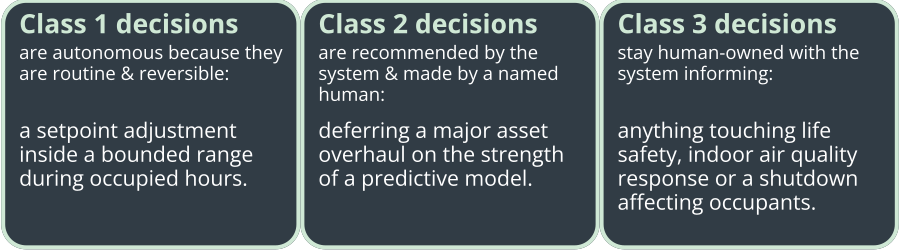
Most organizations draw these lines once, at commissioning, and never revisit them.
What follows is boundary drift. A Class 2 decision becomes Class 1 in practice, not because anyone approved the change but because the approval step became a formality. The recommendation is accepted 200 times in a row. The 201st acceptance is a reflex. On paper, a human still decides. In operation, the system does.
Drift accelerates under vendor upgrades. A platform release adds autonomous optimization to a module that previously only recommended, the release notes describe it as an enhancement, and nobody maps the change back to the decision classes agreed at handover. The building's risk posture moved during a software update.
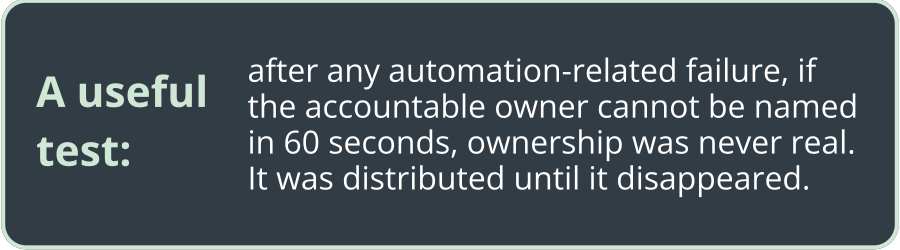
The sequence has no owner
Most facility operations run on a chain of contracted vendors, and automation has made that chain longer.
A single fault can travel through a BAS supplied by one manufacturer, an analytics layer from a second, a computerized maintenance management system (CMMS) from a third, and a service contractor dispatched under a fourth agreement. Each vendor is accountable for its own component. Each component performed to specification.
The outcome that reached the occupant belongs to nobody.
This is a sequence ownership problem. Accountability was assigned step by step while the failure happens across the seams. When a facility team asks who owns the chilled water fault that went unresolved for nine days, the analytics vendor points to the work order, the CMMS provider points to the dispatch rule, the contractor points to the priority code, and every one of them is telling the truth about their own scope.
How to audit an efficiency program
A conventional facility audit verifies assets, conditions and compliance. An efficiency audit for an automated building must verify decisions. Five steps make it usable.
1. Inventory the decisions, not the systems. List every operating decision the building makes without a person in the moment.
-
-
Setpoint optimization.
-
Load shedding under demand response.
-
Work order generation and prioritization.
-
Access exception handling.
-
Scheduling driven by occupancy sensing.
-
Most teams find more than they expected, because decisions arrive bundled inside the procurement of a platform rather than as decisions.
2. Classify each one. Assign every decision on the list to Class 1, Class 2 or Class 3, and record who agreed to the classification and when. The date matters as much as the class. Without it there is nothing to compare against at the next review, which is the only way drift gets caught.
3. Test the override. A human interruption mechanism must hold four properties to count.
-
-
Authority: named roles can stop the system without escalation.
-
Immediacy: the stop changes conditions in the building now, not at the next scheduling cycle.
-
Traceability: every use is logged with the reason and the outcome.
-
Protection: using it carries no career cost.
-
Most override capability fails on immediacy or protection. A stop that takes three approvals is documentation, not a control.
4. Trace one failure end to end. Pick a single real fault from the past year and follow it across every system and contract it touched. Write down the accountable owner at each handoff. The gaps in that list are the sequence ownership exposure, and they surface more than a policy review will.
5. Measure the retained capability. Ask whether the site team can diagnose a common fault with the analytics layer switched off. Time how long a manual restart of a major plant takes. Find out how many technicians have performed one in the past 12 months. These answers are uncomfortable, and they are the working measure of resilience.
The second scorecard
Operational metrics describe what the building did. Whether the organization can still operate the building without the software is a separate question, and it needs its own measurement.
A parallel set of key human indicators (KHIs), tracked alongside the standard operating metrics, closes that gap. Four hold up well in facility operations:
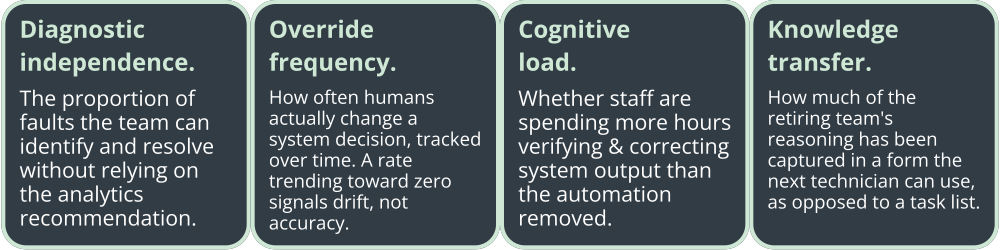
None of these are difficult to collect. They are simply not requested, because the business case for the automation was written in cost per work order and nobody added a line for capability.
What the efficiency case leaves out
 The efficiency trap is the point at which an organization optimizes so hard for cost reduction that it stops asking whether the investment is creating value. Green metrics mask eroding capability. Both dashboards are telling the truth.
In a June 2025 forecast, the research firm Gartner predicted that more than 40 percent of agentic AI projects would be canceled by the end of 2027, naming three causes: escalating costs, unclear business value and inadequate risk controls. That forecast reaches the built environment directly, because building portfolios are now buying the same class of software: systems that act on a decision rather than report a condition. Each of those three causes is set by a management decision, and each is cheaper to address when the boundary gets drawn than when the project gets killed.
For FM, the exposure carries a physical dimension most functions do not have. A misrouted marketing campaign is recoverable. A building system that decides wrong affects occupants, energy contracts, regulatory position, and in some cases safety, and it does so in real time in a space full of people.
The question worth putting to any efficiency program before the next phase of automation is not what it will save. It is which decisions the organization is transferring, who owns each of them by name, and what capability remains on site when the system is wrong.

Dan Levia has led large-scale organizations across product management, engineering, technology operations, customer service, digital help, live help, CRM, payment operations and marketing technology. His experience spans Apple, Intuit, eBay, Travelers and other enterprise environments. Levia has led teams responsible for the systems, workflows and decisions that shape customer experience at scale.
References
Top image via Getty Images.
Read more on Facility Technology & Data Management , Quality and Risk Management or related topics Quality Improvement , Facility Technology , Operational Technology and Risk Management
Explore All FMJ TopicsRelated articles
-

Artificial Intelligence in FM
The stakeholder’s perspectiveBy Dr. Jake Smithwick & Dr. Kenneth Sullivan & Nneka Ubi05.01.2024 -

Don’t Drop the Ball
How a CMMS can make or break an FM organization’s successBy Michael Carmean09.17.2024 -

Beware of Growing Cyberthreats
Why it’s time for stronger facility cybersecurityBy Andrew Harris & Eric Headington10.30.2024
