Membership
 Network
 Regional Sites & Affiliates


 Events
 Participate
 Resources

 Training
 Credentials
 Government


 Content Channels
 Tools
Tools


 Business Overview





Beyond Building Operations
FM’s new mandate

As organizations navigate geopolitical volatility and evolving workplace expectations, the need for strategic, data-powered facility management is acute. FM professionals are prioritizing initiatives that support cost reductions and greater operating efficiency. However, an FM mindset will be needed to meet today’s operational and strategic demands.
Economic uncertainty, driven by factors such as rising tariffs and trade disputes, is compelling organizations to sharpen their focus on cost management and financial risk mitigation. FM teams now have an opportunity to leverage data, technology and strategic partnerships to address these challenges.
FM priorities: Cost efficiency, reliability, resilience & occupant well-being
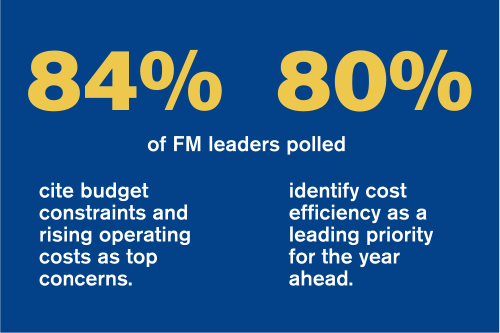
Among FM leaders, 84 percent cite budget constraints and rising operating costs as top concerns, with more than 80 percent identifying cost efficiency as a leading priority for the year ahead, according to JLL’s Global State of Facilities Management Report. Optimizing space utilization and improving organizational efficiency follow closely on the list of priorities.
 Strategies for achieving cost savings
Nearly 60 percent of FM leaders responding to JLL’s survey identify supplier consolidation as their primary cost-reduction strategy, leveraging volume purchasing power through streamlined vendor relationships. Among organizations engaged in FM partnerships, 52 percent prioritize providers with self-delivery capabilities to reduce subcontracting costs. However, only 37 percent collaborate with providers on joint cost-saving initiatives, revealing an opportunity to unlock additional value through deeper partnerships.
Technology and data also play a critical role. More than half of FM teams are using digital tools, including AI, to automate workflows and convert real-time data into actionable insights for energy optimization, predictive maintenance, labor efficiency and other cost-saving endeavors.
Creating more reliable & resilient facilities
Facility resilience has moved to the forefront as FM leaders confront aging infrastructure, talent shortages, energy volatility and cybersecurity risks tied to connected building systems. In response, organizations are strengthening workforce contingency plans, enhancing cybersecurity and investing in energy efficiency.
For 60 percent of FM leaders, business continuity for mission-critical environments remains the top risk management priority, followed by modernizing aging infrastructure and addressing deferred maintenance. Third is workforce contingency in the face of increasing FM talent shortages. Because risks tend to be interrelated, a holistic approach to risk management is essential to balancing immediate operational needs with long-term resilience.
Energy management stands out as the leading sustainability priority that also delivers cost savings. About one-third of FM leaders are establishing backup power sources to mitigate grid instability, while initiatives such as LED retrofits and HVAC optimization continue to reduce consumption and operating costs.
Mitigating talent shortages while accelerating industry transformation
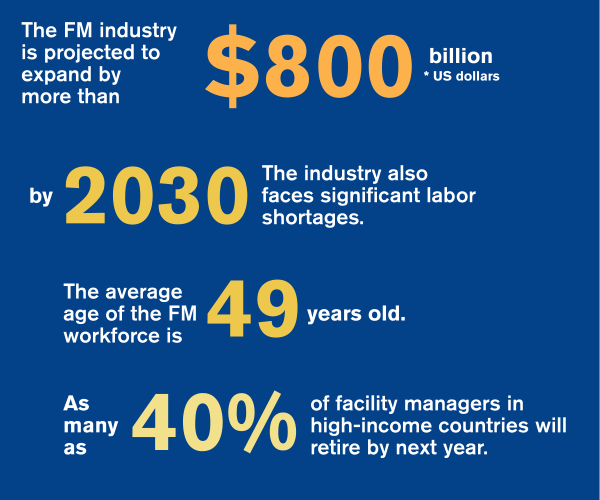
The FM industry is projected to expand by more than US$800 billion globally by 2030 but faces significant labor shortages to meet surging demand. The average age of the FM workforce is 49 years old, and as many as 40 percent of FMs in high-income countries will retire by next year. The retirement cliff has escalated labor market competition and hiring costs, while exacerbating talent scarcity in rural, remote and high-cost-of-living areas.
To bridge the talent gap, FM leaders are implementing robust succession planning and cross-training, while leveraging AI, automation and data analytics to augment human capabilities and productivity. Future-proofing the FM industry through a tech-empowered, digitally native workforce will not only mitigate workforce insufficiency but also present a pivotal opportunity for transformation.
FM’s digital transformation
By mid-2025, 92 percent of organizations had either piloted AI tools in CRE use cases or planned to do so, up from 61 percent in 2024, according to JLL’s 2025 Technology Survey. Roughly one-third planned to increase FM software investment, while a similar share had begun embedding AI into daily operations.
By 2025, 28 percent of FM teams had advanced from evaluation to action in their AI transformation, with 10 percent in pilot or proof-of-concept phases, and 16 percent scaling solutions across multiple use cases. Another 25 percent were actively researching AI solutions and evaluating vendors before formulating a strategy.
Data-related workflow is currently the biggest use case for CRE AI pilots, including data standardization and anomaly detection, data source integration, report automation and static document digitization, according to JLL Research.
Automated performance reporting is a top priority, replacing manual data compilation with real-time dashboards. Service delivery speed, asset uptime and reliability are the most commonly tracked metrics, supporting predictive maintenance and business continuity.
Collectively, these opportunities show a clear roadmap: automate high-volume administrative processes and free up managers and technicians to focus on higher-impact work, meeting with stakeholders and solving complex problems. Work-order management leads the list, followed by asset life cycle insights that inform maintenance planning and capital decisions.
Obstacles to FM digitization
Budget constraints remain the biggest barrier to digital transformation. Although nearly one-third of organizations plan to increase FM software spending, that figure has declined from prior years amid broader economic uncertainty and competing AI investments across the enterprise.
Integration challenges also persist, as legacy systems, data silos and infrastructure complexity increase costs and change-management demands. Data quality presents another hurdle. Nearly half of organizations rate their occupancy data capabilities as insufficient, according to JLL’s 2025 Global Occupancy Planning Benchmark Report, highlighting an ongoing challenge for corporate real estate.
 FM outsourcing’s advancing maturity
While many organizations still self-perform FM services, outsourcing and service integration continue to expand. Integrated FM is projected to grow at a 6.6 percent compound annual rate through 2030.
High-growth sectors, including life sciences, technology and education, are emerging as new drivers of demand. Growth potential remains high in less mature markets such as India, China and Saudi Arabia, with expanding economies, while the United States and United Kingdom, where outsourcing markets are more mature, are seeing slower growth.
CRE teams are also redefining provider relationships, as 78 percent cite deep understanding of the client’s core business as the top selection criterion, followed by communication and customer service. Pricing transparency, cost savings, scalability and technology-enabled innovation remain critical factors as well.
Driving value beyond hard assets
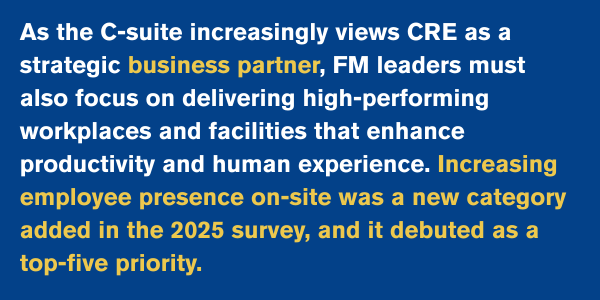
Today’s FM function extends well beyond building operations, shaping the human experience for employees, clients, visitors and other stakeholders. In the age of talent shortages across industries, the C-suite increasingly views an engaging, productive workplace as a competitive edge – and FM is expected to deliver on the concept.
As a result, today’s FM requires a hospitality mindset focused on safety, comfort, health and wellness, and efficient utilization to support the organization’s brand and workplace value proposition. JLL’s 2025 Workforce Preference Barometer shows that 84 percent of employees with positive workplace experiences also support office attendance policies, underscoring FM’s role in leveraging the workplace to support talent and productivity goals.
 The way forward
To future-proof the FM function, FM teams must reimagine their role with a heightened focus on maximizing their impact on corporate brand, employee engagement and stakeholder value. FM’s potential impact can extend far beyond traditional building operations, but into the domains of employee and occupant experience, business continuity and enterprise resilience. The following are top ways that FM teams can transform their role in the larger business.
Aim for asset reliability & service delivery excellence. Operational fundamentals remain paramount as FM leaders prioritize service delivery achievement and asset reliability. Key actions to consider include:
-
Invest in work order management systems that offer analytics and insights.
-
Automate routine tasks.
-
Implement asset life cycle management digital tools and data-driven budgeting.
Integrate risk management. A complex and volatile environment demands a holistic FM risk management strategy that addresses immediate operational needs and mitigates longer-term vulnerabilities. Key actions to consider include:
-
Incorporate proactive risk strategies aligned with the organization’s core challenges and long-term objectives.
-
Build business continuity frameworks for interconnected risks.
Emphasize human-centric workplaces. Human-centric FM creates high-performing workplaces that elevate occupant experience, maximize real estate output and ultimately deliver core business value. Key actions to consider include:
-
Balance efficiency with human experience goals.
-
Expand FM success metrics beyond operational results to include occupant satisfaction and engagement measures.
-
Invest in safety-first culture.
Adopt AI solutions to power efficiency. AI adoption is transforming the FM industry – a trend that will only accelerate soon. Key actions include:
-
Prioritize AI investments that deliver fast operational returns.
-
Establish robust data quality standards and governance frameworks.
-
Address legacy integration complexities.
Optimize the supply chain. As organizations contend with price escalation and rising budget pressure, outsourcing and supply chain optimization has proven to be a leading cost-reduction measure. Key actions to consider include:
-
Consolidate contracts and suppliers.
-
Prioritize providers that demonstrate a deep business understanding, the ability to partner as a strategic advisor, and robust self-delivery capabilities and integrated solutions.
-
Collaborate with tech-powered providers on joint cost-saving opportunities.
Transform the workforce to secure the next generation of FM talent. With an aging workforce, limited talent pipelines and escalated hiring costs, the significant skilled trade labor shortage poses a major challenge for the future growth of FM. Key actions to consider include:
-
Develop comprehensive succession plans and cross-training programs.
-
Incorporate both technical training and leadership development opportunities.
-
Invest in AI and other technology solutions that augment human capabilities.
In an environment shaped by economic headwinds and rapid technological change, FM has emerged as a strategic function with influence far beyond traditional operations. By combining digital transformation with a human-centric mindset, FM can evolve from cost center to strategic partner and create lasting competitive advantage. The message is clear: The FM function has room to grow to reach its full potential in advancing corporate goals.

Dr. Paul Morgan is the Global Chief Operating Officer of Real Estate Management Services at JLL, where he leads comprehensive building lifecycle solutions that maximize client returns on real estate investments. He directs Workplace Management, JLL’s largest sub-business line, encompassing over 53,000 professionals across 80 countries who deliver facilities management services to Fortune 500 companies and leading organizations worldwide. Originally from the UK, Morgan holds a PhD in Organic Chemistry from the University of Manchester and a degree in Chemistry from the University of Salford.
References
Top image via Getty Images.
Read more on Facility Operations , Quality and Leadership & Strategy or related topics Operations and Maintenance Planning , Facility Improvement and Workforce Development
Explore All FMJ Topics