 Membership
 Network
 Regional Sites & Affiliates


 Events
 Participate
 Resources
 Training
 Credentials
 Government


 Content Channels
 Tools
Tools


 Business Overview




Beyond Substantial Completion
The proven path to true operational readiness

The traditional siloed approach to facility construction, wherein mechanical, electrical and specialized systems are designed and delivered in isolation, is becoming a liability. As research and development (R&D) and industrial environments increase in spending and complexity, the gap between substantial completion and true operational readiness widens, resulting in a costly “silo tax” that inflates the total cost of ownership.
Rather than treating integration as a final step in commissioning, leading organizations are embedding it as a foundational pillar, beginning with front-end planning and extending across design, construction, startup and long-term use. This life cycle approach aligns project specifications and design requirements early, ensuring systems are designed inside-out around operational requirements. In highly technical facility and infrastructure projects, operational readiness has high stakes.
This integrated model enables facility managers to transition from reactive troubleshooting to predictive, data-driven operations. By treating systems integration as a foundational pillar rather than a checkbox, organizations can reduce risk, accelerate day-one readiness, and deliver a measurable return on investment (ROI) through energy efficiency and sustained operational excellence.
The cost of the handoff: Introducing the silo tax
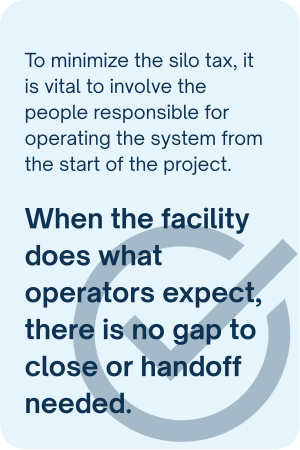
Stakeholders, representing varying disciplines and areas of focus, generally operate autonomously in the traditional project model, with each assuming that integration occurs naturally. Without early collaboration, integration costs more and takes longer than necessary.
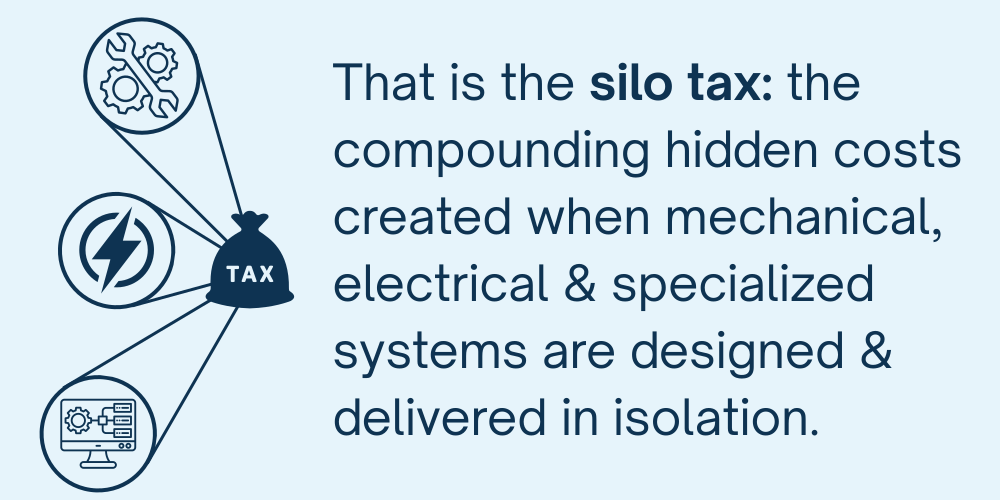
With no single owner for end-to-end performance, the silo tax grows due to three main drivers:
1. Misaligned requirements. When infrastructure, equipment and building teams define scope independently, utilities, space allocations and overall process workflow fail to align. Reconciling them mid-project is far more expensive than aligning them up front.
2. Late definition of requirements & integration of controls. When requirements are not locked in early, central utility capacity, electrical distribution upgrades and control system expansions are treated as late-stage changes rather than design inputs, driving rework and schedule slips that compound as construction progresses.
3. Underestimated legacy constraints. Documentation and drawings of a facility’s power capacity, cooling infrastructure or structural load are not always current. Siloed teams may never share tribal knowledge or compare notes until a resource conflict emerges. One program’s upgrades may have consumed headroom that another team is counting on. Changes in permitting requirements or current code standards can further reduce what is available, as work that seemed straightforward triggers compliance reviews that reveal the gap between assumed and actual capacity.
The consequences of the silo tax emerge throughout the project life cycle as change orders, scope creep and project delays caused by technical rework and additional coordination needed among stakeholders. Rather than a controlled ramp with minor tuning and predictable issues, day one looks like manual patches, conflicting setpoints, missing interlocks and incomplete network and security configurations, followed by weeks or months of on-site firefighting before the facility delivers its intended performance. As facilities become more complex, that gap between substantial completion and true operational readiness widens. What once could be resolved in days now stretches into weeks or months, directly impacting hand-over timelines and pushing the real cost of siloed decisions well beyond original project budgets.
 Why complexity makes the old model a liability
The absence of a single point of ownership always made the traditional handoff model imperfect. The growing complexity of projects and facilities makes it untenable. Today, problems stemming from integration misalignments can rarely be resolved in days. The increasing technological complexity creates more interdependent systems, leading to integration failures that compound faster and cost more to unwind.
 Three converging trends are pushing facility and project complexity higher. Electrification and new energy sources, including high-voltage, microgrids and hydrogen infrastructure, introduce tightly coupled controls and protection schemes that must be coordinated across disciplines from the outset. Deeper data, IT and operational technology (OT) integration means building automation systems (BAS), test and production systems, and enterprise data are increasingly treated as a coordinated ecosystem. Automation and AI-assisted operations add another layer, as robotics, smarter facilities and software frameworks require a standardized integration architecture to function as intended. The more interdependent these systems are, the more likely a late or fragmented integration approach will cascade into rework and delays.
Integration is the foundation, not a finish line
The silo tax occurs because project teams treat integration like a commissioning task rather than an integral part of the project from the earliest planning phase. During the front-end planning (FEP) phase, cross-disciplinary teams detail the requirements and acceptance criteria that govern every subsequent phase. The teams define the data flows, safety functions and maintenance workflows, all before equipment is selected. They translate operating scenarios into specific control modes, data consumers, interlocks and alarm strategies. These requirements establish controls architecture, zoning and utility parameters before design begins. When addressed early, integration becomes a design input rather than a late-stage problem.
Project economics reinforce the urgency of this early investment. The ability to influence project cost is greatest before design begins and drops sharply through construction. Including integration during FEP prevents the far higher costs that accumulate when those decisions are deferred. Change orders, rework and commissioning delays are expensive precisely because they occur later in the project, when they could have been avoided for a fraction of the cost if caught before design and equipment decisions are locked in.
FMs and key operators are critical here, not as reviewers of decisions already made, but as contributors during the FEP process. They have the institutional knowledge to surface legacy constraints, validate use cases, and co-own risk assessments and commissioning criteria. They are there to advocate for day-one readiness, with commissioning budget and schedule explicitly allocated at this stage. Continuity of architecture and accountability across all project phases eliminates the interface gaps that drive rework, commissioning delays and unplanned downtime.
 Designing from the inside out
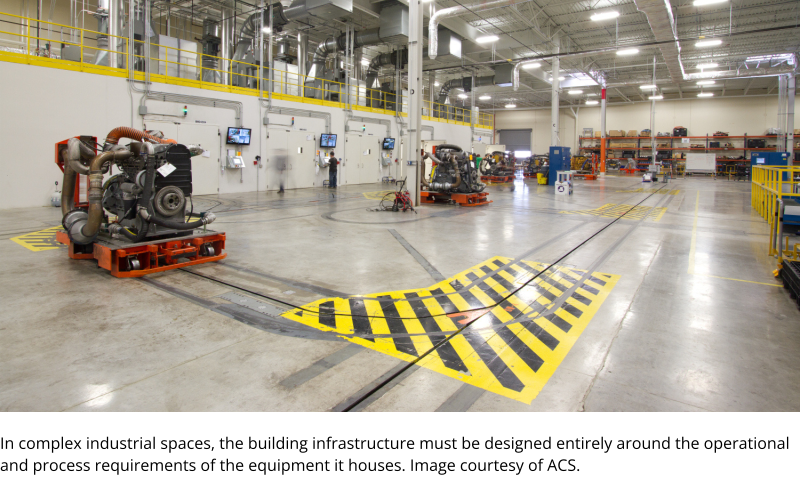
An inside-out approach to design puts the focus first on what the business needs this facility to do: the systems it must support, the throughput it must deliver, and the risks it must manage. The guiding questions are operational. What must occur on a normal day, and what must happen on the worst day? FMs and operators are key sources of answers because they hold the institutional knowledge of failure modes, staffing realities and legacy constraints that do not appear in drawings or specifications.
From those operational requirements, the inside-out sequence works outward. Operating scenarios drive control strategies, network and data architecture, alarming priorities and functional safety requirements. Those decisions then lock in room adjacencies, structural provisions, utilities and envelope details that physically support the facility’s intended behaviors over its full life.
Designing from the inside out is a deliberate inversion of conventional practice, in which building infrastructure is defined first, and programs adapt to whatever constraints result. When the building drives the design, operational requirements become negotiable. When operations drive the design, the building serves its actual purpose from day one.
Bridging IT & OT across the facility life cycle
When IT and OT are viewed as distinct domains with separate owners, integrating the two becomes a source of risk, inefficiency and failure. The ongoing tension between IT’s focus on constant updates and OT’s goal of continuous operations mandates regular collaboration between the teams at every project phase and throughout the life cycle.
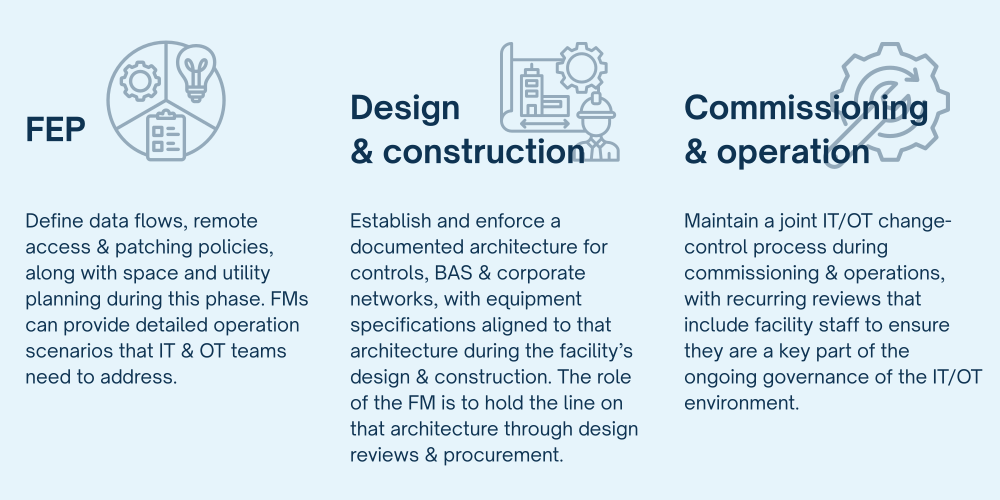
A facility that treats IT, OT and cybersecurity as a coordinated life cycle responsibility avoids many of the handoff gaps and the resulting downtime and rework that drive the silo tax.
What ROI looks like
Integration-forward projects do not just perform better immediately; they reduce the total cost of ownership (TCO) across the facility life cycle. FMs can track ROI metrics that show how projects with true day-one operational readiness perform over time. The first group of metrics quantifies risk reduction, such as fewer safety and cybersecurity incidents, lower outage frequency and faster recovery times.
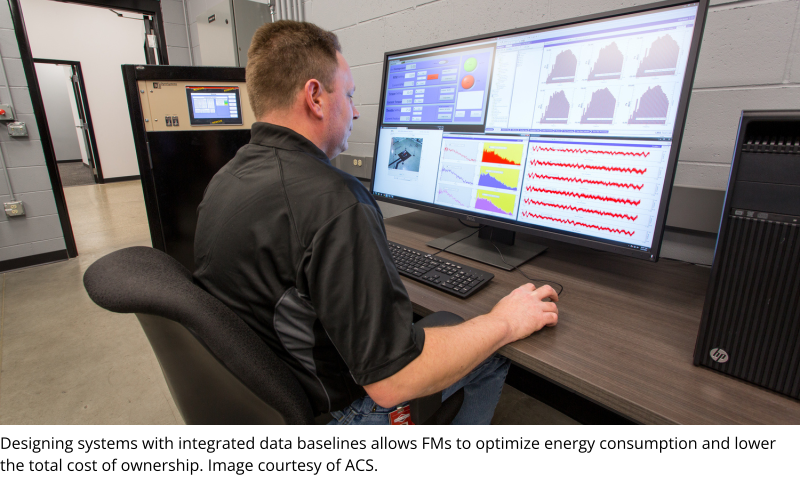
Global industrial electricity consumption is accelerating, with average annual demand growth projected to rise 24 percent through 2030, making energy an increasingly significant driver of facility operating costs. Early integration design enables teams to design where and how energy is measured and controlled, creating a baseline against which FMs can optimize energy consumption moving forward. With integrated controls, FMs can track energy per unit of output and then tune sequences, setpoints and load scheduling for real savings over the life of the facility. Other TCO metrics include change-order spend, corrective maintenance hours, and rework projects avoided over a 5-10-year horizon compared to prior facilities or industry benchmarks.
FMs can treat day one as a leading indicator of whether a project is on or off its planned ROI and TCO trajectory. A facility that reaches day one with only predictable issues and minor tuning is well-positioned to stay on track. If there is extensive manual patching, conflicting setpoints or missing interlocks, the silo tax will rise due to extended commissioning, rework and future maintenance.
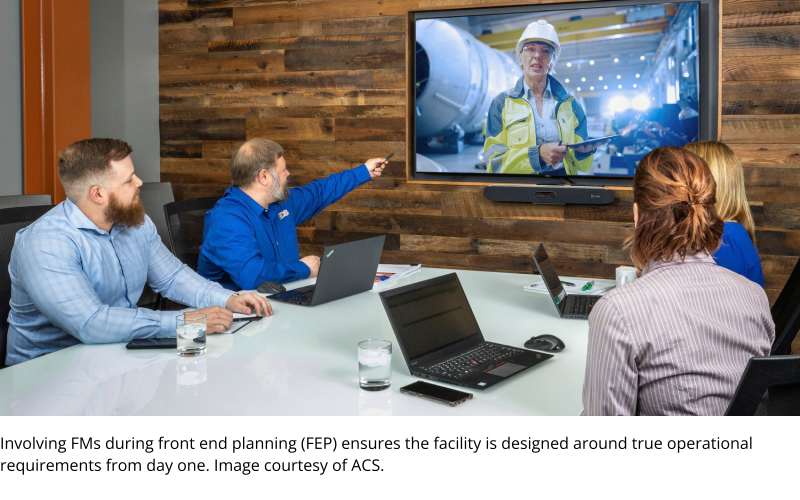 Day one readiness starts at the beginning
The silo tax accrues from a project structure that distributes accountability, rewards lowest-bid decisions, and treats integration as a late-phase problem. How FMs position themselves within project development helps influence structural changes that lower the silo tax:
-
Participation. Facility representatives contribute during FEP, with use cases, legacy constraints, cybersecurity requirements and commissioning criteria that reflect operational reality from the start.
-
Integration. Ensure integration is scoped, resourced and contracted at FEP and not during commissioning.
-
Alignment. Treat IT and OT integration as an ongoing operational program, with governance that extends from design through the project life cycle.
-
Management. Approach the ROI case in life cycle terms that include key metrics affecting TCO and not just initial capital costs.
In a complex facility, integration discussions need to start early, during the planning phase. As new energy sources and rising safety and cybersecurity demands drive greater complexity, the cost of siloed decisions only increases. When FMs champion integration and life cycle accountability from the start, the results include smoother day ones and improved project life cycle economics.

Everett Lenz is a project integration Lead for ACS and brings extensive expertise to the forefront of project integration and technical solutions, driving client initiatives forward with exceptional precision and insight. Specializing in the strategic alignment of major automotive OEM test facilities, he serves as the primary point of contact from front end planning (FEP) through project funding. With a hands-on approach, Lenz oversees the systems integration perspective during design, execution and commissioning, ensuring that each project not only meets but exceeds acceptance criteria. His unique application knowledge and commitment to leveraging lessons learned make him an invaluable asset, consistently delivering results that surpass expectations in the ever-evolving landscape of project execution.
Matt Thiel stands as a seasoned professional at the forefront of facility and equipment planning and integration, executing client projects with exceptional precision and expertise. Specializing in the careful specification and procurement of cutting-edge test systems and equipment, he also plays a key role in developing strategic facility workflows and layouts to optimize operational efficiency. With a hands-on approach, Thiel manages and executes commissioning processes, ensuring that each project not only meets but exceeds acceptance criteria. His unwavering commitment to excellence and meticulous attention to detail make him an invaluable asset, consistently delivering results that surpass expectations in the ever-evolving landscape of project execution.
References
wipo.int/en/web/global-innovation-index/w/blogs/2025/end-of-year-edition
acronis.com/en/blog/posts/how-unplanned-ot-downtime-is-silently-draining-industrial-profits
Top image via Getty Images. Article photos provided by ACS./p>
Read more on Facility Technology & Data Management and Project Management or related topics Facility Technology , Information Technology and Project Management
Explore All FMJ TopicsRelated articles
-

Artificial Intelligence in FM
The stakeholder’s perspectiveBy Dr. Jake Smithwick & Dr. Kenneth Sullivan & Nneka Ubi05.01.2024 -

Don’t Drop the Ball
How a CMMS can make or break an FM organization’s successBy Michael Carmean09.17.2024 -

Beware of Growing Cyberthreats
Why it’s time for stronger facility cybersecurityBy Andrew Harris & Eric Headington10.30.2024