
 Membership
 Network
 Regional Sites & Affiliates


 Events
 Participate
 Resources

 Training
 Credentials
 Government


 Content Channels
 Tools
Tools


 Business Overview





Building a Better Workflow
A practical framework for AI intake agents in FM ticketing

Facility management teams at mid-to-large sites routinely handle hundreds of maintenance requests, service calls and status queries each month. The volume is predictable; the process rarely is. Requests arrive through phone, email, web forms and messaging apps, classification is inconsistent, and skilled operations staff spend a large share of the week on intake work that follows a small number of repeatable decision paths.
AI intake agents promise to absorb that repetitive load. The harder question for an FM is not whether the technology performs in a demonstration, but where it adds measurable value in a live operation, and where human judgement must stay in control. A clear framework separates the two.
The stakes are operational, not theoretical. Buildings account for around 30 percent of global final energy consumption, according to the International Energy Agency, and the teams that keep those buildings running are under constant pressure to do more without adding headcount.
 Three questions decide whether an AI intake agent relieves that pressure or quietly adds to it.
1. Which ticket categories are structurally suited to AI triage?
Not every request belongs in an automated queue. The categories that suit AI triage share three structural traits, and a short scoring exercise across those traits separates strong candidates from weak ones.
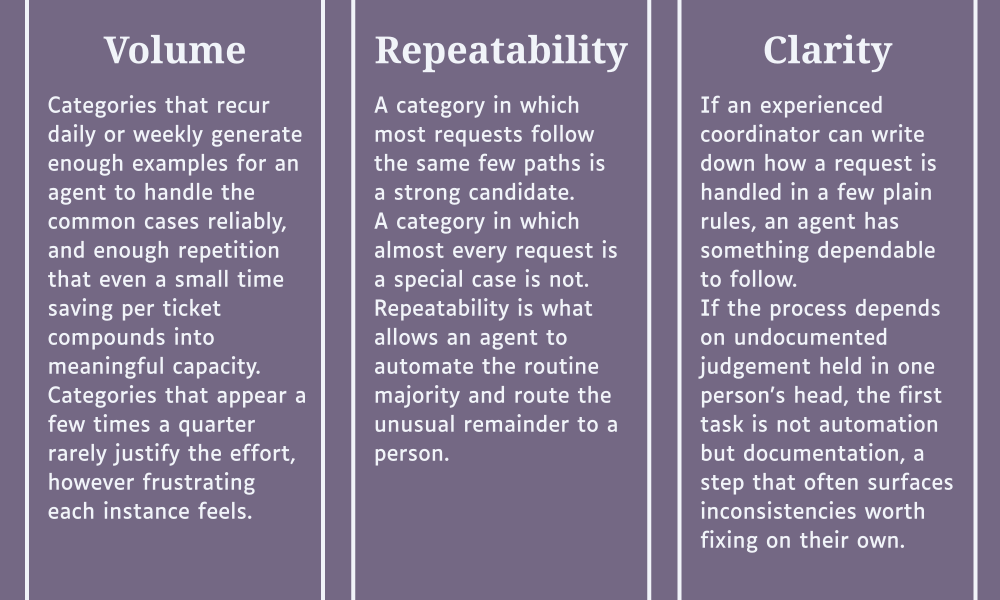
Applied to a typical FM queue, the pattern becomes clear. Access requests, lighting outages, temperature complaints, routine cleaning requests and status queries tend to score high on all three traits. Safety incidents, security events, and anything carrying legal, health or contractual exposure score low on rule clarity and high on risk and belong with a person by default. A useful exercise for any FM team is to pull three months of ticket history, group requests by category, and rate each category on volume, repeatability and rule clarity. The categories that score high on all three are the places to begin.
2. What integration depth production-grade automation is required?
The gap between a demonstration and a dependable deployment is integration depth.
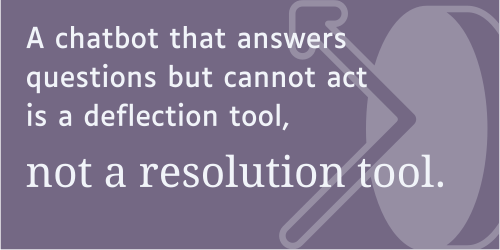 It may keep a request away from a coordinator for a few minutes, but if the underlying issue is not resolved, the request returns as a repeat contact, an escalation or a complaint. The cost is not removed; it is deferred and hidden.
Production-grade automation reads from and writes into the systems of record. That means the computerized maintenance management system (CMMS), the work-order platform, contractor scheduling tools and asset registers. An intake agent that can classify a request, verify it against asset and warranty data, create or update a work order, and schedule the right contractor is doing operational work. One that can only reply with text is not.
Several controls make that depth safe rather than reckless. Classification should return structured, validated data, not free text, so downstream systems can act on it. Actions should be scoped per category, so an agent handling a lighting request cannot reach tools it has no business using. Every request should be validated before it executes: confirming the asset exists, that the request falls within policy and that action has not already been taken. Repeated or duplicated actions should be blocked, and any request that exceeds a defined limit should move to a person automatically. Depth without these guardrails increases risk; depth with them is where measurable value comes from.
The distinction that matters most is between deflection and resolution. Deflection counts how many requests were kept away from staff. Resolution counts how many requests were actually closed and stayed closed. An automation program optimized for deflection will learn to route requests away; one optimized for resolution will learn to solve them. FMs evaluating a platform are well served by asking how it measures resolution, what happens to a request the agent cannot handle, and how that handoff reaches a coordinator with full context.
3. How to sequence deployment to protect service continuity?
Service continuity is the binding constraint in FM. An automation that mishandles a safety-critical request causes far more damage than any efficiency gain it delivers elsewhere. Sequencing the rollout to respect that constraint is what separates a durable program from a stalled pilot.
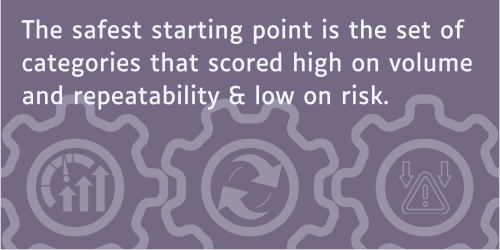 Beginning there delivers early capacity gains on requests where a mistake is inconvenient rather than dangerous, and it builds the operational confidence needed to expand. Beginning with the hardest, highest-risk category is the most common way these programs lose trust.
Before an agent acts on live requests, a shadow phase is prudent. In shadow mode, the agent processes real tickets and proposes actions, but a coordinator executes them, and the two are compared. Only when the agent's proposed actions match human decisions consistently does it graduate to acting on its own, and only within the categories where that record holds.
Escalation must be treated as a normal outcome, not a failure. Clear triggers, such as low classification confidence, any action blocked by a control or repeated failed attempts, should route a request to a person along with everything the agent already gathered. A good handoff saves the coordinator the work the agent has done; a poor one returns a raw ticket to the queue and erases the value.
Progress should be measured on outcomes rather than activity. Resolution rate, repeat-contact rate within a defined window, and escalation rate together show whether the automation is doing the work or merely hiding it. Expansion should follow the evidence, category by category, rather than a fixed timeline.
The framework in practice
Three questions carry the decision. Which categories are structurally suited to AI triage, based on volume, repeatability and rule clarity? What integration depth is required, measured by whether the agent can act in the systems of record under proper controls. And how to sequence the rollout so that service continuity is never the price of efficiency.
Answered in that order, the questions keep the focus where it belongs: on the routine, high-volume work that automation handles well, and on the exceptions that still require human judgement. The FM teams that gain the most from AI intake agents are not the ones that automate the most tickets. They are the ones that automate the right tickets, keep people in control of the rest, and measure success by whether the work was genuinely done.

Ralf Klein is the founder of Triad, an AI automation agency based in the Netherlands that builds operational AI agents for support and operations teams, including in property and facility management. His work focuses on where automation reliably resolves high-volume ticket work in the built environment and where human oversight remains essential. He writes about measuring AI by operational outcomes rather than activity.
References
Read more on Facility Technology & Data Management , Project Management and Facility Operations or related topics Work Management Systems , Facility Technology and Operational Technology
Explore All FMJ TopicsRelated articles
-

Artificial Intelligence in FM
The stakeholder’s perspectiveBy Dr. Jake Smithwick & Dr. Kenneth Sullivan & Nneka Ubi05.01.2024 -

Don’t Drop the Ball
How a CMMS can make or break an FM organization’s successBy Michael Carmean09.17.2024 -

Beware of Growing Cyberthreats
Why it’s time for stronger facility cybersecurityBy Andrew Harris & Eric Headington10.30.2024
