
 Membership
 Network
 Regional Sites & Affiliates


 Events
 Participate
 Resources

 Training
 Credentials
 Government


 Content Channels
 Tools
Tools


 Business Overview





Buzzworthy
The strategic reality of digital twins in FM
Facility management operates at the intersection of reliability, cost control and human comfort. Unlike technology-driven sectors that can tolerate experimentation, FM environments demand stability. A single misstep such as an unplanned outage, a failed chiller or a mismanaged energy strategy can immediately and negatively impact occupants, operations and organizational credibility. In this context, FM leaders are often conservative with technology adoption, favoring proven methods over experimental solutions.
Against this backdrop, the growing conversation concerning digital twins generates both curiosity and skepticism within the FM community. Often presented as a revolutionary solution capable of predicting failures, optimizing energy consumption and simulating future operational scenarios, digital twins promise a level of control that traditional FM tools have struggled to deliver. Yet for many FMs, digital twins remain abstract — appearing more suited to smart cities, airports or high-tech manufacturing campuses than to the realities of commercial offices, hospitals, retail portfolios or mixed-use developments.
The question is not whether digital twins are valuable, but whether organizations are structurally and culturally prepared to adopt them effectively. To answer that, organizations must advance beyond the hype and understand what a true digital twin is, what it can realistically achieve and how FM leaders can leverage it without disrupting operations.
Defining digital twins beyond the marketing narrative
A major challenge in FM technology adoption is conceptual confusion. Terms such as building information modeling (BIM), smart buildings, Internet of Things (IoT) and digital twins are frequently used interchangeably, despite representing distinct capabilities. Misunderstanding these differences often leads to failed projects, wasted budgets and frustrated stakeholders.
A digital twin is not simply a 3D model, nor is it a dashboard displaying live data. It is a continuously evolving digital replica of a physical asset or system, informed by real-time and historical data, capable of analysis, prediction and simulation. In practical FM terms, a true digital twin integrates:
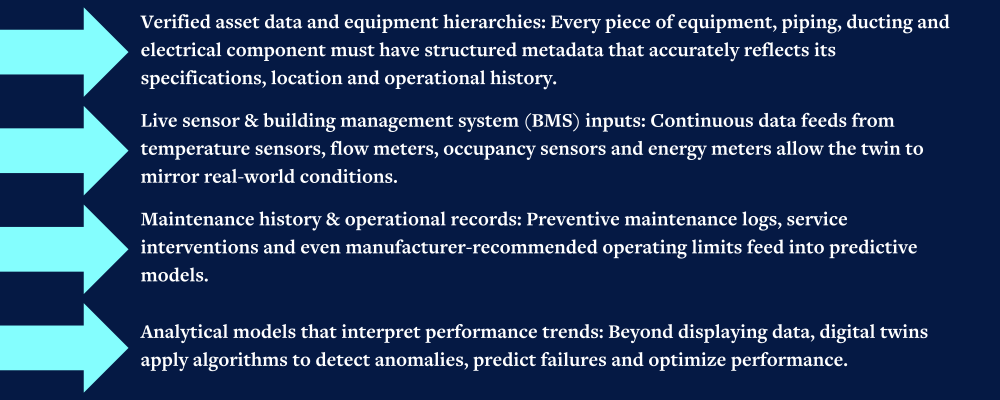 The distinguishing factor is behavioral intelligence. A digital twin does not merely show what is happening; it helps explain why it is happening and what is likely to happen next. For instance, a chiller may appear to be running efficiently, but a digital twin can analyze vibration, temperature and pressure trends to indicate early-stage bearing degradation long before a traditional BMS alarm triggers.
What’s holding back digital twins in FM?
Despite their potential, digital twins remain rare in day-to-day FM operations. This is not due to lack of interest, but due to systemic barriers that many organizations underestimate.
Fragmented & low-quality data
Most FM portfolios suffer from inconsistent asset data. Equipment registers may exist but naming conventions differ across sites. Preventive maintenance records are incomplete. Modifications made during operations are not reflected in drawings or systems. A digital twin built on unreliable data only amplifies existing problems, creating “garbage-in, garbage-out” scenarios.
Legacy systems & integration gaps
Many facilities operate with aging BMS platforms, proprietary protocols, and standalone CAFM or CMMS systems. Integrating these environments into a single digital ecosystem is technically complex and often costly. In practice, FM teams often face months of tedious data cleansing and system mapping before a pilot digital twin can be operational.
Skills & capability constraints
Facility teams are traditionally structured around engineering and operational competencies. Data analytics, system integration and digital modeling require new skills that are still scarce within FM departments. Upskilling existing teams or hiring digitally competent personnel is critical but often overlooked.
Unclear business ownership
Digital twin initiatives frequently fall into the gap between FM, IT, sustainability and finance teams. Without clear ownership and governance, projects lose momentum or become vendor-driven rather than value-driven. This lack of accountability is one of the primary reasons why many digital twin pilots fail to scale.
The FM digital readiness continuum
Digital twins should be understood as the upper end of a digital maturity journey, not an entry point. Most organizations are several steps away from true predictive and simulated operations.
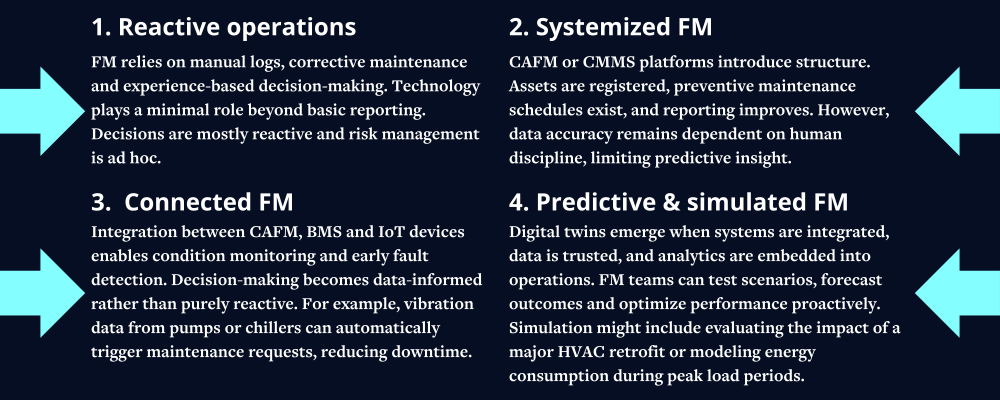 Most FM organizations operate between the second and third stages. Recognizing this reality is essential for setting realistic expectations. Attempting a full-scale digital twin without foundational readiness often leads to frustration and wasted investment.
Practical use cases where digital twins deliver measurable value
Digital twins are most effective when applied selectively rather than universally. Some of the most compelling applications include:
Optimizing HVAC performance
Large HVAC systems are complex, energy-intensive and critical to occupant comfort. A digital twin can model thermal behavior, equipment efficiency and load variations, enabling fine-tuned optimization that traditional controls cannot achieve. For instance, simulating airflow adjustments can identify potential energy savings of up to 15 percent while maintaining occupant comfort.
Predictive maintenance of critical assets
Rather than relying solely on time-based preventive maintenance, digital twins support maintenance decisions based on actual operating conditions. Motors, chillers, pumps and elevators can be monitored in real time, reducing unnecessary interventions while minimizing the risk of catastrophic failures.
Energy & carbon management
As organizations face increasing pressure to reduce emissions, digital twins provide a mechanism to simulate energy conservation measures, evaluate retrofit options and validate sustainability investments before implementation. For example, retrofitting LED lighting across multiple floors can be virtually modeled to predict cost savings and ROI before capital expenditure.
Space & occupancy intelligence
By integrating occupancy data, digital twins help FM teams align cleaning, HVAC and lighting strategies with real usage patterns, improving efficiency without compromising user experience. In post-pandemic office environments, this capability has become particularly relevant for hybrid work models.
Emergency preparedness & risk simulation
Digital twins can simulate emergency scenarios, from fire evacuations to power outages, enabling FM teams to proactively adjust plans and validate response strategies. This predictive capability enhances safety compliance and business continuity planning.
Governance, risk & data integrity considerations
Implementing digital twins introduces new governance responsibilities that FM leaders must anticipate.
-
-
Data governance: Clear standards must define data ownership, update responsibility, validation processes and cybersecurity controls. Without governance, digital twins quickly lose credibility, and decision-making based on the twin becomes risky.
-
Vendor dependency risks: Many digital twin solutions are proprietary. FM leaders must evaluate long-term flexibility, interoperability and exit strategies to avoid technological lock-in. Open standards and scalable architecture are key factors in sustainable adoption.
-
Operational risk management: Overreliance on digital models without human oversight can introduce risk. Digital twins should support, not replace engineering judgment. Even the most sophisticated model can fail if the underlying sensors malfunction or asset data is incorrect.
-
Measuring ROI: Moving beyond cost reduction
 A common mistake is evaluating digital twins purely on immediate cost savings. Their true value often lies in:
-
risk avoidance and reliability improvement
-
extended asset life and deferred capital expenditure
-
improved occupant satisfaction and service continuity
-
enhanced decision-making credibility with senior management
These benefits may not always appear directly on a budget line but significantly influence organizational performance. A facility with minimal downtime, predictable maintenance schedules and optimized energy consumption creates intangible value that extends far beyond immediate cost savings.
Leadership & cultural readiness
Technology adoption in FM succeeds or fails based on leadership intent. Digital twins demand a cultural shift — from reactive problem-solving to proactive system stewardship. Leaders must:
-
encourage data discipline and accountability
-
invest in training and cross-functional collaboration
-
align digital initiatives with organizational strategy rather than trends
When FM teams trust data and understand its relevance, digital twins become enablers rather than burdens. Leadership must champion not just technology, but also the behavioral changes necessary to maximize its value.
A phased & realistic implementation path
For most organizations, the optimal approach is incremental:
-
Standardize asset data and naming conventions
-
Improve CAFM and BMS data reliability
-
Introduce targeted sensors where insight is lacking
-
Pilot a digital twin on a critical system
-
Expand only after demonstrating operational value
This phased approach reduces risk, builds confidence across stakeholders and provides measurable results that justify further investment.
The future of digital twins in FM
Over the next five years, digital twins are expected to shift from experimental tools to strategic platforms, particularly in large, complex portfolios. They will not eliminate the need for skilled FM. Instead, they will elevate the profession by enabling deeper insight, stronger justification of decisions and closer alignment with business objectives.
Organizations that invest today in data quality, integration and people will be positioned to adopt digital twins meaningfully. Those who wait for a plug-and-play solution may find themselves perpetually unprepared.
Conclusion
Digital twins are neither a passing trend nor an immediate necessity for every facility. They represent a destination — a level of operational maturity earned through disciplined data management, strategic leadership and cultural readiness.
For FM professionals, the opportunity is not to chase technology, but to prepare the foundation that allows technology to deliver real value. When implemented thoughtfully, digital twins transform FM from a cost center into a strategic partner in organizational performance, unlocking insight, efficiency and resilience.

Faiq Rauf is an experienced facility management professional with more than a decade of hands-on involvement in multi-site operations, maintenance strategy and cost optimization. His work focuses on aligning operational delivery with asset reliability, workforce effectiveness and long-term value protection. He brings a practical, field-driven perspective shaped by managing complex building systems in demanding environments. Rauf's interests include sustainable FM practices, operational governance and bridging the gap between strategy and execution.
References
Read more on Facility Technology & Data Management or related topics Operational Technology and Facility Technology
Explore All FMJ TopicsRelated articles
-

Artificial Intelligence in FM
The stakeholder’s perspectiveBy Dr. Jake Smithwick & Dr. Kenneth Sullivan & Nneka Ubi05.01.2024 -

Don’t Drop the Ball
How a CMMS can make or break an FM organization’s successBy Michael Carmean09.17.2024 -

Beware of Growing Cyberthreats
Why it’s time for stronger facility cybersecurityBy Andrew Harris & Eric Headington10.30.2024