
 Membership
 Network
 Regional Sites & Affiliates


 Events
 Participate
 Resources

 Training
 Credentials
 Government


 Content Channels
 Tools
Tools


 Business Overview





Case Study: An Evolution in Law Office Design
From non-descript corridors to collaborative spaces
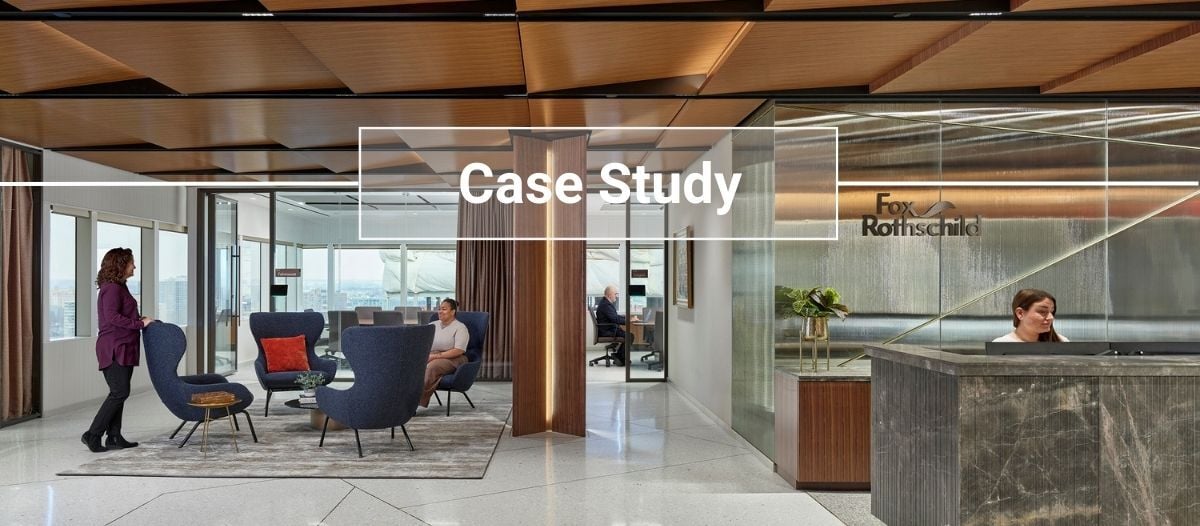
The traditional law office, once associated with large mahogany desks, floor-to-ceiling filing cabinets, and sterile gray corridors, is a relic of the past. Today, a new generation of legal workspaces is emerging: offices complete with modern aesthetics characterized by shared offices, communal lounges and flexible collaboration zones that reflect the fundamental shifts reshaping the legal profession.
This transformation is indicative of a broader shift in how legal work gets done. Through hybrid employment models, technological advancement and heightened workplace wellness standards, law firms have evolved to more holistically navigate post-pandemic realities, while rediscovering that the physical workspace can be a strategic tool for attracting talent, fostering greater collaboration and connecting with local communities.
Decreasing office footprint
The past year brought a wave of downsizing commercial office footprints while owners and operators grapple with decreased leasing. While certainly catalyzed by the onset and aftermath of the COVID-19 pandemic, many legal offices began downsizing their square footage over the last two decades, mostly in response to significant rises in real estate costs.
Though there are a variety of factors, this shift can in part be attributed to the digitization of the legal process itself, including streamlined document management systems and robust digital reference libraries. Where massive filing rooms and libraries once dominated law firm real estate, consuming thousands of square feet with rows of document storage, digital archives now have the capacity to store important filings in a fraction of the space. This elimination of extensive paper storage has created opportunities for firms to completely reassess spatial allocation. Coffee stations, flexible meeting rooms and lounges that support the dynamic needs of hybrid work arrangements are now included in legal firms’ offices without increasing the overall real estate footprint. This shift reflects a greater understanding that in a human-centric profession, the most valuable real estate should be dedicated to spaces that facilitate thinking, collaboration and client engagement.
The trend toward smaller office footprints carries significant economic implications that extend beyond simple lease reduction. While decreased square footage per attorney does reduce real estate expenses, the more strategic benefit lies in how firms can reallocate those savings toward post-pandemic needs including technology, travel and flexible furniture that enhances productivity and efficiency. This resource reallocation reflects a fundamental shift in how law firms view their physical presence. Rather than treating real estate as a status symbol, the most progressive firms are approaching the workspace as a tool — one that should actively contribute to operational efficiency, talent retention and client satisfaction.
The adoption of hybrid work
In the same way that the pandemic accelerated trends like shrinking footprints already reshaping legal workplaces, the adoption of hybrid work models that blend remote and in-office collaboration has also become a focal point for designers. This shift has changed how firms approach space planning, moving away from the once non-negotiable model of large, multi-sized private offices toward more flexible arrangements that accommodate varying occupancy levels. Practices are implementing universal office sizes and reservable spaces, democratizing space and eliminating the hierarchies traditionally expressed through space allocation.
The prioritization of collaborative spaces and meeting rooms reflects the reality that much legal work requires environments that can adapt to different group sizes and needs, whether internally or with clients. Investment in integrated technology supports both remote and hybrid meeting formats, ensuring that all participants can contribute effectively, regardless of their physical location. This might include high-quality video conferencing systems, wireless presentation tools and interactive displays catered to the need for more seamless hybrid meetings. Room scheduling software and sensors are implemented where deemed appropriate, optimizing the newer, more flexible use of space. These tools all contribute to helping firms improve the quality of meetings and interactions, minimize disruption associated with collaborative areas, and co-create more meaningfully in real time.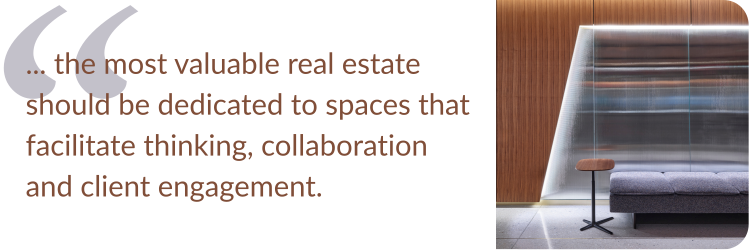
This shift also follows an increased focus on employee wellness. The move towards hybrid work and multi-purpose workspaces offers employees greater flexibility, contributing to their overall well-being. In the office, former secondary spaces, such as collaborative zones, respite areas and other amenities, have been elevated to become purposeful "collision points" where spontaneous interactions and exchanges flourish. By combining this thoughtful space planning with integrated technology, firms are creating environments that reject static models of work, and instead, foster a greater sense of community, engagement and well-being to further drive organizational success.
Embracing thoughtful design
With an increased focus on wellness, law firms are embracing color palettes and design elements that reflect their unique brand identities and local context. In a profession known for its intensity and stress, attorneys can benefit from flexible work environments and biophilic design, which includes prioritizing the use of organic forms, natural elements and access to daylight to leverage the calming effects of humans’ innate connection with nature.
The challenge lies in striking the right balance — incorporating enough personality and warmth to create an inviting atmosphere while preserving the professionalism that clients expect from their legal advisors. Successful firms are achieving this balance through sophisticated material selection, which often comprises an interplay of natural and synthetic materials, elevated with varied textures, color variation and contrasting tactile finishes.
Biophilic design further strengthens a sense of place, connecting attorneys to the city and community they are served through open sightlines and wide access to outside views. Office location is also integral for supporting engagement for both employees and clients; buildings in walkable neighborhoods with fitness amenities, dining options and gathering spaces encourage employees to spend meaningful time in the office while enhancing overall experience.
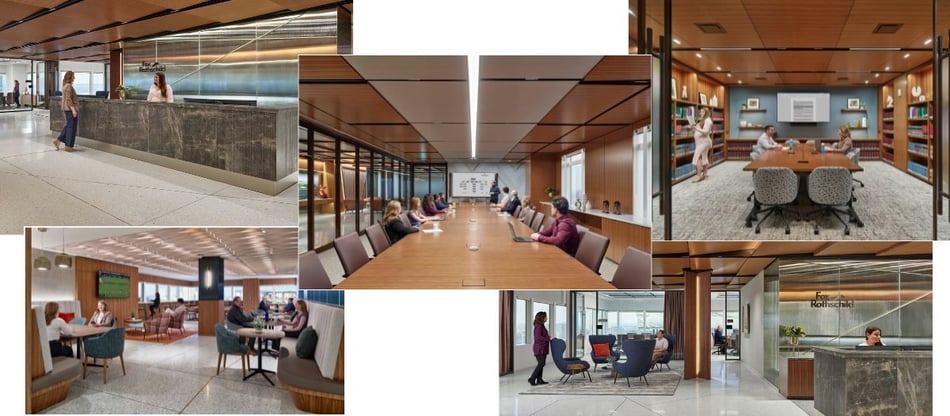
Case study: Fox Rothschild PhiladelphiaThe latest in a long series of collaborations spanning more than 35 years, FCA was tapped to envision Fox Rothschild LLP’s new Philadelphia headquarters. The firm has designed many iterations of Fox Rothschild’s offices and helped guide their space standards across the country for several decades. The new office spans 90,000 square feet across three floors and stands as a testament to the ways in which nationally recognized law firms are successfully navigating the transition to the “tomorrow” of the legal office. The updated design looks to the firm’s heritage for inspiration while firmly positioning the office for future growth. Aesthetically, the space nods to Fox Rothschild's original 1997 office in Philadelphia, Pennsylvania, USA, also designed by FCA, reinterpreting a variety of classic elements to better accommodate the expectations of today's workforce. This approach allows the firm to maintain continuity with its established identity while still signaling its broader commitment to innovation and adaptation. With a design concept centered on creating a strong connection to Philadelphia, subtle references to the city's historic urban grid are incorporated directly into the space's architectural geometry and detailing. This place-based approach helps establish the office as authentically rooted in its community while still underscoring the firm’s national identity. Moving through the space, a contrasting palette of terrazzo and natural wood is juxtaposed against soft upholstery, creating visual interest while reflecting the transitional nature of the space's design concept. This material strategy successfully bridges the gap between traditional legal gravitas and contemporary approachability. In terms of space allocation, the new layout reflects hybrid work priorities, keeping the user experience in mind with every design decision. Glass-front offices shifted toward the interior and workstations positioned along the perimeter to maximize natural light exposure throughout the workspace. Universal office sizes promote equity and flexibility, while reservable spaces and mobile storage solutions support the varying needs of hybrid workers. The middle floor features a centrally located employee cafe, designed by FCA into a vibrant hub modeled after boutique hotel-style lounges. This space includes grab-and-go offerings, sparkling and flavored water taps and diverse seating options, reinforcing its role as a secondary workspace where remote workers can collaborate or relax when visiting the office. Client-facing areas are strategically positioned on the top floor, creating an impressive environment for meetings and presentations —keeping privacy for sensitive discussions at the forefront. Reflecting the firm’s equal commitment to clients and employees, Fox also directed the team to design an internal-use café with the same level of quality, detailing, materials and finishes as the client-facing spaces. |
Looking forward: The future of legal workspace
In the future, the most successful legal firms will be those that can maintain their professional credibility while creating environments that support collaboration, flexibility and well-being for staff, driving experience for internal and external parties alike.
This evolution represents a new standard for law offices that embrace reduced real estate, uniform office sizes, technology integration, and flexible workflows that can be adapted to different markets and client needs. As the legal industry evolves, the firms that thrive will be those that recognize their physical workspace as a strategic asset that can drive performance, attract talent, and enhance client engagement — and the most important investment today may not be in impressive individual offices, but in spaces that thoughtfully break down hierarchies to help teams do their best work.

Tiffany Hughes, NCIDQ, LEED ID+C, is a senior interior designer with a strong corporate workplace portfolio, specializing in high-profile commercial and hospitality projects with a focus on national law firms. She brings expertise in guiding buildings through the evolving needs of the modern workplace, ensuring spaces are adaptable and future ready. Known for her exceptional design sense and keen eye for finish selection, Hughes consistently creates environments that leave a lasting impact.
Read more on Real Estate , Leadership & Strategy and Facility Operations or related topics Case Study , Space design and planning and Occupant Services
Explore All FMJ TopicsRelated articles
-

Plugged In
Solving the data disconnect in real estate and FMBy Amanda Muzzarelli & James Waddell07.01.2024 -
Food for Thought
Installing pop-up food programsBy Stafford McKay09.18.2024 -

Guarding Against Graffiti
Protocols that help prevent & remove graffiti on college campus buildingsBy John Lesak & Sarah Brummett11.26.2024