
 Membership
 Network
 Regional Sites & Affiliates


 Events
 Participate
 Resources

 Training
 Credentials
 Government


 Content Channels
 Tools
Tools


 Business Overview




Case Study: Cost Optimization in FM Without Operational Damage
Why realigning resources is the sustainable path to savings

Cost optimization is no longer an occasional exercise in facility management. It has become a continuous expectation driven by rising operating costs, fixed service fees, increasing asset complexity and growing performance demands from stakeholders. Organizations expect their facility managers to deliver higher service reliability while operating within shrinking budgets, which is a challenge that often creates tension between financial control and operational stability.
Many organizations approach cost reduction initiatives through familiar and convenient measures. Technical manpower is reduced, preventive maintenance frequencies are relaxed, spare part budgets are constrained and vendor contracts are aggressively renegotiated. While these actions may create immediate financial relief, they frequently do so at the expense of long-term reliability, safety and asset health.
As FMs are tasked to do more with less, it is possible to achieve cost optimization without layoffs, increased breakdowns or service disruption. FMs can achieve sustainable savings through correcting operational misalignment rather than through blunt cost cutting.
The reality of cost pressure in modern FM operations
FM operates at the intersection of finance, engineering and service delivery. Unlike many corporate functions, FM cost reductions are felt immediately on the ground. Reduced budgets directly influence maintenance quality, response time, asset reliability and user satisfaction.
In competitive markets, organizations often award FM contracts based on price rather than operational maturity. As a result, many organizations enter service delivery already under cost pressure. When additional reductions are imposed mid-contract, FMs are forced to make difficult decisions under tight constraints.
In this context, the difference between cost reduction and cost optimization becomes critical. Cost reduction focuses on lowering expenditure. Cost optimization focuses on removing inefficiency while protecting value. The case described here was approached with the second mindset.
Portfolio overview & operational constraints
The portfolio consisted of multiple occupied buildings operating on extended schedules. The facilities supported business-critical functions and could not tolerate frequent system downtime or prolonged service interruptions. Mechanical and electrical assets included chilled water plants, air handling units, pumps, electrical panels, uninterruptable power supply systems, and fire and life safety infrastructure.
From an operational perspective, these systems were interdependent. Failure in one area often cascaded into wider service disruption. Any cost optimization strategy had to preserve system reliability and response capability.
Senior management requested a cost reduction target of approximately 15 percent across the portfolio. While the target itself was not unusual, the expectation was clear: service levels must remain stable, and risk exposure must not increase.
Why traditional FM cost-cutting creates hidden losses
Traditional cost-cutting measures in FM often appear logical but fail under operational scrutiny.
Reducing manpower may lower payroll cost, but it frequently increases overtime, contractor reliance and fatigue-related errors. Deferred preventive maintenance reduces immediate expenditure but accelerates asset degradation, leading to higher corrective maintenance cost and premature replacement. Aggressive vendor cost reduction without scope clarity transfers risk back to the client organization, increasing management burden and liability exposure.
These approaches fail because they focus on budget lines, not work dynamics. Those in leadership may assume cost is evenly distributed, when in reality, cost concentration in FM is driven by misallocated effort, poor planning and reactive behavior.
Recognizing these risks, the organization decided to avoid immediate cuts and instead chose to understand how work was actually performed.
Adopting a diagnostic mindset
Before making any budget adjustments, a structured diagnostic assessment was initiated. The purpose was not to defend existing costs, but to identify inefficiencies that were invisible in high-level financial reports.
This diagnostic approach required engagement with site teams, review of historical data and honest evaluation of work practices. Although time-consuming, it created a factual foundation for informed decision-making.
Framework of the bottom-up assessment
The assessment was structured around five interconnected dimensions: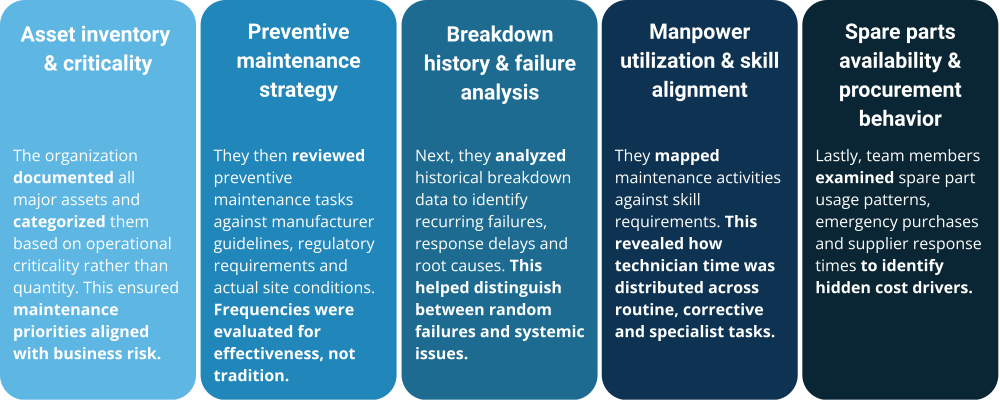
Key observations from the diagnostic studyThe assessment produced several important insights. Highly skilled technicians were spending a disproportionate amount of time on low-complexity, predictable tasks such as inspections, cleaning, lubrication and basic adjustments. While essential, these tasks did not require advanced troubleshooting capability and represented inefficient use of skilled labor. Emergency spare part procurement emerged as a major cost amplifier. The absence of standardized spare lists and defined stock levels resulted in reactive purchasing, higher unit prices and extended downtime during failures. Vendor engagement practices also showed misalignment. External contractors were routinely engaged for work that the in-house team was fully capable of executing safely. This duplication increased cost without improving outcomes. Collectively, these findings confirmed that the issue was not excessive manpower or excessive maintenance. The issue was misalignment between skills, tasks, spares strategy and vendor scope. |
Realignment as the core optimization strategy
With a clear understanding of the problem, the optimization strategy focused on realignment rather than reduction.
Manpower realignment based on risk & complexity
Maintenance tasks were categorized into predictable routine activities and high-risk or specialist interventions. Routine tasks were assigned primarily to in-house teams with structured planning and supervision. Specialist tasks remained with qualified vendors.
|
This ensured that skilled technicians focused on complex, value-adding work. Productivity improved, overtime reduced and operational resilience increased without reducing headcount. |
Transforming spare parts from cost to control
Spare parts management was repositioned as a reliability function rather than a financial burden.
Fast-moving and critical spares were standardized across sites. Minimum and maximum stock levels were defined based on asset criticality, failure probability and supplier lead times. Procurement was consolidated to improve pricing consistency and supplier accountability.
|
As a result, emergency purchases declined significantly, response times improved and budget predictability increased. |
Vendor scope rationalization
Vendor contracts were reviewed with emphasis on scope clarity rather than headline savings. Services that duplicated in-house capability were removed, while specialist services were retained with clearly defined deliverables.
|
This approach reduced contract values by 20-25 percent in several cases without increasing operational risk. More importantly, it restored clarity of responsibility and improved coordination between in-house teams and vendors. |
Impact on operational performance
Following implementation, cost reductions aligned closely with management targets. More importantly, these savings were not offset by increased failures or complaints.
Preventive maintenance compliance improved, breakdown frequency declined and response times became more predictable. Asset conditions stabilized, and operational confidence increased among site teams.
|
From a governance perspective, management gained greater visibility and control. Decisions were supported by operational data rather than assumptions, enabling proactive rather than reactive management. |
Life-cycle cost perspective
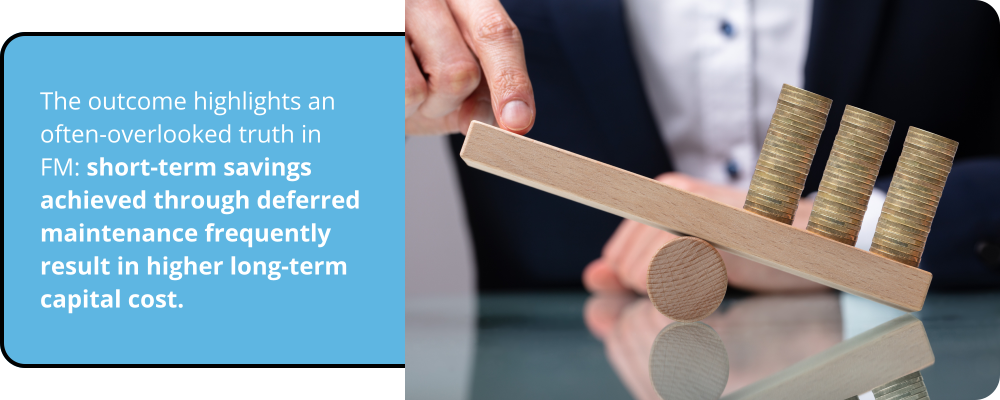
A key benefit of the realignment approach was improved life-cycle cost control. By protecting preventive maintenance and optimizing spare availability, asset degradation was slowed and failure-related stress reduced, which delayed major capital expenditure and improved return on asset investment.
Leadership lessons
This case offers several lessons for FMs leaders operating under cost pressure.
Cost optimization should begin with understanding how work is performed, not with arbitrary targets. Manpower decisions must consider utilization and skill alignment, not headcount alone. Preventive maintenance should be treated as a risk mitigation tool, not a discretionary expense. Vendor engagement should complement internal capability, not replace it.
Most importantly, alignment creates efficiency, resilience and control. Misalignment creates hidden cost, operational risk and long-term instability.
Governance, controls & decision transparency
An often-overlooked benefit of structured cost optimization is improved governance. In many FM operations, decisions related to manpower, maintenance and vendor engagement are made reactively, often under pressure and without full visibility of downstream impact. This creates inconsistency and weakens management control.
In this case, the diagnostic approach introduced transparency into decision-making. Manpower allocation, spare part stocking and vendor engagement were no longer based on habit or urgency, but on defined criteria linked to asset criticality and operational risk. This clarity improved internal accountability and strengthened confidence at senior management level.
From a governance perspective, cost optimization shifted from a periodic financial exercise to an ongoing operational discipline. Managers were able to justify decisions using data rather than assumptions, reducing friction between finance and operations. Over time, this alignment between operational reality and financial oversight became a key enabler of sustained cost control.
Replicability across FM portfolios
While this example is drawn from a specific multibuilding portfolio, the principles applied are widely transferable. Most FM operations share similar characteristics: mixed asset criticality, limited budgets, reliance on vendors and pressure to maintain uninterrupted service.
The approach described does not depend on advanced technology or large capital investment. It relies instead on structured thinking, accurate data and disciplined execution. Any FM organization with access to basic asset records, maintenance history and workforce data can apply similar diagnostic methods.
By focusing on alignment rather than reduction, FMs can adapt this framework to portfolios of varying size and complexity.
 Conclusion
Cost optimization in facility management does not require sacrificing reliability, safety or workforce stability. When approached through structured diagnosis and thoughtful realignment, organizations can achieve meaningful and sustainable savings while improving operational performance.
This experience demonstrates that the most effective cost optimization strategies are not those that cut deepest, but those that align smartest. For FMs facing increasing financial pressure, this distinction is not optional — it is essential.
In an era of rising costs and rising expectations, FMs are not just custodians of assets, they are architects of resilience. Sustainable cost optimization is not about cutting corners; it is about connecting them more intelligently.

Faiq Rauf is an experienced facility management professional with more than a decade of hands-on involvement in multi-site operations, maintenance strategy and cost optimization. His work focuses on aligning operational delivery with asset reliability, workforce effectiveness and long-term value protection. He brings a practical, field-driven perspective shaped by managing complex building systems in demanding environments. Rauf's interests include sustainable FM practices, operational governance and bridging the gap between strategy and execution.
References
Images via Getty Images.
Read more on Project Management and Finance & Business or related topics Case Study , Project Management , Cost Savings and Operational and Capital Budgeting
Explore All FMJ Topics