
 Membership
 Network
 Regional Sites & Affiliates


 Events
 Participate
 Resources

 Training
 Credentials
 Government


 Content Channels
 Tools
Tools


 Business Overview





Case Study: From Tender Delivery to Organizational Capability
Lessons learned from an international FM bidding in MENA

International FM tenders in the MENA (Middle East, North Africa) region are increasingly complex, particularly for airports, mixed-use developments and large-scale hard services projects. Adapting international best practices is crucial to understanding RFP review, clarification management, technical-commercial coordination, document control, operational readiness and risk management.
 Context of the tender review
After completing an airport FM tender, the team conducted a structured review based on internal survey inputs.
The review confirmed strong commitment and an acceptable submission under pressure, while identifying key improvement areas: project-based tender management, early strategy alignment, clear authorization, RFP extraction, technical-commercial coordination, vendor/OEM database development, document control and knowledge retention.
|
Area |
Consolidated Finding |
Management Implication |
|
Team commitment |
Strong effort; acceptable submission under time pressure. |
Use front-loaded planning and earlier decisions. |
|
Tender strategy |
Positioning was suitable; evidence could be stronger. |
Define win themes and proof points early. |
|
Project management |
Tender was not managed clearly as a project. |
Assign an authorized bid/tender project manager. |
|
RFP compliance |
Extraction and compliance mapping were useful but late. |
Use the compliance matrix as a live control tool. |
|
Technical-commercial alignment |
Manpower, vendors, spare parts and commitments were closely linked. |
Review commercial assumptions with technical commitments. |
|
Knowledge retention |
Valuable templates and experience were created. |
Build and maintain a tender knowledge base. |
Key observations from the tender process
-
Tender pressure comes from late clarity, not only tight time
-
RFP complexity creates hidden risk
-
Technical quality requires both expertise and evidence
-
Commercial alignment cannot be left to the end
-
Vendor/OEM management is a critical success factor
A practical tender management framework for FM projects
Based on the tender review, future FM tenders should adopt a simple stage-gate model supported by key management controls. Each stage should have clear outputs, responsible owners and control tools to ensure compliance, consistency and submission readiness.
The key controls include project governance, RFP extraction, compliance tracking, technical-commercial alignment, vendor/OEM management, document control, risk closure and knowledge retention.
|
Stage |
Key Purpose |
Main Outputs |
Key Control |
|
1. Opportunity Review |
Confirm bid fit and feasibility. |
Go/No-Go decision; key risks; resource estimate. |
Tender project management procedure |
|
2. RFP Intake and Control |
Organize tender documents. |
Document register; version folder; checklist. |
Document control and proposal template |
|
3. RFP Extraction |
Capture requirements and risks. |
Requirement table; compliance matrix; clarifications. |
RFP extraction and compliance matrix |
|
4. Tender Strategy |
Define win themes and direction. |
Strategy sheet; solution framework; assumptions. |
Tender project management procedure |
|
5. Proposal Development |
Prepare technical and commercial content. |
Technical proposal; cost model; vendor inputs; QHSE response. |
Technical-commercial alignment mechanism; Vendor / OEM database |
|
6. Review and Alignment |
Check completeness and consistency. |
Review comments; action tracker; risk closure; approval. |
Risk and issue closed-loop tracker |
|
7. Final Submission and Archive |
Submit and retain knowledge. |
Final files; submission evidence; lessons learned. |
Tender knowledge base |
Detailed lessons learned
Lesson 1: FM tenders should be managed as projects
Large international FM tenders in MENA should be managed as cross-functional projects, not writing tasks. Fragmented RFPs, changing clarifications, strict SLA penalties and complex commercial assumptions require structured control across RFP review, technical solutions, costing, compliance, document management and final submission to avoid rework, gaps and weak evidence.
Lesson 2: Start with strategy before writing
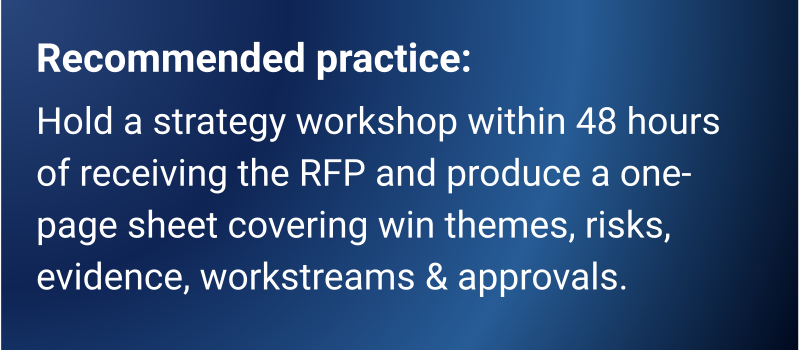
Many tender teams start writing too early, creating initial speed but later confusion. A better approach is to define strategy first: client priorities, scoring logic, key risks, differentiators, evidence, technical direction, commercial assumptions and responsibilities.
Lesson 3: Treat the compliance matrix as a control tool
The compliance matrix should be a live management tool used from the beginning to final submission. Each RFP requirement should be assigned an owner, response strategy, proposal reference and status. This allows the bid manager to monitor completeness and identify gaps early.
|
Recommended Field |
Description |
|
RFP page number |
Use the original RFP page number or bottom-left page number when applicable. |
|
Clause number |
Record the exact clause reference. |
|
Requirement keywords |
Summarize the requirement in concise keywords. |
|
Responsible owner |
Assign a person or discipline team. |
|
Response strategy |
Define how the proposal will respond. |
|
Offer reference |
Link to chapter, section and keywords. |
|
Page reference |
Update after final formatting. |
|
Status |
Open, drafted, reviewed, closed or not applicable. |
Lesson 4: Clarifications must be managed like contractual changes
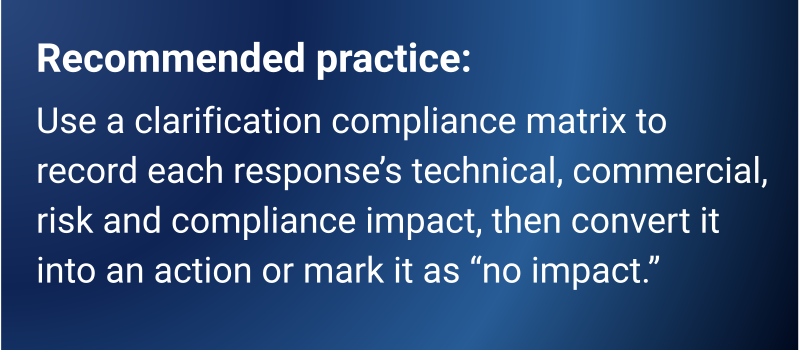
In MENA tenders, client clarifications may change scope, spare parts responsibility, exclusions, KPI interpretation, permits, penalties or site facilities. They should be treated as part of the RFP and version-controlled.
Lesson 5: Technical & commercial teams must work together
A technical solution that is not priced is a risk. A price that does not reflect the technical promise is also a risk. Tender teams should hold formal technical-commercial alignment meetings at key milestones, especially after manpower planning, vendor input, spare parts strategy, mobilization plan and KPI commitments are drafted.
|
Technical Commitment |
Commercial Check Required |
|
24/7 duty coverage |
Salary, shift allowance, backup manpower and overtime assumptions. |
|
OEM-authorized maintenance |
Vendor contract price, authorization cost, spare parts lead time. |
|
Critical spare parts availability |
Inventory cost, warehouse space, replenishment mechanism. |
|
Fast response time/MTTR |
On-site staffing, tools, vehicles, dispatch and escalation cost. |
|
CMMS reporting and dashboard |
Licenses, accounts, mobile terminals, data management effort. |
|
Mobilization and handover |
Temporary facilities, recruitment, training, asset verification and document review. |
Lesson 6: Proposal writing requires a common style & editor
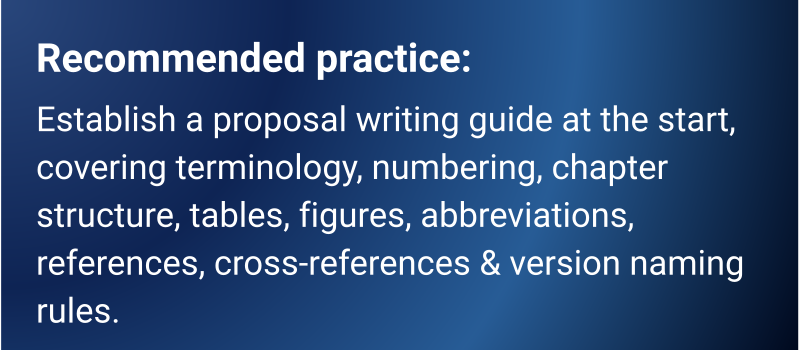
When multiple contributors write different chapters, the proposal may become inconsistent in tone, detail, terminology, layout and evidence quality. For major tenders, a dedicated document controller and proposal editor are needed to ensure coherence, traceability and final presentation quality.
Lesson 7: Vendors should be managed as proposal partners
Vendor inputs are critical and should be structured through a standard response pack covering scope, methodology, manpower, spare parts, response time, SLA/KPI commitments, authorization, certificates, exclusions, price validity and contacts.
Tender risks often appear as small comments, such as unclear scope, missing vendor quotes, inconsistent manpower, uncertain penalties, spare parts ambiguity or missing CVs. Without a visible tracker, these issues may remain open until final review.
Lesson 8: Risk & issue closure should be visible
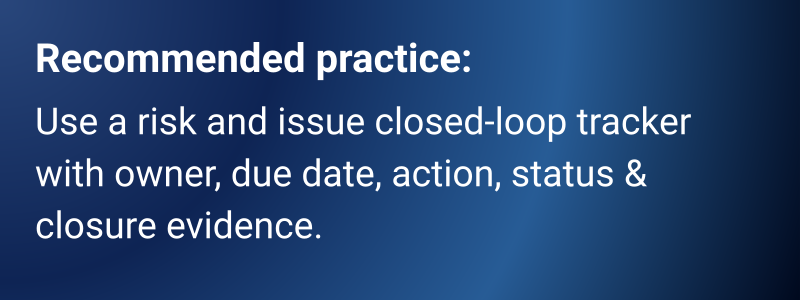
Tender risks often appear as small comments: unclear scope, missing vendor quote, inconsistent manpower, uncertain penalty, ambiguous spare parts responsibility, or missing CV. Without a visible issue tracker, these risks may remain unresolved until the final review.
Lesson 9: Knowledge must be retained immediately after submission
The best time to capture lessons learned is immediately after submission, while memories are fresh. Tender files, vendor data, clarification responses, compliance matrices, technical modules, pricing assumptions and review comments should be archived in a standard folder structure.
This turns the experience of one tender into reusable organizational capability.
Recommendations
To improve future FM tender performance, organizations should establish standard tools, clear governance, and practical working methods. The following recommendations provide a minimum framework for future MENA FM tenders.
Standard tools & templates
A standard template package should be developed and maintained for future FM tenders.
|
No. |
Tool / Template |
Purpose |
|
1 |
Tender Project Charter |
Defines objectives, scope, roles, schedule, authority and deliverables. |
|
2 |
Go/No-Go Assessment Sheet |
Supports early bid decision and resource planning. |
|
3 |
RFP Requirement Extraction Table |
Captures client requirements in a structured format. |
|
4 |
Compliance Matrix |
Maps RFP requirements to proposal chapters and pages. |
|
5 |
Clarification Register |
Tracks client questions, answers, impacts and actions. |
|
6 |
Technical-Commercial Alignment Register |
Links technical commitments with cost assumptions and exclusions. |
|
7 |
Vendor/OEM Response Template |
Standardizes vendor inputs and supporting evidence. |
|
8 |
Risk and Issue Tracker |
Tracks risks, actions, owners and closure evidence. |
|
9 |
Review Comment Sheet |
Records expert comments and response actions. |
|
10 |
Final Submission Checklist |
Controls final packaging, signatures, attachments and electronic copies. |
|
11 |
Lessons Learned Template |
Records successes, gaps and future improvements. |
Governance model & RACI logic
Major tenders require clear governance. The bid manager/tender project manager should have sufficient authority to coordinate workstreams, set deadlines, escalate issues and control document versions. Leadership should focus on strategy, key decisions and resource support.
|
Role |
Main Responsibility |
|
Bid sponsor |
Approves bid strategy, major assumptions, resources and final submission. |
|
Bid manager/tender project manager |
Owns schedule, task allocation, coordination, issue tracking and submission readiness. |
|
Technical lead |
Defines technical direction, reviews content and ensures RFP compliance. |
|
Commercial lead |
Owns pricing, cost boundaries, assumptions and financial risks. |
|
QHSE lead |
Develops quality, health, safety, environment and compliance responses. |
|
Procurement/vendor coordinator |
Collects vendor quotations, OEM evidence, technical inputs and spare parts data. |
|
HR/manpower coordinator |
Prepares manpower plan, CVs, qualifications, recruitment and training inputs. |
|
Document controller/proposal editor |
Controls versions, format, numbering, references, appendices and final packaging. |
|
External experts |
Review technical depth, market realism, compliance risks and competitiveness. |
Practical guidance for future FM tenders
-
-
Future MENA FM tenders should use a front-loaded schedule. The proposal framework, win themes, RFP extraction and responsibility allocation should be completed early, leaving the final stage for review and approval.
-
RFPs, appendices, drawings, bill of quantities, clarifications and client emails should be treated as one integrated requirement package. A live compliance matrix should be established from day one and updated with proposal changes.
-
Technical-commercial alignment meetings should be held before major drafts are frozen, especially for manpower, vendor scope, spare parts, consumables, temporary facilities, permits, exclusions and pre-existing defects.
-
Major tenders should use structured vendor/OEM inputs, a qualified vendor database, a document controller, a proposal editor, a risk and issue tracker, and a clear archive process. Lessons learned should be converted into templates, procedures and training materials.
-
For FM professionals, tender management is more than proposal writing. It connects operations, strategy and business development, requiring RFP interpretation, contract awareness, SLA/KPI design, cost control, risk management, vendor coordination, technical writing and cross-cultural communication.
-
Knowledge retention
-
-
By institutionalizing these lessons, an FM organization can turn tender pressure into organizational learning, improve future bid competitiveness, and strengthen long-term service delivery capability.
-
Conclusion
-
-
Successful international FM bidding requires both technical expertise and management discipline.
-
A major tender should be managed as a structured project, not only as a document-writing task.
-
The key improvement is to build a repeatable tender management system, covering:
-
✅project governance
✅RFP extraction
✅compliance control
✅clarification management
✅technical-commercial alignment
✅vendor/OEM database
✅document control
✅risk closure

Xingya Yong, CFM, FMP, is a senior facility management professional with over 20 years of experience in technical operations, hard services management, project transition and integrated FM system development. He has led and contributed to major FM tendering, takeover inspection, technical proposal development and performance management initiatives across China and the Middle East, with strong expertise in ISO 41001, QHSE, SLA/KPI management, CMMS, maintenance strategy, vendor coordination and operational readiness. Yong has extensive FM experience across industrial manufacturing facilities, laboratories, R&D environments, corporate offices, commercial complexes, international airport terminals, CBD city-operation projects, critical environments, multi-site portfolios and large-scale hard services operations. He combines practical engineering knowledge with strategic FM management capability, positioning him as an experienced FM practitioner in international hard services and operational management.
References
Top image via Getty Images.
Read more on Facility Operations , Finance & Business and Project Management or related topics Operational and Capital Budgeting , Supplier or Vendor Management and Project Management
Explore All FMJ Topics