
 Membership
 Network
 Regional Sites & Affiliates


 Events
 Participate
 Resources

 Training
 Credentials
 Government


 Content Channels
 Tools
Tools


 Business Overview





Case Study: NFC-enabled Mobile IDs
A blueprint for university campuses
More than ever, university students are using their smart phones to access campus buildings, purchase meals and experience various elements of campus life with a single tap of their mobile device. This level of access is no longer a pipe dream, future endeavor or just a one-off experience. This is happening right now at the University of Arizona, which has become a model to scale the use of mobile access at colleges and universities around.
What can campus facility managers learn from this deployment of NFC-enabled mobile IDs?
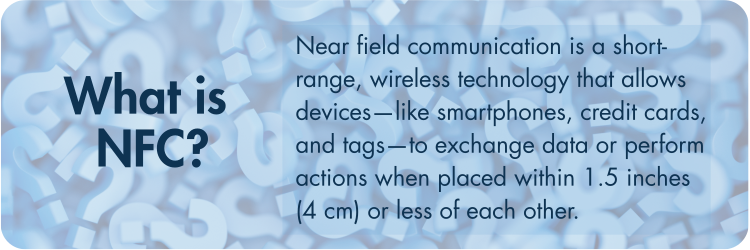 Students, faculty and staff at the University of Arizona (Tucson, USA) have discovered and embraced a new freedom – from plastic badges and the clunkiness of multiple physical keys. At the same time, it has become a blueprint for FMs to also experience a different kind of freedom, which is to use their transaction and ancillary systems of choice while preserving integration interoperability.
At the heart of this blueprint for university student digital IDs is a tech-agnostic approach with a connected access platform that operates independently of proprietary hardware and software to seamlessly integrate data from various systems. A university (or any organization) can harness their existing infrastructure by unifying all their siloed systems into a single, centrally managed ecosystem.
For example, a university can leverage its existing access control system(s) and mobile-enabled readers to incorporate the use of digital student IDs. The strategy for facilities is to take advantage of the standardization of digital wallet apps such Apple Wallet and Google Wallet as the tools by which a student ID can be added to phones and smart watches easily and quickly. By leveraging these mobile devices already being used on campus, any university can roll out NFC-enabled digital student IDs the same way that the University of Arizona recently did for 53,000 students and 16,000 faculty and staff.
 The transformation of phones into highly secure mobile IDs means that students, faculty and staff can complete any action that would have previously required a physical card – both on and off campus – with their smart device. Users can simply hold their device up to a reader to enter dorms, libraries and fitness centers, as well as to buy lunch, make purchases at campus stores and print documents, among other things. It is an all-access pass to campus life.
No extra steps required
For FMs, this all may sound too good to be true or a recipe for complexity. What about provisioning? What about security? The mobile access deployment blueprint at the University of Arizona is built on foundational pillars that are not only student-oriented for mobile-centric living, but also FM-friendly:
 Ease of set-up, ease of use & ease of management: An existing university ID for a student or faculty can be transferred automatically to an NFC-enabled mobile device with no extra steps required. As soon as the device is activated, the digital ID is ready to use, just like the way traditional physical cards have worked in the past. Automation in the provisioning and set-up of digital student IDs has advanced to the point where an FM can have far better visibility by managing all the mobile IDs from a single view, while making access easy and effortless for the user. Centrally managing physical access also offloads unnecessary burdens from facility managers and resources previously allocated toward physical card issuance, allowing them to be refocused on higher-value functions.
Unifying disparate systems & applications: It is critical to have an agnostic integration layer that ties together all the different systems and business applications, from physical identity and access to payment, event management and beyond. Simultaneously, this seamless backend integration ensures that there are no gaps, no hiccups and no roadblocks to rolling out mobile IDs. All of this is key to empowering universities to offer mobile IDs, which not only eliminates long card issuance lines, but they have also become part of the “cool factor” for students when they are choosing what university to attend.
Higher security: The adoption of NFC mobile devices for physical access provides enhanced security for facilities, with built-in features for users to immediately lock or suspend their devices when they are lost or stolen. Google’s Find My Device feature is accessible from any web browser to lock, suspend or erase a device, and the mobile ID holder can also use it to reactivate their mobile ID once their device is found. Apple’s Find My feature makes it possible to remotely lock, erase or suspend a device so that someone, perhaps a bad actor, cannot use the mobile ID. Once the device is found, the mobile ID holder simply signs in with their iCloud password, and their mobile ID will reactivate. Apple’s iCloud Binding for access credentials feature also helps prevent fraud in financial transactions, such as meal plans and prepaid campus card systems.
Sustainable efficiency: The transition to mobile access with mobile student IDs saves a university money, time and resources because it no longer must buy and distribute so much plastic. It is also better for the environment to not have so many plastic cards recycled. The production, transportation and disposal of physical cards all contribute to carbon emissions and fossil fuel depletion. A credential life cycle study found that mobile credentials result in a 75 percent reduction in carbon dioxide emissions compared to plastic cards.
Tighter compliance: With digital student IDs that are centrally managed, a university can quickly generate reports from one source, which is a significant improvement over tracking physical access logs across multiple systems. This enables FMs to easily produce audit reports and prove compliance with specific regulations, all while ensuring operational efficiency and integrity.
These pillars serve as lessons learned for universities to deploy mobile student IDs on a large scale across university campuses. It is proven by the landmark mobile ID deployment for 69,000 University of Arizona Wildcats that leverages students who bring their own technology, campus key readers and tech-agnostic platforms that are powering their new mobile CatCard. Operating independently of proprietary hardware or software, the platform seamlessly integrates data from various systems to give facility managers the flexibility to use their preferred transaction and ancillary systems, while still ensuring integration interoperability as their institutions evolve.
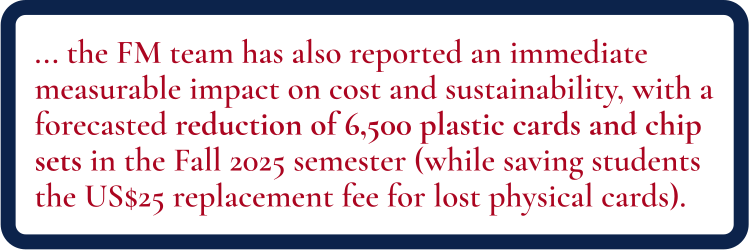
The biggest gain for the university is that the new mobile CatCard supports its progress toward a more connected and secure digital campus. The FM team has also reported an immediate measurable impact on cost and sustainability, with a forecasted reduction of 6,500 plastic cards and chip sets in the Fall 2025 semester (while saving students the US$25 replacement fee for lost physical cards).
Importantly, students are excited to have CatCard on their phones to make campus life a lot easier, including never having to think about being locked out of campus services when they lose or forget physical ID cards. Yet the University of Arizona mobile CatCard launch does not just serve its Wildcats. Its streamlined approach to implementation has set the stage for other universities to deploy NFC wallets for mobile access. This includes putting facility management on the leading edge of innovation for transforming the campus experience for students, faculty and staff.

Read more on Facility Operations , Facility Technology & Data Management and Risk Management or related topics Occupant Services , Case Study and Occupant Security
Explore All FMJ Topics