
 Membership
 Network
 Regional Sites & Affiliates


 Events
 Participate
 Resources

 Training
 Credentials
 Government


 Content Channels
 Tools
Tools


 Business Overview




Case Study: Taiwan
Using government collaboration to keep COVID-19 at bay
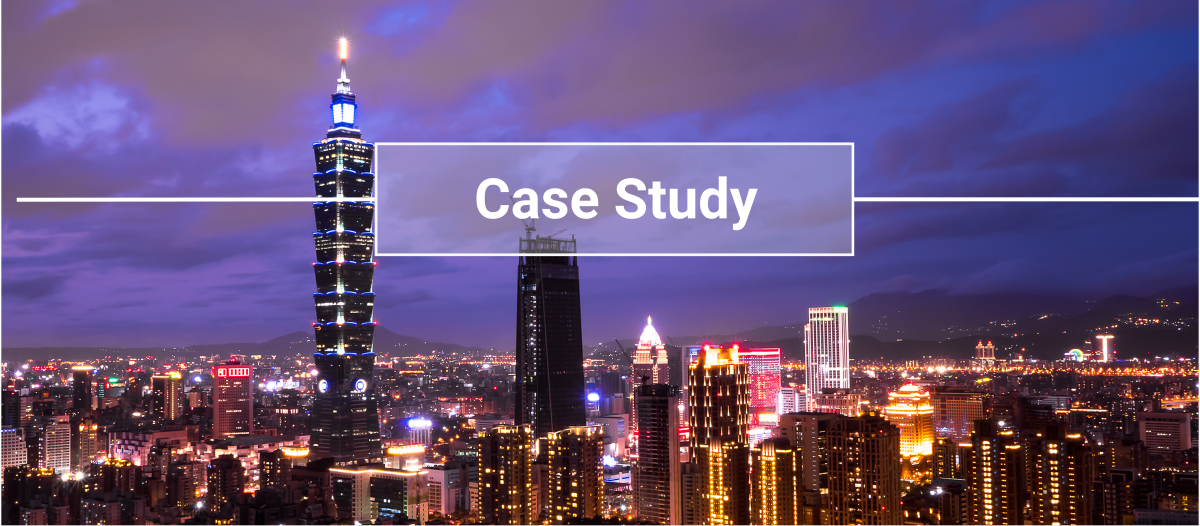
Some of the countries that are keeping COVID-19 under control come surprisingly close to the epicenter of the pandemic. A great example of this is the collaboration between government and the private sector in Taiwan, an active tech-driven economy right off the shores of China, where the virus originated.
As early as April 2020, a leading oil producing company in Taiwan, established business continuity plans following government guidelines, and since then have managed to fend off viral attacks and kept its employees safe. Many of the corporate programs related to facility management remain relevant.
The COVID-19 pandemic poses a great challenge to humanity and requires everyone to adapt to the new conditions. In the workplace, where most of the population spends close to a third of their time there is a flux of dynamics between the public and private sectors, represented by the government and the enterprise, respectively. When the two are able to align and collaborate, there is maximum effectiveness in their joint actions.
The context
Although Taiwan is situated in Far East Asia, its economic and political system is similar and relevant to the leading West ern societies. Its population and climate are similar to the state of Florida in the U.S. Its per-capita GDP ranks similarly with Germany and Sweden. Taiwan people directly elect their president, and are governed by a political system dominated by two strikingly contrasting parties.
The private sector of Taiwan boasts many of the unsung heroes behind global tech brands and is no doubt an active contributor to the global economy.
While Taiwan is less than 1,000 kilometers (600 miles) from Wuhan, China, the epicenter of the COVID-19 pandemic, it has managed to keep the total number of infections under 1,000 and deaths just seven (as of Jan. 1, 2021). There has not been a lockdown throughout the pandemic. People have been going to the office as usual, with no more than a handful of health precautions. These mild control mechanisms can serve as good references for enterprises around the globe, after the peak of the pandemic.
Top-level guidelines As early as March 5, 2020, the Taiwan government issued a document titled “Guidelines for Enterprise Planning of Business Continuity in Response to the Coronavirus Disease 2019 (COVID-19).” The paper recommends the following business response strategies when the infections are sporadic:
I. Actively encourage employees with fevers or acute respiratory symptoms to stay at home and rest.
II. Personal and workplace sanitation management for employees with fevers or acute respiratory symptoms.
III. Advocating proper cough etiquette and hand hygiene. IV. Regularly clean the environment and maintain good indoor ventilation.
It goes further to lay out guidelines in case the situation exacerbates with continuous or widespread community viral transmission:
I. Implement personal and workplace hygiene management.
II. Implement environmental epidemic prevention measures when confirmed infection case(s) exist within the company/ enterprise.
III. Adjust work hours, office hours, attendance or business trips to reduce cross-transmission between employees.
Additional detailed recommendations for implementing the guidelines are provided in this 22-page document. Some examples are included below.
1. Devise employee health monitoring plans and track abnormalities, including health monitoring surveys, conduct outine temperature checks, inquire about respiratory symptoms and assist mployees in seeking medical attention.
2. Establish clear rules on visitation and make alcohol-based hand sanitizers available for visitors; and devise health urveys for visitors upon entry. Visitors with risk should not be allowed to enter the work site.
3. Enforce resting at home for sick employees. Require employees to adhere to cough etiquette and to wash hands regularly. Companies should provide contactless trash receptacles.
4. Regularly clean the office environment and maintain good air ventilation.
5. Employees who develop fever and respiratory symptoms during work hours should report to their supervisors immediately, wear face masks, be transferred to an individual space and seek medical attention.
6. Schedule daily sanitization carried out by trained employees or contractors. Surfaces including table tops, chairs and floors are to be sanitized with a bleach solution or approved cleaning agent.
7. Employees who shared space with a confirmed case but have been approved to enter the workplace are required to wear face masks and required to wash hands regularly.
8. Implement flexible coordination of the workforce, establish off-site working mechanisms, reduce the number of concurrent workers and investigate the feasibility of work from home.
9. Adjust working space to maintain proper distance between seats, implement spatial segregation between employees, clients and collaborating parties.
10. Obey government-issued travel advisories, cancel unnecessary overseas business trips.
11. Cancel or delay large-scale assemblies or conferences and consider alternatives. Encourage employees to refrain from participating in mass events and activities.
12. Conduct job function cross training, so that business operations can be maintained when staff are on leave.
13. Employers should provide flexibility when employees need to stay home to take care of children at home due to possible school closure.
14. Utilize digital communication tools for continued sales and marketing operations. Negotiate with clients to extend delivery period. Negotiate with financial institutions for extension of grace period on interest payments.
The guideline also required employers to observe all regulations concerning personal privacy and confidentiality during the process.
Business continuity planning in the private enterprise
Following the government-issued guidelines, Taiwan’s leading petrochemical enterprise with nearly 16,000 employees and 500 field offices, produced its business continuity plan, which became a widespread case study model promoted by the government. In an online video clip, the company described its implementation with the following highlights:
1. Employee awareness & training
a. Deploy digital signage to provide relevant and updated information.
b. Provide ample personal hand sanitizer.
c. Promote social distance for employees both indoors and outdoors.
d. Promote wearing face masks when proper distance cannot be maintained.
2. Visitor management
a. Limit building entrances and exits to ensure all visitors are screen and managed.
b. Monitor body temperature for visitors and employees using long range sensors.
c. Conduct travel history survey for employees, contractors and visitors.
d. Require health declaration for contractors and visitors.
3. Health risk management
a. Require high-risk workers to follow quarantine procedures. Track and monitor employees with abnormal body temperature.
b. Conduct teleconferences for meetings involving 30 or more people.
c. Postpone non-essential training. Change to online training if possible.
d. Spread out elevator traffic by controlling floors of access.
4. Remote work management
a. Prepare for work from remote locations.
b. Set up secondary work location as emergency backup.
c. Isolate primary and secondary managers to avoid both being sick at the same time.
d. Provide secure network access from home (VPN).
5. Factory management
a. Essential workers who must be physically at the factory to perform work must be assigned shifts and only be allowed in at specified time.
b. Keep tight control of over-time work to minimize overlapping. Use automated scheduling tools and display schedule information clearly.
It is quite clear that technology is expected to deliver many of the solutions to help manage the workplace.
Implementation with FM technology
From this case, it is apparent that technology plays a central role to help tame the pandemic. The tools are so effective that it can be expected that months, even years, after the world lifts lock downs and returns employees to work, most of the mechanisms will remain to reduce the risk of spreading any remaining infections. They are summarized below.
Digital signage for improved corporate communication — the dynamic nature of digital displays makes them well suited for announcing up-to-date information and effective at drawing attention. They can be conveniently deployed at building entrances/ exits and near elevators to provide vital and regulatory guidelines.
Visitor management with personal identification and surveying — automated kiosks with employee badge readers can speed up entry and exit control for office buildings. The system keeps records of visitors, counts and limits the number of people present at the same time, and can collect health and travel history surveys.
Body temperature scanners for speed and safety — automated thermal cameras speed up the scanning of visitors upon their arrival, and avoid the risk of contact when using handheld temperature scanners.
Online conferencing to replace meetings and training — whenever possible, conduct conversations over electronic means to avoid physical contact.
Workplace scheduling tools and display — presence at the workplace or at meetings for essential workers must be tightly managed with scheduling tools so total occupancy of space can be managed, and later contact tracing is possible.
Conclusion
The case study in Taiwan demonstrates how a vibrant economy so close to the source of the pandemic managed to keep itself safe from the crisis. The process started from high-level government guidelines and progressed through private enterprise efforts. By utilizing technology to assist in streamlined risk-prevention processes, large enterprises are able to manage their facilities effectively and keep occupants safe and productivity mostly in tact. Step-by-step, this joint effort between the government and the private sector may serve as a valuable example of how the rest of the world will be able to reopen for a full recovery.

Read more on Training and Leadership & Strategy or related topics Training , Strategy and Case Study
Explore All FMJ TopicsRelated articles
-

Unlocking Operational Excellence
Essential strategies to elevate efficiencyBy Paul Phillips05.08.2024 -
Institutional Knowledge
5 steps to preserve & maximize veteran know-howBy Brian Haines11.05.2024 -

Fostering Employee Success
How workplace safety & retention lies in trainingBy Clare Epstein10.25.2024