 Membership
 Network
 Regional Sites & Affiliates


 Events
 Participate
 Resources

 Training
 Credentials
 Government


 Content Channels
 Tools
Tools


 Business Overview





Cooling, Power & Speed
The 3-way tension in modern data center construction
The physical infrastructure supporting the modern internet is in its most radical transformation since the dawn of the commercial web. For decades, data centers were treated like specialized industrial warehouses. The construction industry built them using repeatable, standardized blueprints designed for server racks that drew a predictable amount of electricity.
That framework has collapsed under the weight of AI and advanced computing. The massive computing clusters required to train modern AI models have introduced a brutal engineering challenge. Data center construction is now caught in a rigid, three-way tension between electrical power availability, physical cooling capacity and construction delivery speed.
1. Power procurement as a construction bottleneck
The primary bottleneck in data center development has shifted from capital availability to raw electrical power procurement. The Lawrence Berkeley National Laboratory estimated that U.S. data centers consumed about 176 TWh of electricity in 2023, equal to 4.4 percent of total U.S. electricity consumption. By 2028, that demand is projected to reach a range of 325-880 TWh, capturing between 6.7 and 12 percent of projected U.S. electricity use.
This rapid surge has overwhelmed local utility grids, forcing builders to wait years just to connect a new facility to the electrical power grid.
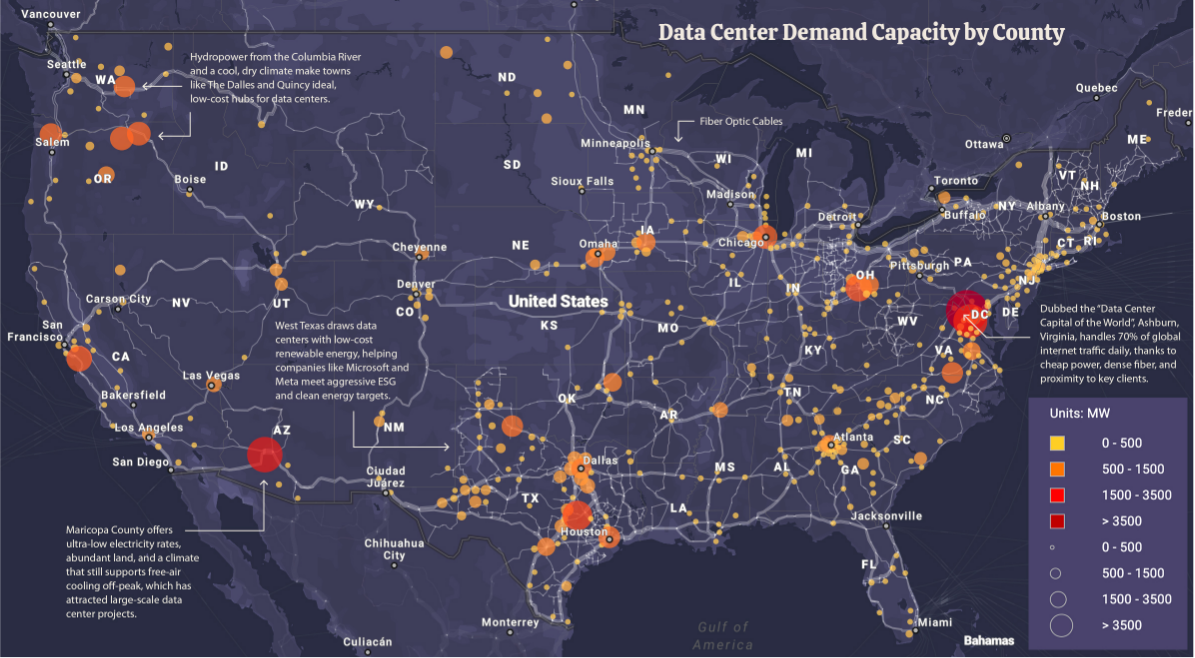
According to data from the Lawrence Berkeley National Laboratory, projects reaching commercial operation in the United States spend an average of 55 months in utility interconnection queues. This long wait has completely changed site selection and master planning. Developers can no longer simply buy land near major fiber-optic networks. Instead, they must design facilities that act as independent power plants, incorporating on-site battery storage systems, natural gas turbines or direct connections to clean energy sources.
Furthermore, high-voltage electrical equipment like custom transformers now carries manufacturing lead times of up to two years. Civil engineering teams must pour foundations and build structural shells long before the final electrical hardware even arrives at the site.
This power uncertainty also changes how campuses are physically planned. Electrical yards, substations, generator compounds, battery systems and future expansion zones must be reserved before the final utility strategy is fully confirmed. A site that appears adequate on a conventional master plan may become constrained once redundant feeds, fuel storage, acoustic setbacks and maintenance access are introduced. As a result, early civil, structural and electrical decisions must preserve multiple power scenarios. Flexibility at this stage is not excess capacity; it is protection against redesign when utility commitments, equipment selections or energization dates shift. That requirement turns power planning into a site-wide construction decision rather than a utility exercise.
2. The physical breakdown of air cooling
As data center power demands spike, the heat generated by the computer chips rises exponentially. Traditional data centers relied on massive air-conditioning units to push cold air through raised floors and open server aisles. This method worked effectively when server racks drew less than 10 kW of power.
Today, average rack densities have surged to 27 kW according to the industry research group AFCOM. At the leading edge, new AI server architectures draw between 120 and 140kW within a single rack footprint. Air cannot physically absorb or dissipate that concentrated heat flux. This thermodynamic reality forces the construction industry to transition to liquid cooling systems.
|
Cooling System Type |
Electrical Capacity Limit |
Primary Construction Constraint |
|
Legacy Air Cooling |
Up to per rack |
Requires massive air ducts and large spatial footprints. |
|
Direct-to-Chip Liquid Cooling |
Up to per rack |
Requires extensive secondary piping networks and leak protection. |
|
Chassis Immersion Cooling |
Exceeds per rack |
Requires heavily reinforced concrete slabs to support fluid weight. |
 This shift transforms the internal architecture of the building. Direct-to-chip cooling requires routing miles of liquid pipelines directly above sensitive electronics, demanding strict weld certifications and automated leak-detection systems. When developers opt for full immersion cooling, where servers are submerged in tanks of specialized fluid, the structural weight of the building skyrockets. Structural engineers must completely recalculate the floor load capacities, moving away from lightweight flooring toward ultra-thick, reinforced concrete slabs.
Liquid cooling also creates an operational challenge beyond heat removal. Pumps, heat exchangers, coolant distribution units, valves, sensors and leak-detection devices all require clear access for inspection and replacement. These components cannot be positioned only according to whether they fit within the model. Their maintenance envelopes, isolation zones, drainage paths and removal routes must remain usable throughout the facility’s operating life. In high-density white spaces, a few inches lost during coordination can obstruct a valve, restrict equipment replacement or force technicians to work dangerously close to energized infrastructure. Constructability and maintainability therefore must be evaluated together from the earliest coordination stage.
3. The financial cost of accelerated build cycles
In the technology sector, financial success is tied directly to deployment speed. The company that brings computational capacity online first captures the market. However, the complexity of modern engineering constraints is slowing completion schedules globally, causing roughly 35 percent of announced data center projects to face delays.
The added complexity has also driven a stark escalation in construction costs. Real estate firm JLL reports that while a standard data center shell and core costs around US$11.3 million per megawatt to construct, an AI-optimized facility equipped for high-density liquid cooling can easily exceed US$20 million per megawatt.
To bypass traditional multiyear design schedules, construction teams are adopting two primary strategies:
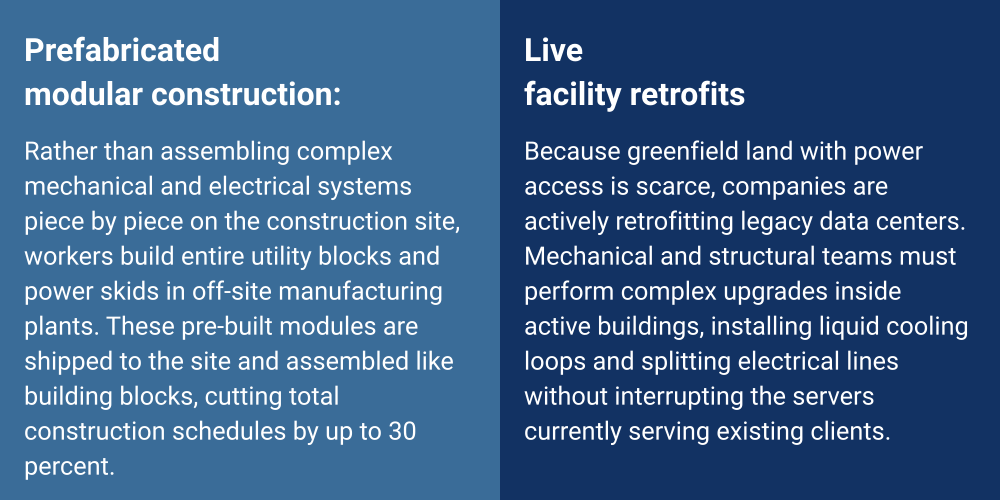 Both strategies increase the number of interfaces that must be controlled. Prefabricated assemblies depend on exact connection points, verified tolerances, coordinated lifting paths and a site sequence that matches factory production. Live retrofits add another layer of risk because new work must be isolated from operating systems without compromising redundancy. This makes phased commissioning essential. Power, controls, cooling, monitoring and life-safety systems must be tested in logical packages as each area becomes available. A schedule may be compressed, but system verification cannot be postponed without transferring unresolved risk directly into operations.
Flawless spatial coordination as an absolute mandate
 Navigating this unprecedented level of structural density requires a fundamental shift in design execution. Traditional 2D schematic workflows are entirely inadequate for the micro-tolerances required by modern white spaces.
Because high-voltage electrical containment, complex secondary piping loops and massive structural reinforcers must occupy the exact same spatial footprint, building teams must treat comprehensive 3D MEP modeling as a mission-critical phase rather than an administrative step.
Resolving geometric clashes in a virtual environment before a single pipe is fabricated is the only viable method to safeguard these projects from catastrophic field modifications. Modeling every valve, weld and pipe slope to precise physical tolerances guarantees that dense mechanical infrastructure can be integrated directly over live computational environments without disrupting primary power pathways. Proactive virtual construction modeling transforms these spatial hazards from a source of field friction into a predictable, highly systematic assembly process.
Wrapping up
The modern data center can no longer be built through isolated phases of engineering. A single modification made by a mechanical engineer regarding liquid temperatures instantly alters the electrical team’s power requirements and changes the physical footprint of the equipment yard.
Construction teams finding success in this landscape are those that treat the data center not as a collection of separate parts, but as a single, unified thermodynamic ecosystem. By balancing power procurement, fluid dynamics and modular construction schedules simultaneously, builders can deliver the physical backbone that the digital future requires.
As data center demand accelerates, is the industry’s biggest constraint now capital, power availability, construction capacity or operational readiness?

Akash Patel is a VDC/BIM Manager at United-BIM, supporting contractors, engineers and project teams through BIM coordination, MEP modeling, clash detection and construction documentation. His work focuses on the practical side of digital construction: resolving coordination issues before they become field, schedule or handover problems.
References
Read more on Facility Operations and Facility Technology & Data Management or related topics Operations and Maintenance Planning and Operational Technology
Explore All FMJ Topics