
 Membership
 Network
 Regional Sites & Affiliates


 Events
 Participate
 Resources

 Training
 Credentials
 Government


 Content Channels
 Tools
Tools


 Business Overview





Defragmented
Making building information work for facility operations

A facility manager receives the keys to the new build-out. The blueprint arrives three weeks after opening. HVAC drawings show system zones, but not the replacement schedule from the commissioning contractor. Electrical schematics identify circuits, but the breaker mapping exists only in a handwritten logbook. Fire safety plans are in one folder; emergency procedures in another. Critical information is fragmented across disconnected systems, a routine problem that creates daily operational friction.
The central challenge is not a lack of information. Construction documents serve the trades. Operations require a different organizational model entirely. The gap between information as handed over and information as needed undermines maintenance planning, slows repair response and complicates emergency procedures. Facility staff spend disproportionate time searching for asset data rather than maintaining assets, a problem that cascades through operations.
Closing the handover gap & building information workflow
What handover typically includes:
- construction drawings (organized by trade and timeline)
- equipment specifications
- operation and maintenance manuals
- warranty and commissioning reports
What FMs actually need:
- asset location and system assignment
- maintenance schedules and intervals
- service contractor contacts
- performance baselines and history
- spare parts and refrigerant specifications
The organizational mismatch is fundamental. An FM asking, "Which HVAC unit serves the third-floor west wing?" must search across multiple documents designed for construction coordination, not operational access, and operating in a large facility exacerbates the problem. For example, an FM at a hospital receiving 500 MB of drawing files organized by construction division needs clarity on which systems support critical care areas, and which can be taken offline safely. A corporate office with mechanical systems spanning multiple floors and vendors requires transparency on maintenance sequences and interdependencies.
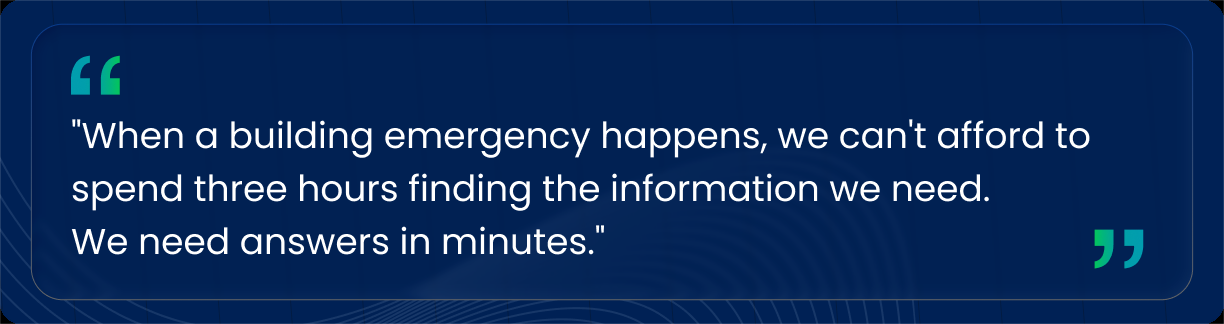 Building emergencies compound the problem. When systems fail, FM teams cannot afford extended searches for critical information. Emergency response requires immediate access to equipment specifications, shutdown procedures, contractor contacts and system interdependencies. Inaccessible information delays response extends downtime and increases risk. FM teams spend hours cross-referencing documents and reconstructing relationships when minutes count.
The consequences are operational inefficiency, increased risk of missed maintenance and compromised emergency response. Maintenance becomes reactive rather than strategic.
Why disconnected records slow FM teams down
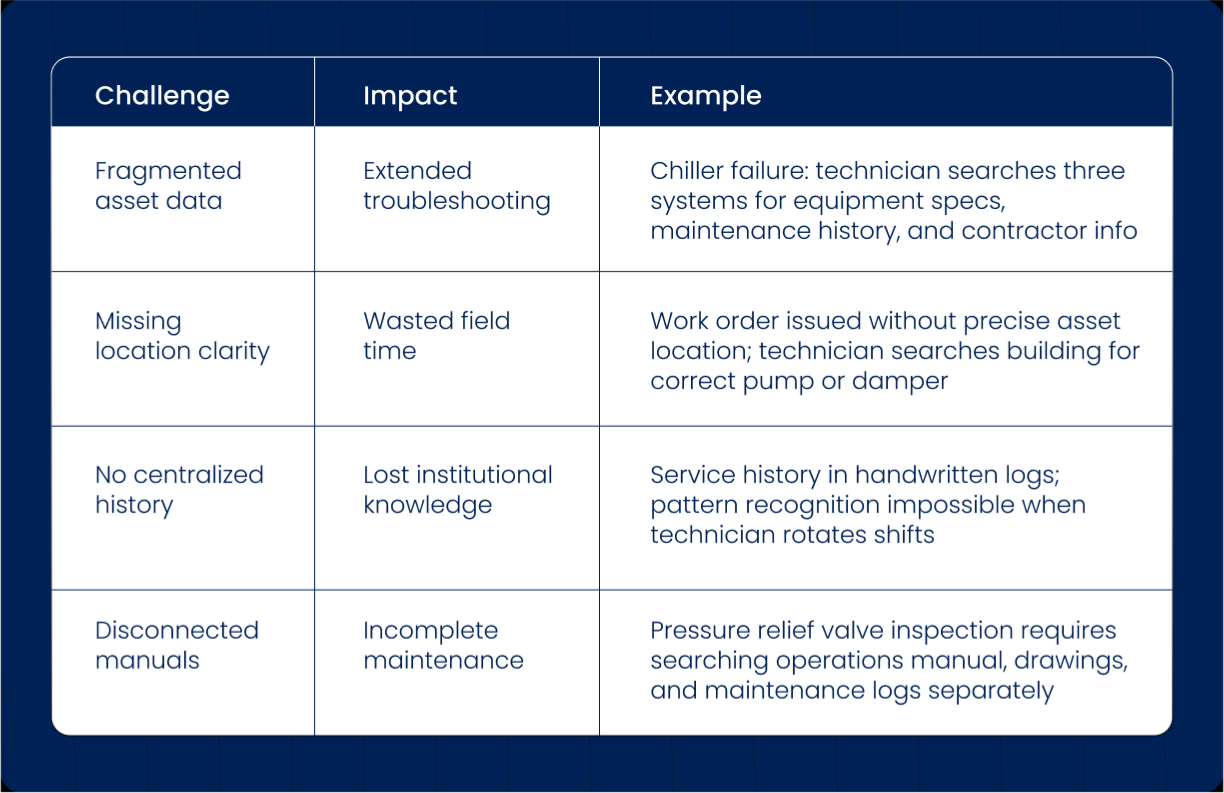 A technician responding to a comfort complaint needs HVAC unit location, thermostat settings, recent temperatures and maintenance notes. In fragmented systems, this information gathering consumes hours, if information is even available. In structured systems, linking building location to asset records provides answers in seconds. The time cost is substantial, and the impact on occupant satisfaction and operational efficiency is direct and measurable.
Equipment failures highlight the problem. When an HVAC unit stops functioning, FM teams need immediate access to equipment manuals, approved service contractors, recent maintenance records, performance baselines and warranty status. Gathering this from multiple sources while building conditions degrade is inefficient and stressful. If information is unavailable, troubleshooting proceeds slowly. Repair contractors perform unnecessary diagnostics or replacement work because system history is unknown. Each information gap extends the repair timeline and increases costs.
Asset visibility suffers similarly. FMs planning maintenance budgets need to understand equipment age profiles, major system conditions and replacement cycles. Without integrated asset records, this understanding is partial and effort-intensive to assemble. Planning becomes reactive rather than strategic. Maintenance is scheduled in response to failures rather than in anticipation of them.
Using asset data to improve maintenance planning
Structured asset records enable predictive maintenance. Instead of fixed-interval servicing, FMs can prioritize high-risk assets, schedule maintenance during low-occupancy windows and order parts in advance.
Essential asset data:
-
specifications (model, serial number, capacity, operating parameters)
-
installation date and precise location
-
complete maintenance history
-
performance trends and efficiency ratings
-
warranty, service agreements and contractor contacts
-
compliance status and inspection dates
This data reveals patterns. A pump requiring repair four times in two years approaches replacement. A system generally in need of service every 18 months but failing every 10 months in one zone signals a problem worth investigating. Interdependencies become visible: a chilled water pump serving multiple buildings, an electrical feeder shared by offices and warehouse, an HVAC system linked to building automation logic.
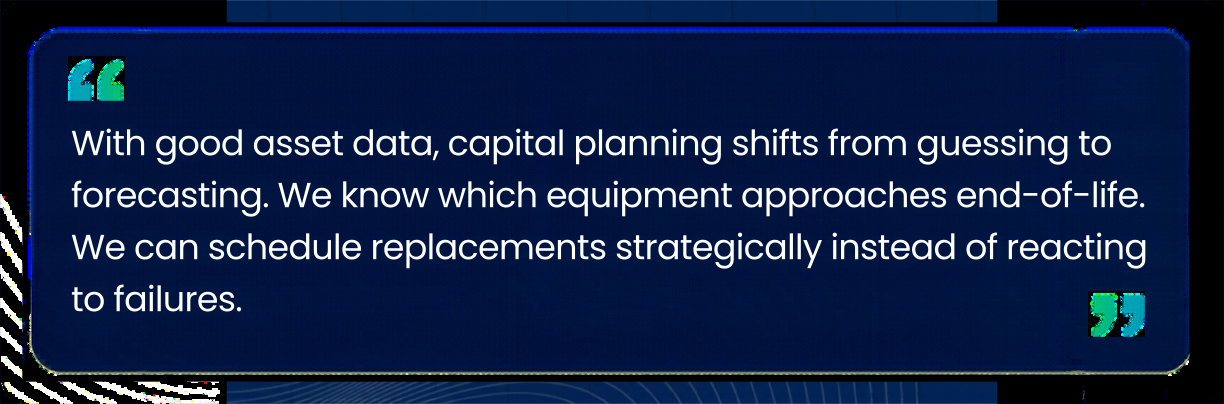
Pattern recognition enables strategic planning. Capital planning shifts from conservative guessing to data-driven forecasting. FMs know which equipment approaches end of life and can schedule replacements strategically instead of reacting to failures. Budget forecasting improves measurably when based on documented maintenance needs of specific assets. A facility with asset data showing 40 percent of HVAC units approaching end of life can plan replacement cycles systematically. Equipment decisions are made regarding risk and cost factors rather than on emergency repair urgency.
 Asset data also strengthens facility resilience. In major equipment failures or emergency repairs, asset records provide contractors with configuration details, service history and performance baselines that accelerate diagnosis and repair. For compliance and regulatory purposes, documented asset information demonstrates proper maintenance and operational oversight.
Making BIM data useful after handover
Building information models (BIM) created during design and construction contain valuable specification and spatial data but are structured for construction, not operations. A BIM model documents every duct length, cable run and structural detail, which is essential for trades, irrelevant for facility operations. Operations teams need to know what equipment exists, where it is located, how it is maintained and how it connects to larger systems. They do not need three-dimensional geometry of ductwork or precise coordinates of structural connections.
Translating BIM to operations requires:
-
extracting relevant equipment and systems (mechanical, electrical, plumbing, fire safety, building automation)
-
organizing extracted data by location and function, not design phase
-
supplementing with operational data: maintenance history, service contracts, performance baselines
-
integrating regulatory and compliance requirements specific to jurisdiction and use
The practical approach treats BIM as valuable initial data, accurate equipment specifications and spatial relationships, while recognizing that operational usefulness requires additional work. Some organizations extract equipment schedules from BIM and populate asset management systems during commissioning. Others create simplified operations-focused models stripped of construction detail but retaining equipment identity, location and system relationships. These operation models serve as reference tools for planning, renovation and training without the overhead of maintaining a construction-level model.
Core principle: BIM data is most valuable when translated into an operational context and integrated into systems that facility teams actually use. The translation requires intentional effort but preserves the structured data accuracy BIM provides while reorganizing it for how operations work.
Strengthening asset visibility & facility decision support
Asset visibility depends on three elements:
-
Comprehensive inventory: Buildings change over time, and drawings do not always reflect current conditions. Regular audits and documentation help records stay aligned with the physical facility.
-
Accurate location information: Building, floor and room details are essential. In complex facilities, zone maps or system identifiers help technicians locate assets quickly and accurately.
-
Current condition assessment: Condition ratings linked to asset records help teams identify priorities, maintain consistency and track changes over time.
Strategic decisions, capital planning, vendor selection, budget forecasting — depend on this information. Without asset data, capital planning becomes conservative and reactive. FMs replace equipment earlier than necessary to avoid failure risk, leading to unnecessary capital expense. They could also defer replacement too long, risking unexpected failures and emergency repairs. Either approach is suboptimal.
Accurate location information is particularly critical in emergency response. When a pipe ruptures or electrical fault occurs, facility teams must locate manual shutoffs and isolation points in seconds, not minutes. System interdependencies must be understood immediately. Incomplete location data or missing system maps compromise emergency response and increase facility disruption and risk.
The life cycle impact
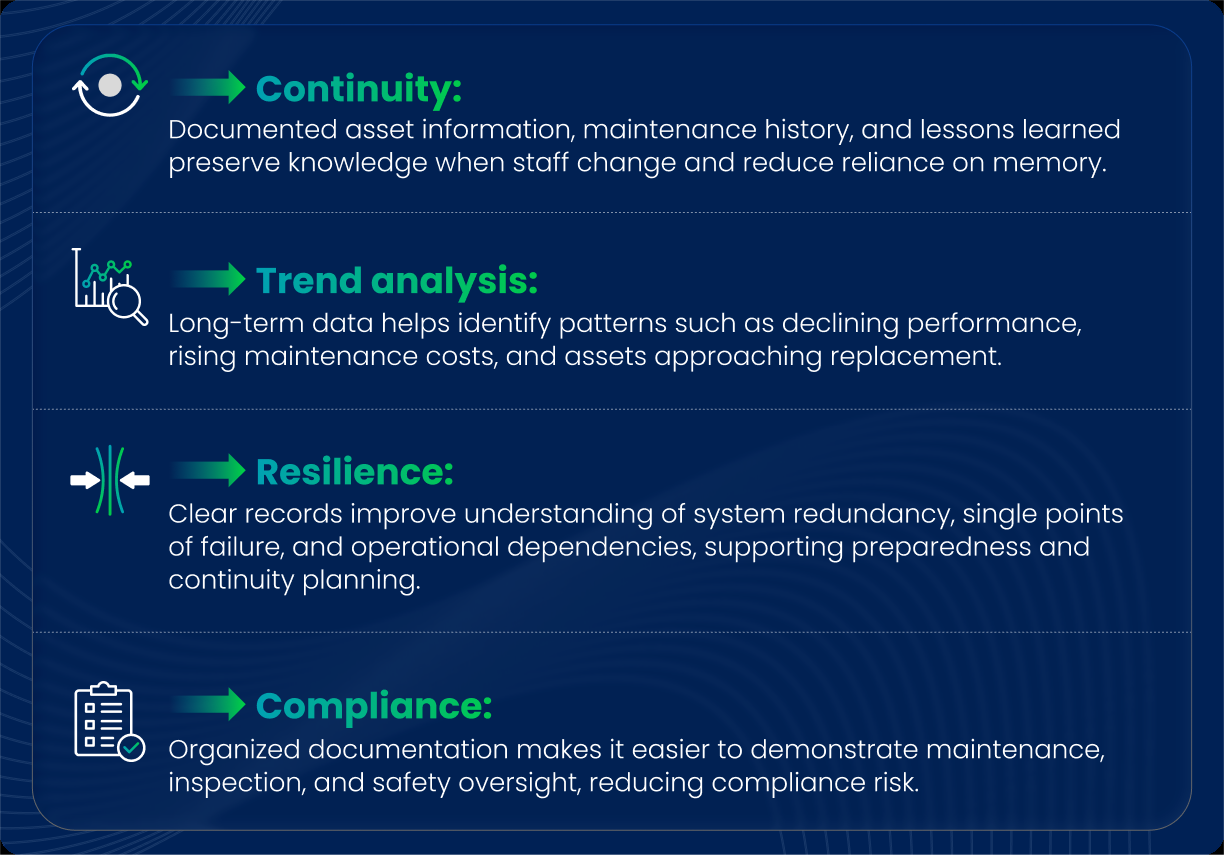
Better information supports FM across decades of operations:
 Conclusion
A building does not stop generating information when construction ends; it begins generating operational consequences. The usefulness of handover information therefore depends less on volume and more on whether it can support FM’s realities. Records that are difficult to access or disconnected from daily workflows weaken decision-making at the very stage when clarity matters most.
Seen this way, organized building information is more than a record of what was delivered. It is part of how an organization sustains facility performance, adapts to change and protects long-term value. For FM teams, the quality of information after handover can influence not only how work gets done, but how well the building continues to function as an operational asset.

Preetie Singh is the Founder and CEO of Tejjy Inc., an 8 (a) certified and women-owned design-build firm. She brings more than 19 years of leadership in the AEC industry. Her work focuses on BIM-enabled operational efficiency and technology-driven management. She is also a strong advocate for better coordination between construction and facility management.
References
Top image via Getty Images. Article images courtesy of Tejjy Inc.
Read more on Facility Technology & Data Management or related topics Data strategy and information management , Facility Technology and Operational Technology
Explore All FMJ TopicsRelated articles
-

Artificial Intelligence in FM
The stakeholder’s perspectiveBy Dr. Jake Smithwick & Dr. Kenneth Sullivan & Nneka Ubi05.01.2024 -

Don’t Drop the Ball
How a CMMS can make or break an FM organization’s successBy Michael Carmean09.17.2024 -

Beware of Growing Cyberthreats
Why it’s time for stronger facility cybersecurityBy Andrew Harris & Eric Headington10.30.2024