
 Membership
 Network
 Regional Sites & Affiliates


 Events
 Participate
 Resources

 Training
 Credentials
 Government


 Content Channels
 Tools
Tools


 Business Overview





Designing an Electrical Resilience Framework for Facilities
From risk identification to operational readiness
Electrical infrastructure underpins nearly every critical function within a facility. Life safety systems, emergency lighting, data environments, medical equipment and core building operations all depend on consistent, reliable power. Yet despite this dependence, many electrical programs across facility types and regions remain structured around reaction rather than anticipation.
The assumption that a compliant facility is a resilient one carries significant operational risk. Regulatory compliance establishes minimum standards, not performance benchmarks. A panel that passes inspection can still harbor overloaded circuits. A generator that meets code requirements can still fail to transfer load under real conditions. Documentation that satisfies an auditor does not guarantee that a system will perform when called upon during a partial or full power loss event.
Resilience requires a different approach — one grounded in systematic risk identification, verified performance and structured review.
The gap between compliance & operational resilience
The financial stakes are real. According to Uptime Institute's Annual Outage Analysis, more than half of facility operators globally report that their most recent significant outage cost is more than US$100,000, with one in six reporting costs exceeding US$1 million. Many of those disruptions trace back to systems that were compliant on paper but never verified under real conditions.
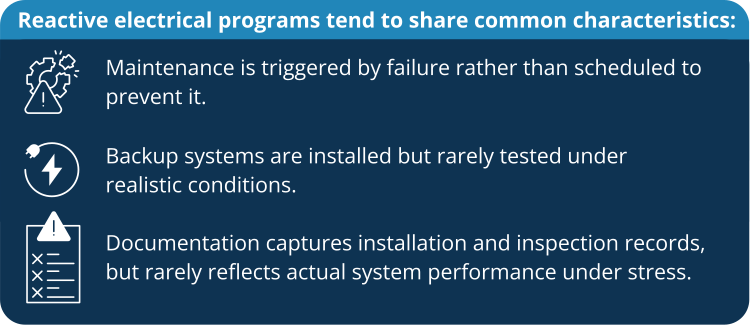
When disruptions occur, organizations discover dependencies that were never mapped, transfer sequences that do not perform as expected and load configurations that have drifted from their original design. This gap between documented status and actual readiness is not limited to one region or facility type. It is a global issue that appears in health care, commercial real estate, manufacturing, higher education and government facilities. The shared factor is a program built around compliance rather than operational continuity.
A structured resilience framework closes this gap through four defined stages, moving the organization and its facilities from passive compliance toward active verification. This is the foundation of sound electrical resilience planning for facilities across diverse environments and regulatory contexts.
A 4-stage framework for electrical resilience
Closing the gap between compliance and real operational readiness requires a structured approach. The following framework breaks that process into four stages, each building on the last and each applicable across facility types and regions regardless of size or sector.
 The starting point for any resilience program is an accurate picture of how power enters and moves through a facility. Infrastructure risk mapping documents:
-
incoming utility feeds, switchgear, distribution panels and transfer switches
-
backup generation and uninterruptible power supply (ups) systems
-
systems supporting life safety, mission-critical operations or high-consequence functions
This is not a replacement for single-line diagrams. It is a field-verified audit that confirms whether documentation reflects current conditions.
The focus on electrical systems is supported by consistent global data. Uptime Institute research identifies power-related failures as the leading cause of impactful outages, accounting for 54 percent of serious incidents across facility types and regions. That figure positions electrical infrastructure risk mapping not as a periodic task, but as a core operational discipline.
Dependency mapping traces how loads connect across panels and transfer points. This step regularly surfaces unexpected relationships: a critical circuit sharing a panel with noncritical loads or a life-safety system relying on a transfer path with no backup. Load vulnerability analysis then identifies single points of failure and capacity constraints across the distribution system.
The output is a verified infrastructure picture that supports all subsequent risk work.
 Once vulnerabilities are identified, not all of them can be fixed at once. Stage 2 provides a method for deciding what gets addressed first, in what order and within what budget.
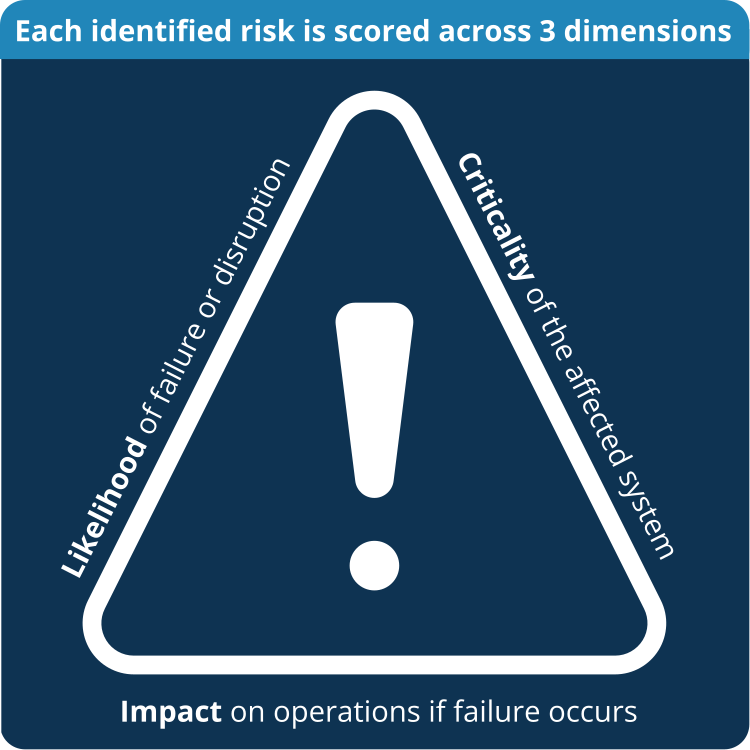 Multiplying these three factors produces a numeric score for each vulnerability. This allows FM teams to compare risks objectively, rather than relying on informal judgment or whoever raises the loudest concern.
The scores then shape how corrective actions are scheduled. High-scoring risks are addressed immediately. Lower-scoring items are folded into normal budget planning. Redundancy improvements, capacity upgrades and deferred maintenance each get assigned to the right window based on their score, not based on convenience.
For organizations with facilities subject to regulatory oversight or insurance review, the scoring process also creates a written record that risk identification was managed systematically.
 Risk analysis describes what could go wrong. Testing shows what actually happens. Stage 3 moves from documentation to active verification through three core activities:
Backup power validation tests whether the generation capacity holds under real load. Full-load or near-full-load generator testing evaluates fuel delivery, cooling performance and cold-start reliability under conditions that routine inspections do not replicate.
Transfer switch testing confirms proper sequencing and timing. Automatic transfer switches (ATS) are designed to detect utility loss and switch to backup power within defined parameters. Testing verifies that the switch performs correctly under load, that timing meets the requirements of connected systems and that the return to utility power proceeds without issue.
Scenario-based readiness drills simulate partial or full power loss and observe how teams respond. Equipment may function correctly while procedures break down. These drills surface communication gaps, unclear responsibilities and manual steps that only emerge during an actual event. The goal is operational readiness, not just equipment reliability.
The outputs of Stage 3 are performance records that document actual system behavior, not assumed behavior.
 Most electrical programs keep records of installations and inspections. What they often miss is what testing revealed, what was changed and what problems were left open. That is where risk builds up unnoticed.
Research on electrical maintenance programs consistently shows that 77 percent of electrical failures are preventable. The problem is rarely the equipment itself. It is that maintenance findings are not properly recorded, tracked or acted on.
Stage 4 addresses this by keeping records that reflect what is actually happening in the system:
-
Test results, configuration changes and unresolved issues are formally logged.
-
Risk assessments are updated when equipment ages, loads change or operations shift.
-
Resilience reviews are scheduled around real operational milestones, not just calendar dates.
When staff and personnel change, this documentation ensures the next person knows the system's current condition, its known weaknesses and what still needs attention.
Good documentation does not just satisfy an auditor. It keeps the organization ready.
 Embedding electrical resilience into governance
The four-stage framework is not a one-time project. Applied consistently, it becomes part of how a facility manages electrical infrastructure over time:
-
Risk mapping informs capital planning.
-
Scoring supports budget justification.
-
Stress testing validates investments.
-
Documentation creates accountability and continuity.
Organizations that follow this structure shift from compliance maintenance to operational preparedness. Disruptions do not become less likely, but their impact becomes manageable. Hidden dependencies have been identified. Backup systems have been tested. Staff understand their roles during a power loss event. Documentation reflects the system as it currently exists.
For FMs working across different regions and environments, the methodology is designed to transfer. Specific equipment, applicable standards and operational priorities will vary. The underlying logic, mapping dependencies, scoring risks, validating performance and maintaining accurate records, applies wherever electrical continuity is critical to operations.
Electrical resilience is not a destination. It is an ongoing practice, built on structured methodology and sustained organizational commitment. The gap between compliance and readiness can be closed, but only through deliberate and verified action.

Veselina Lezginov is a Content Strategist at Arrow Electric, where she works closely with the company’s subject-matter experts to develop educational content around electrical infrastructure, facility resilience, modernization strategies, and emerging industry trends. Through her work, she helps translate operational expertise into practical insights and thought leadership for professionals across the built environment.
References
Top image via Getty Images.
Additional resources:
Strategic Infrastructure Decisions — IFMA FMJ guide on infrastructure risk assessment and long-term resilience planning
Climate Resilience and Risk Mitigation Strategies for Facilities — IFMA Knowledge Library resource on infrastructure resilience planning for facility management professionals
Read more on Facility Operations or related topics Energy , Operations and Maintenance Planning and Operational and Capital Budgeting
Explore All FMJ Topics