Membership
 Network
 Regional Sites & Affiliates


 Events
 Participate
 Resources

 Training
 Credentials
 Government


 Content Channels
 Tools
Tools


 Business Overview





Diagnosing System Effect
Common causes & where to start
 Anyone who engages in the testing, adjusting, balancing or just plain troubleshooting of any fan knows all too well that phenomenon of things just not making sense. The reality is that the confluence of airflow, total static pressure and brake horsepower all lining up at that magical juncture on the fan curve seldom happens. Why is that?
There are several reasons. One obvious answer that any seasoned technician might give you is that the likelihood of “lab conditions” in the field is rare. Things such as straight duct runs, reasonably accessible traverse and static locations, and regular everyday air turbulence may all contribute to the frustration of trying to make your field-measured fan data match its submitted fan curve. While training as a technician and learning on the job, I remember thinking to myself that “system effect” was just a catch-all term for any time a system was not making design, and we were simply out of ideas as to why. I was not necessarily wrong, but what is system effect really?
According to the AABC Technician Training Manual, “System effect is defined as the loss in performance of a fan due to adverse conditions at the fan inlet or outlet.” According to AMCA, the three most common causes of poor fan/system performance are:
-
Improper outlet connections
-
Nonuniform inlet flow
-
Swirl or spin at the fan inlet
Armed with this baseline knowledge, let’s take a look at some everyday examples of things our firm has seen in the field. This is a troubleshooting guide or mental process flowchart that we sometimes use to guide us through what does not make sense. Some things to look for are:
-
Fan turning backwards
-
Belt slipping
-
Fire/smoke dampers closed
-
Backdraft damper not opening completely
-
Duct leakage
-
Open access doors
-
Endcaps missing
-
Anyone who has worked in this industry could fill volumes with what can go wrong with a fan (to clarify: when we are talking fan, we could mean exhaust, blower or supply fan within an air handling system). One of the first tell-tale signs of system effect we look for is a combination of low airflow and low static. Fan laws dictate that this simply cannot happen…right?
But it does happen. And when it does, you are likely witnessing system effect. If you are measuring low airflow and low total or external static pressure, that should tip you off that there is an issue at the inlet or outlet connection. Remember, “improper outlet connections” or “swirl or spin at the fan inlet.”
Again, many of us could fill volumes with what can go wrong at a fan inlet to knock it off of its curve performance. It really comes down to a technician’s willingness to drill holes, gain access and inspect that connection for issues. Some common things we look for are:
-
Turning vanes
-
Are they installed?
-
Are they installed correctly?
-
Is there anything blocking them?
-
-
Motorized dampers (outlet and inlet)
-
Are they disrupting the airflow pattern? Inlet or outlet?
-
-
Leaking roof curbs
-
Plastic or insulation sucked into the fan wheel
-
Leaking canvas connections
-
Jogs or offsets at the canvas connections
-
-
Damage to fan inlet “bell” curve
-
Tabs of sheet metal right at the inlet/outlet disrupting airflow patterns
Did none of these solve the issue? Now we can dive deeper into what can go wrong:
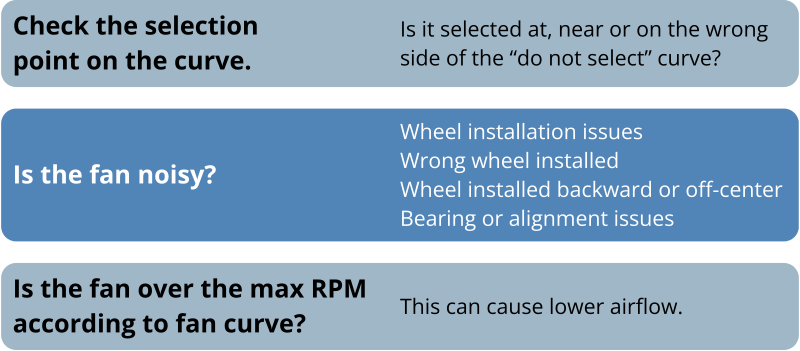
The other, sometimes less obvious cause of poor fan performance can be the system effect brought on by the configuration or installation of the fan itself. There are numerous examples of inlet and outlet configuration diagrams available to us that demonstrate both right and wrong ways to configure a fan. However, perhaps the most common we see is when outlet ducts are installed counter to the rotation of the fan, as highlighted below.
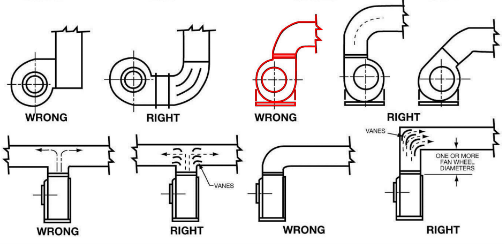 Image provided by Precision Engineering.
With the ever-increasing pressure to finish projects faster and cheaper, there can be a tendency to simply upsize motors, change sheaves, overspeed VFDs and try to blast through whatever inefficiencies are lurking within the fan or duct installation. There are times and places for that, but it betrays our obligation as AABC-certified professionals to strive for optimal energy efficiency and building sustainability.
We encourage all technicians and firms to keep a running journal of things that can go wrong with fan and pumping systems in hopes of creating an ever-evolving process diagram to quickly solve these system effect issues while in the field. Of course, as with any field issue, it really comes down to a field technician’s willingness to go that extra mile and uncover the root cause, but it helps to have a starting point based on previous experiences.

Cody Shook, P.E., TBE, CxA, is a 30-year industry veteran of the TAB and commissioning fields and founder of Precision Flow Engineering. He is a certified Testing, Adjusting and Balancing Engineer (TBE) and member of AABC; a certified Commissioning Authority (CxA) and member of ACG; and a licensed Professional Engineer (P.E.) in the state of Texas.
References
Top image by Getty Images.
Read more on Facility Operations or related topics Building Systems , Maintenance Processes and Problem Solving
Explore All FMJ Topics