
 Membership
 Network
 Regional Sites & Affiliates


 Events
 Participate
 Resources

 Training
 Credentials
 Government


 Content Channels
 Tools
Tools


 Business Overview





Digital Maturity
Knowing the number is not the same as knowing what to do

The topic of digital maturity for real estate (RE) and facility management has seen a recent revitalization. In a webinar titled “From Foundation to Function: A Practical Path to Digital Maturity in RE & FM,” new research and insights around digital maturity were explored by an expert panel, including speakers from IFMA, Verdantix (an independent research and advisory firm) and Planon (a global leader in real estate and facility management solutions).
This new research revealed a pattern across many of the RE and FM organizations that were surveyed.
When asked where they stand in terms of digital maturity, most participants positioned themselves on a scale with relative confidence.
Yet, those same participants were consistently stuck when it came to more difficult questions: what to do next and how to ensure progress translates into lasting value.
Think of digital maturity as a measurement. For instance, stepping on a standard scale will provide a number. Most people are intuitively looking for a specific number and understand whether their result is good or bad. However, the number alone does not give the whole picture or even explain the “why.” The number also does not automatically indicate what actions will make the most meaningful difference. Instead, understanding the underlying factors that resulted in that number to choose the right next steps to take, if any are needed at all.
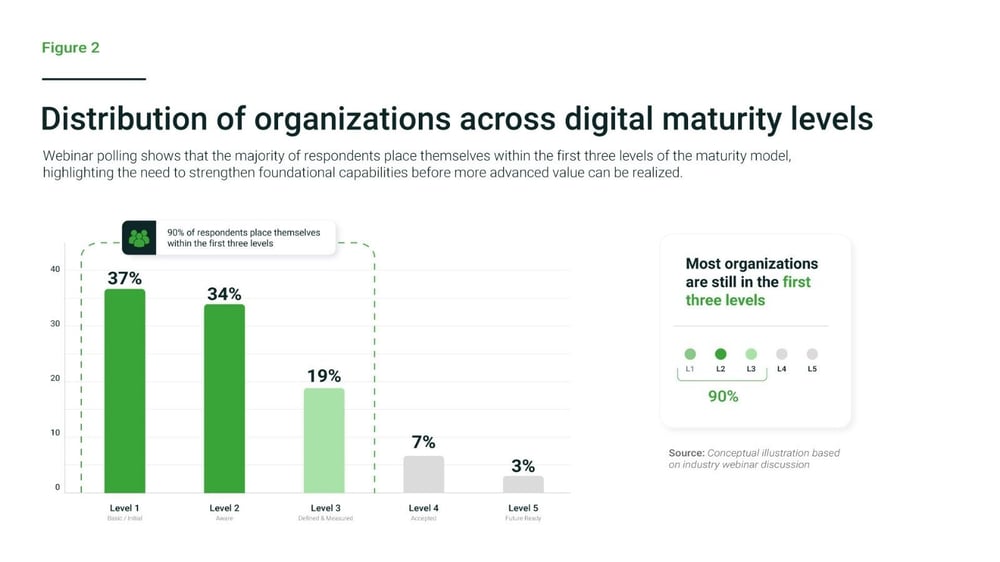
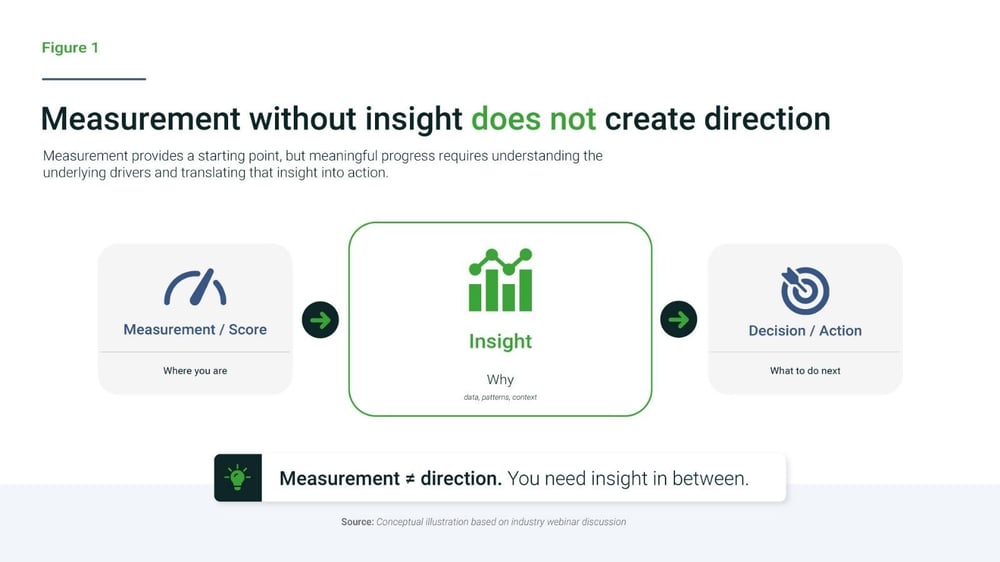 Digital maturity in RE and FM works in much the same way. Many organizations can position themselves on a maturity scale. They know roughly where they stand. They know the general challenges they face and areas where they want to improve. A poll from the same webinar showed that the vast majority of organizations place themselves within the first three levels of the maturity model. However, when wanting to improve their maturity level, they still struggle to decide what to prioritize, which behaviors to change, and how to sustain progress over time. Dashboards and self-assessments provide visibility, but they do not automatically create direction. In this sense, maturity scores provide orientation, but without underlying insight they can lead to assumptions rather than decisions. This distinction helps explain why digital maturity initiatives so often stall, even when substantial investment has already been made.
This concentration in the lower maturity levels highlights a broader pattern: progress is being made, but not sustained at scale.
Investment without sustained progress
Across industries, RE and FM organizations have invested heavily in enterprise platforms, analytics and maturity frameworks. Despite this, most continue to operate at low to intermediate levels of maturity. Many have some foundational basics in place, including some form of data management, a workplace management tool and technology stack, as well as a structure in place for the right people and departments to use those technologies.
In many cases, the technology landscape itself is relatively mature. Data is available, systems are integrated, and reporting is possible. What proves harder is translating that visibility into confident decision-making and sustained behavioral change. Digital maturity becomes something that is measured rather than something that truly shapes how work is done.
What research & practice reveal
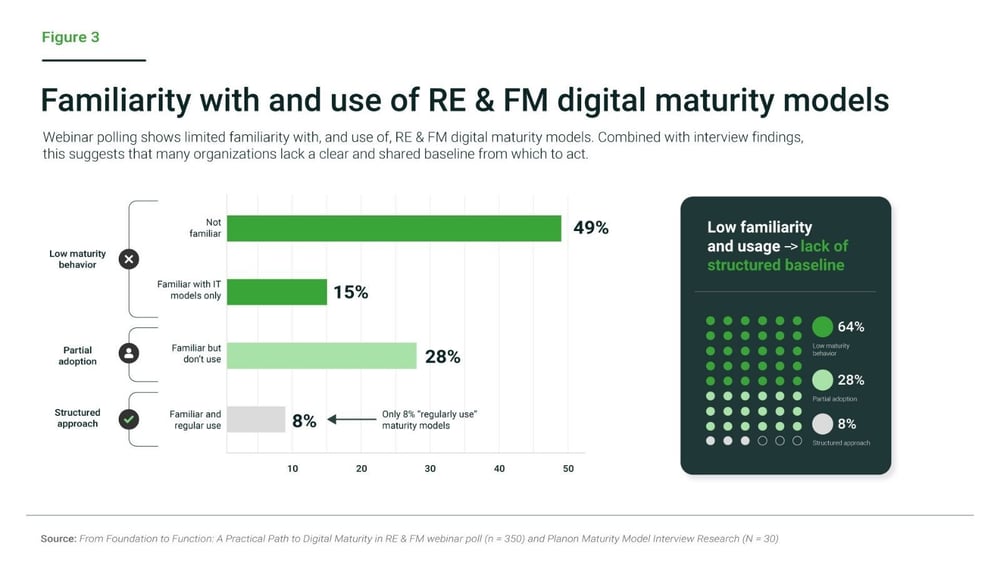
Interview-based research from Verdantix and Planon shows that many organizations have considered digital maturity and even have an idea of where they think they stand, but far fewer have formed a structured baseline that they can point to for proof or actively use to measure improvement. This pattern was reinforced by a poll during the webinar, with the majority of 350 respondents reporting that they had limited familiarity with RE and FM maturity models or indicated that they do not use them in practice.
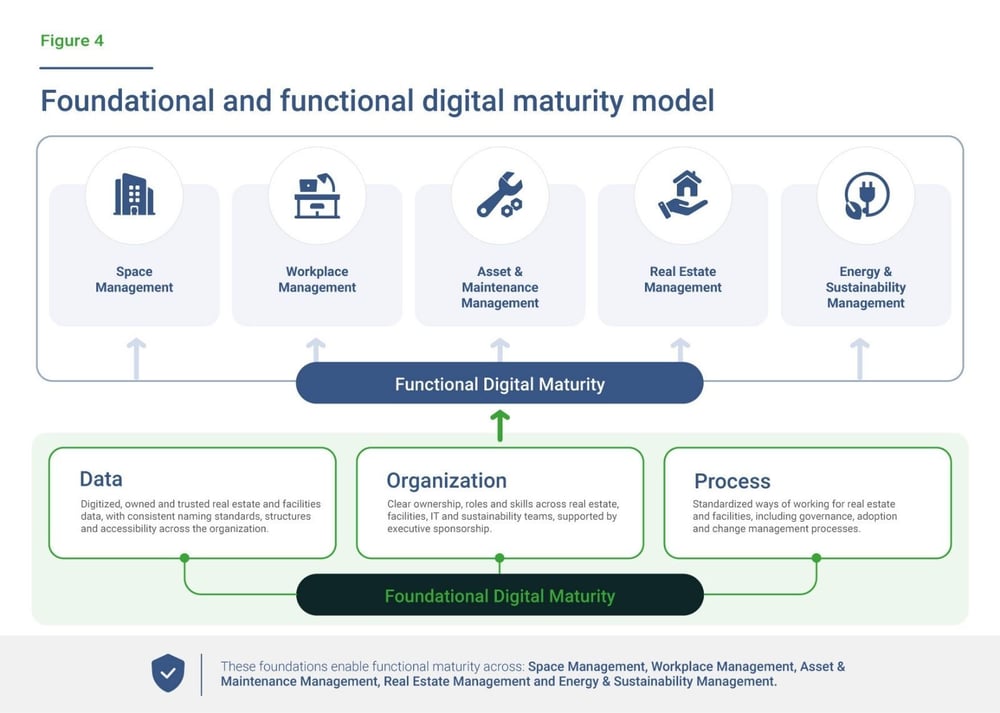
What do we mean by digital maturity?Digital maturity in RE and FM is often associated with technology adoption, but in practice it reflects something broader. It describes how effectively an organization aligns its data, processes and organizational capabilities to support informed decision-making over time. At its core, digital maturity rests on three foundational pillars:
Atop this foundation, organizations develop capability across functional areas such as asset and maintenance management, space and workplace management and real estate portfolio management. Digital maturity is typically described across five levels, ranging from informal and reactive (Level 1) to predictive and continuously optimized (Level 5). In practice, most organizations operate within the first three levels, where progress often slows due to gaps in data trust, process consistency and organizational alignment. This structure is often visualized as a digital maturity model that brings these elements together. |
 Digital maturity as a human capability challenge
Digital maturity is often framed in technical terms: system integration, analytics sophistication and automation. Yet the evidence increasingly points to a different constraint. Platforms enable access to data, but value only emerges when people can interpret that data, question assumptions and use their new insights to make decisions. For that to happen, a new type of role is emerging: the FM Analyst.
Broader industry research reinforces this shift in perspective.Insights from the IFMA Executive Summit (2026) — The Next Wave of Facility Management: From Digital Transformation to AI Leadership – Executive Summary — highlight that the future of facility management will be defined less by technology adoption alone and more by leadership, capability and organizational alignment. Taken together, the findings emphasize that organizations must align technology with purpose, translate data into decisions, build trust through governance and develop adaptive human capability. In this context, digital maturity is not simply a measure of technology adoption, but an indication of an organization’s ability to align people, data, processes and decisions over time. |
At early maturity levels, the limiting factor is rarely just technology alone. Instead, there is often a resource issue or talent gap where the limiting factor is experience, confidence, sound judgment and the ability to translate operational information into something that resonates with wider organizational priorities such as cost, risk and sustainability. This points to a longstanding issue for many RE and FM teams regarding digital maturity: it is not just a systems issue. It is also a human capability challenge. Access to technology does not guarantee progress. In many organizations, the challenge is not the availability of data or systems, but the ability of teams to interpret that information and use it confidently in decision-making.
The FM Analyst mindset: A way of working
 Research by IFMA, including The Rise of the FM Analyst by IFMA Director of Knowledge and Insights Dr. Matt Tucker, describes the FM Analyst not as a formal role, but as a mindset and working profile that reflect the modern data-enabled FM professional.
This mindset is not about performing complex statistical analysis. Rather, it is about developing confidence and curiosity to question data, interpret what it is saying and apply those insights in a real-world context. It enables professionals to move beyond reporting activities and contribute to decision-making in a meaningful way.
The FM Analyst mindset is characterized by capabilities such as curiosity, storytelling, pattern recognition, data confidence, problem-solving and cross-functional thinking. These capabilities help bridge the gap between data availability and actionable insight.
Why early maturity progress depends on personal meaning
At Levels 1, 2 and 3 of digital maturity, organizations are still standardizing their data, aligning stakeholders and challenging established ways of working. There is not always a clear or immediate ROI for some of the changes to processes, behaviors or workflows at this stage. This often makes it difficult to keep momentum up. However, it is important to highlight human factors during these stages. Human elements like experience gained, recognition received and team morale are not always formally measured, but they shape whether individuals and teams continue to engage with the maturity journey. At lower levels, where progress depends heavily on behavioral change, this human dimension becomes critical.
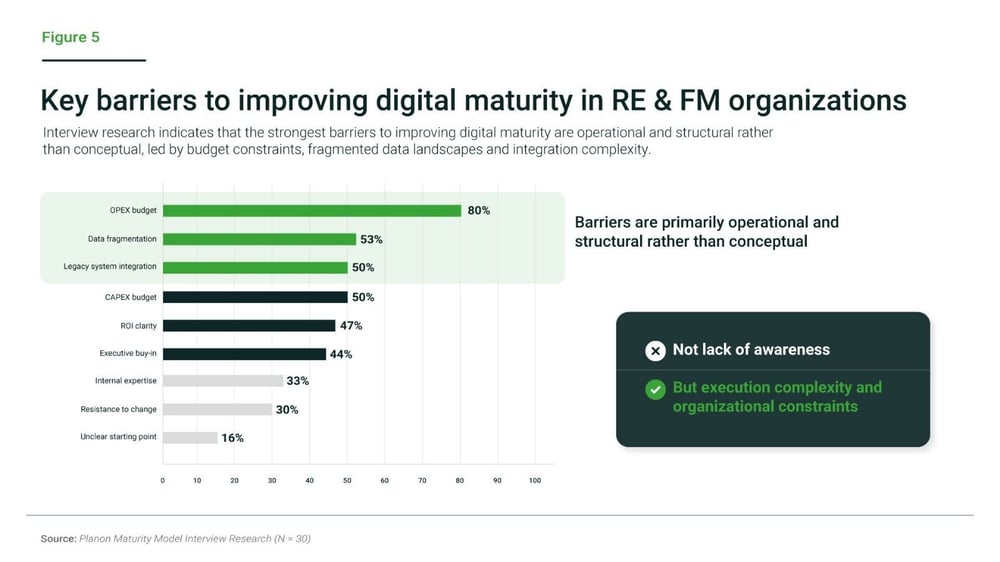 Verdantix and Planon identified some key barriers to improving digital maturity from their research. These include constraints such as budget limitations, fragmented data landscapes, integration complexity and competing organizational priorities. None of these barriers indicate that organizations struggle with recognizing the value of digital maturity; instead, they reveal the true obstacle, which is achieving the right conditions necessary for organizations to fund and support efforts to continuously improve digital maturity.
From individual effort to organizational capability
Digital maturity becomes sustainable when analytical thinking is embedded into everyday decision-making rather than relying on a small group of specialists. In practice, progress tends to endure when maturity assessments are treated as shared learning tools, when implementation focuses on adoption and understanding, and when professionals are trusted to interpret data and challenge assumptions.
When analytical behaviors become shared team practice, they can be scaled and embedded into organizational processes. This shift from individual to organizational capability marks an important stage in digital maturity. As practices stabilize, organizations are better positioned to compare performance, justify investments and continuously improve. There is also clear demand for structured approaches, with many organizations recognizing the value of using maturity models not just for assessment, but as a guide for continuous development.
What this looks like in practiceConsider a regional health care provider operating mission-critical facilities, where asset performance directly affects patient safety. Despite significant outsourcing, the organization has limited visibility into operational data and lacks clear ownership, governance and integration across teams. Rather than investing immediately in advanced maintenance or space capabilities, the first step is strengthening the foundation. This includes defining data ownership, establishing basic standards, aligning FM with IT and clinical teams, and introducing structured workflows to replace fragmented, email-based processes. As these foundational elements move from ad hoc to defined practices, decision-making improves, errors reduce and data becomes reliable enough to support further investment. This shift enables the organization to progress consistently toward higher maturity, rather than introducing isolated improvements that are difficult to sustain. |
What organizations should do next
For organizations looking to take the next steps, it is important to assemble the right team to take this one. It is not just a one-person job. Instead, many departments should be involved.
A practical starting point is to establish a shared, evidence-based maturity baseline and use it to identify one or two priority decisions that better data should support. From there, organizations can focus on building analytical confidence among operational RE and FM teams, creating cross-functional forums where data can be interpreted collectively, and recognizing those who challenge assumptions and use evidence to inform action.
Progress can be tracked in two ways: through early qualitative signals such as confidence, trust, alignment and engagement, and through longer-term performance outcomes as capabilities mature. In this way, the maturity journey becomes not only a way of assessing where an organization stands, but a structured way of deciding what to do next.
Preparing to take the Digital Maturity Self-AssessmentInsights from the Digital Maturity Model for Real Estate and Facility Management – Executive Summary highlight that organizations should approach maturity assessment as a structured, cross-functional exercise rather than an individual task. Key preparation steps include:
Together, these practices help ensure that maturity assessments provide an accurate baseline and a meaningful conversation starter for improvement. |
From insight to action in practiceThis approach is increasingly applied in collaborative workshop settings, such as From Insight to Action: Making Digital Maturity Stick in RE & FM, where practitioners complete a digital maturity quickscan, compare results with peers and translate findings into concrete next steps. Building on insights from recent research and practitioner discussions, these sessions focus on bridging the gap between knowing where organizations stand and understanding what to do next. Through facilitated reflection, participants identify common barriers such as data fragmentation, limited baseline clarity and competing priorities. |
Why the FM Analyst mindset matters
Digital maturity is not a higher assessment score. It is better decision-making. The FM Analyst mindset helps turn data into insight and insight into action. Organizations that make the greatest progress are not necessarily those with the most advanced technology, but those that build the capability to use information confidently, consistently and collaboratively.

John de Beijer is a senior solution marketer at Planon, focusing on digital transformation in real estate and facility management. His work centers around digital maturity, data-driven decision-making and the evolving role of FM professionals, with a focus on translating industry research into practical, actionable insights.
References
Top image via Getty Images. Article images courtesy of the author.
Read more on Facility Technology & Data Management and Quality or related topics Information Technology , Facility Technology , Operational Technology and Quality Improvement
Explore All FMJ TopicsRelated articles
-

Artificial Intelligence in FM
The stakeholder’s perspectiveBy Dr. Jake Smithwick & Dr. Kenneth Sullivan & Nneka Ubi05.01.2024 -

Don’t Drop the Ball
How a CMMS can make or break an FM organization’s successBy Michael Carmean09.17.2024 -

Beware of Growing Cyberthreats
Why it’s time for stronger facility cybersecurityBy Andrew Harris & Eric Headington10.30.2024