 Membership
 Network
 Regional Sites & Affiliates


 Events
 Participate
 Resources

 Training
 Credentials
 Government


 Content Channels
 Tools
Tools


 Business Overview





Digital Twinning
The future of building engineering & design
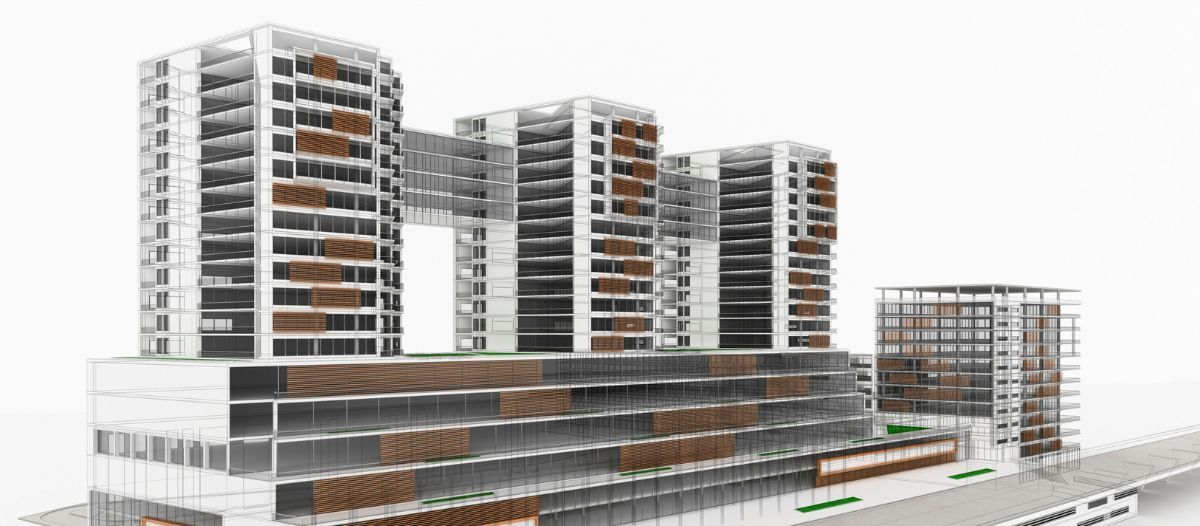
Data is the currency of efficiency and productivity, revealing both risks and opportunities across the built environment. Healthy buildings require both responsive facility management and data insights that can be interpreted into action. Building data can come from anywhere and everywhere. Converging on-premise system data with off-premise data at a rapid volume and speed often renders it too unwieldy to manage. Dynamically changing factors are driving the need to make buildings smarter, more sustainable, adaptive to occupant needs and self-aware. The digital twin vision provides reliable, enriched datasets that feed machine learning, driving smarter artificial intelligence, which is the engine that automates the responsive building.
The digital twin solution
A digital twin is a virtual, real-time replica of a physical product, asset or system. It is the digital replica of every system, asset, event, space and occupant within the as-built environment. The digital twin takes datasets across a facility and creates more enriched information, helping simulate use cases and scenarios before they affect the physical built environment, with datasets and APIs that can factor in several data points across systems to generate an entirely unique, customized set of data.
In the past, a digital twin was limited to focusing solely on a single aspect of a building – like an HVAC system or lighting. Now, however, digital twins have expanded to include every aspect of a campus, building, space or asset, allowing near-absolute insight into the operation of a facility. This complete digital representation provides an easy-to-access, cloud-based overview of data across the built environment. Data gathering and synthesis become even more challenging during building engineering and design, where effective data utilization can make or break the optimization of a building or campus.
A digital twin also allows for cloud-based testing and predicting future processes. This can save thousands of dollars via the avoidance of ineffective changes within a facility, such as the addition of a new asset or system in the physical world. Being able to answer “what if” questions makes a digital twin critical as more and more highly technological systems are introduced into facilities around the world.
Digital twins & democratizing data
Systems like energy, security, HVAC and IT/OT (among others) all create metadata that is typically siloed. The data from these systems and subsystems oftentimes lives only within the system itself, without being unified or analyzed in a holistic way across the facility.
The future of the healthy building converges all available datasets that drive building efficiency and performance optimization, which, in turn, drive the ROI required for business outcomes. But the collection of data, even if accounted for during the engineering and design phase, is not enough. Without unification and enrichment of data from across systems, very little context across the as-built environment can be achieved. A digital twin, alongside supporting systems, can gather, enrich and bring holistic context of location, events, assets and occupants across the built environment. This leads to better operational performance and extensibility of new applications using the latest in machine learning and artificial intelligence. The digital twin and corresponding building graph provide reliable and cleansed datasets, which machine learning models need for making better predictions, used for artificial intelligence and automation.
By unlocking data from their respective silos, unifying multiple datasets to provide clearer context, a more complete understanding of each facility system’s performance can be achieved in a repeatable and reliable fashion – both in how a system functions within itself and in how a system is affected by surrounding systems. Enriched information is gathered by the digital twin and used to feed machine learning engines, which creates predictive algorithms and artificial intelligence for building-health automation, capable of reacting and responding. This provides FMs a powerful, data-driven automation tool that helps simulate, predict and preempt issues from disrupting business operations.
Combining FM & IT/OT
A digital twin does more than unify and enrich data. It connects the visual elements of the digital twin’s attributes of location, events, assets and people as part of the building information model (BIM). The BIM, or architectural drawings of the building, is becoming the de facto master repository for storing digital twin attributes and provides the visual aspect of relationships across the as-built environment. The visual representation of the digital twin occurs in 3D modeling and provides context to provide up to eight-dimensional (8D) representations. It is the digital twin that provides the construct to achieve this level of dimensional fidelity. These visualized interfaces help translate the building system context into communication among FM, operational technology and information technology. With easier visibility into the goals of FM, unprecedented value is created across buildings, campuses, and overall real-estate portfolios.
Digital twins grant higher visibility into dynamically changing building system data, including lights, security, parking and HVAC, for example, so each of these systems can be optimized and streamlined. A digital twin helps gather all of the location, event, assets and people data, integrate relevant external data and present that data as a complete set of information to act on. This data democratization is part of a successful digital twin strategy. It is through data democratization that FMs can create scenarios in the virtual space to analyze impact and outcome and determine the impact of a new asset or system – not just within a single area but across the entire facility.
Implementing digital twins in greenfield or brownfield projects
Most new greenfield (new construction) customers are starting with a 3D, 4D, 5D or 8D BIM and need a digital twin to provide the level of data fidelity that meets their desired outcomes of sustainability, energy simulation modeling, occupant wellness and automation. It will become nearly impossible to expand dimensions and manage change management without a well-managed digital twin. The earlier in the process a digital twin can be introduced, the faster it can be integrated into the project. From an FM perspective, the earlier in the process that digital twins are involved – even as early as working with the architects of the project – the cheaper it is to organize and cleanse the data required to implement digital twins.
With a brownfield (existing buildings) project, older BIMs typically need to be updated and enhanced to extract the full value of the digital twin visualization. Because the digital twin was not part of the original project, it is treated much more like an overlay and requires more involvement in ingesting the location, assets, events and people so data can be collected by the digital twin for use.
In both cases, the flexible nature of a digital twin helps during implementation. Digital twins are designed to evolve as more data is measured and acquired, so whether starting new construction or overlaying a digital twin on an existing building, this technology is able to adjust and grow as needed throughout its use.
Digital twins in the real world
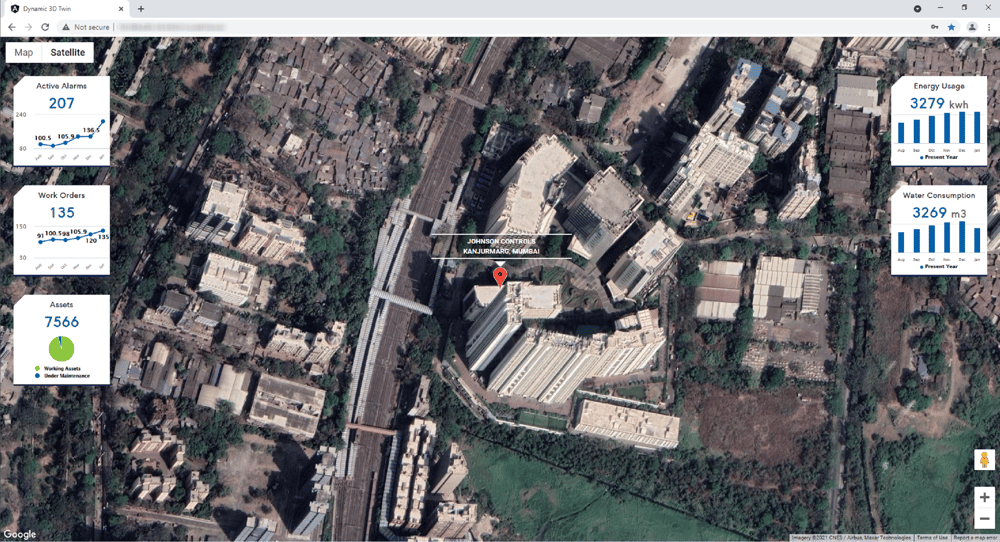
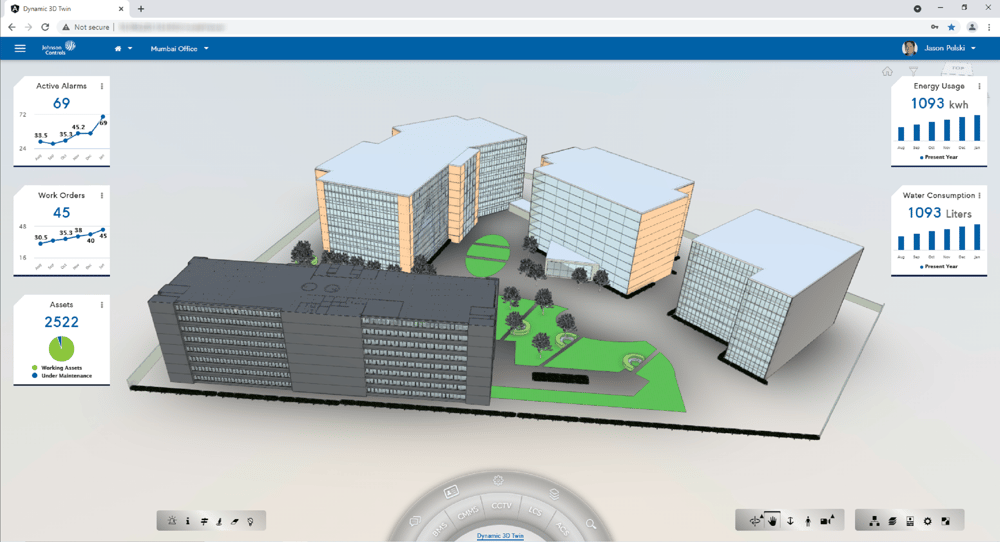
This example shows a digital twin in use at a facility in Mumbai. Integrated into the facility’s building management systems (BMS), the digital twin allows for remote control, monitoring and automation management – all while real-time data is being gathered and synthesized into actionable information. With complete control of the building using existing protocols such as BACnet, Modbus, and MQTT, the digital twin allows an FM to see fault detection and diagnostics, even allowing for work order generation if service or routine maintenance is necessary. In this example, the digital twin also creates the opportunity for scenario optimizations and risk simulations, so changes to the facility can be done virtually – and intelligently – before any changes in the physical world are made.
As seen in Figure 2, the FM can select and focus on an air handling unit within the building, as the entire BIM and digital twin are geo-referenced with real-time telemetry data (including real-time asset data), a user manual and the current temperature.
The use of a digital twin can also extend to simple, more direct optimization. For instance, when service is required on an asset within a facility, the digital twin can provide the service technician with the specific location of that asset, a step-by-step guide to reach it and any pertinent information regarding what security protocols may be in place or with whom they may need to speak. This helps speed up the maintenance process and reduces the impact of maintenance on the FM staff.
Digital transformation is having a big impact on an FM’s day-to-day operations. Today, FMs must interpret huge datasets and attempt to make decisions based on the context of what is happening in the as-built space. And that data load is only increasing – making it even harder to synthesize information and act appropriately. Digital twins will help create models to interpret and streamline the data points, helping FMs be more proactive in facility operation and optimization.
The Future of digital twins
While the current state of digital twins is already revolutionizing and optimizing the effectiveness of smart building interaction, future digital twin states will include more expansive machine-learning models. It is likely that, within five to 10 years, this technology will create more complete building automation, where models are making operational decisions in the digital world based on real events in the physical world. Simply put: a building will be able to determine with confidence when a part needs to be replaced, create a work order for itself and submit it – all without the need for an FM to intercede on the thousands of events that occur in a day.
FMs will not have to wait long for some of these benefits – this technology is already being implemented. For instance, there is a facility in Europe that has automated the opening of windows to increase indoor air quality (IAQ) in the building based on the relationship of CO2 levels inside and outside, the position of the sun and the temperature outside, effectively reducing energy loads while increasing IAQ .
Getting started with a digital twin
The first step in utilizing a digital twin is having a robust edge IoT platform that provides a reliable asset and event management process. Asset management and associated event mapping, alongside integration, is key. This information can then be supplied to the digital twin to create the building graph, where enriched datasets are stored.
Digital twins are not quite plug-and-play-ready yet, particularly because as-built environments differ greatly. Starting with a knowledgeable digital twin partner, highly experienced in the building controls space, is a good place to start. The best digital twin partner is one that bridges the edge IoT with the digital twin and cloud to unify the asset, space, event and people data relationships. The more thorough and involved stakeholders are across a facility, the faster the digital twin implementation happens.
Digital twins are the future of FM. As this technology becomes more prevalent and is integrated at the start of a building project, more FMs will be able to proactively interact with building data. Through this synthesized data, FMs will find their roles shifting from one that is largely reactive to one that orchestrates optimization and utilization efforts more often. The buildings they oversee will, in turn, become more healthy, more secure and more intelligent.

Jason Pelski is cloud Platform product lead for Johnson Controls, where he provides product-driven leadership for the OpenBlue digital cloud platform. He is focused on digital transformation of buildings, occupants, and operations, as well as democratizing data across the digital ecosystem using cloud-native architectures, digital twins, AI, and best-in-class security to create and accelerate value driven customer solutions across the entire business portfolio.
References
Top image via Getty Images.
Additional images courtesy of Johnson Controls.
Read more on Facility Operations and Facility Technology & Data Management or related topics Operational Technology , Facility Technology and Operations and Maintenance Planning
Explore All FMJ Topics