
 Membership
 Network
 Regional Sites & Affiliates


 Events
 Participate
 Resources

 Training
 Credentials
 Government


 Content Channels
 Tools
Tools


 Business Overview





Exercising with MBCx
Maintaining optimal performance over time

When a person commits to working out for fitness, motivation is high and hopefully, they experience positive results. Sometimes, as time goes on they can become less motivated and more relaxed about trips to the gym. He or she might even start to gain weight.
A new building is no different. At first, everything is in perfect order; the building is comfortable, and fairly energy efficient, and owners and operators are motivated to keep it performing optimally.
Over time, however, things shift and systems age. Building performance starts to degrade. That’s where Monitoring-Based Commissioning (MBCx) comes in. Like hiring a personal trainer, MBCx allows a building to get back into shape, and continue performing at a high level.
What is MBCx?
Monitoring-Based Commissioning, or MBCx, is a proactive process that continuously identifies opportunities to improve building operations over time. Leveraging automated fault detection and diagnostics (AFDD) software, MBCx alerts building operators of actionable information on building faults and opportunities for continued systems optimization in real-time.
Already performing annual energy audits or periodic Retro-Cx?
Many buildings are conscious of their energy and operations spending and are already conducting periodic energy audits or even engaging in Retro-Commissioning (RCx). This approach is much like falling in and out of a workout routine. It may be easy to shave off a few pounds, but lasting change will only come when maintaining the same level of fitness over a prolonged period of time.
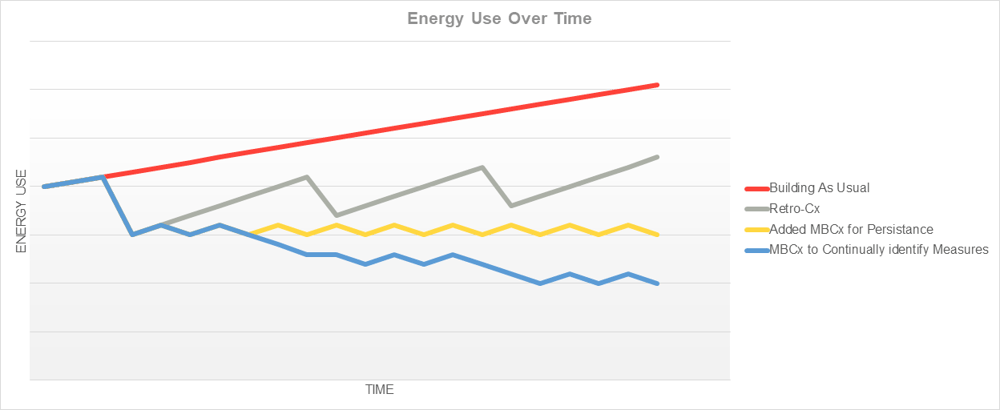
Graph I
Consider Graph I. The red line shows an average building’s energy use over time. Without any benchmarking, energy use will increase at a steady pace. In this case, the building engineer is likely adjusting as necessary to maintain building occupant thermal comfort, addressing one local issue at a time without knowledge of what “quick fixes” are doing to the overall MEP system, without real systematic change.
Engaging in Retro-Cx (grey line) annually will serve as a routine examination of building automation system (BAS) trends, with the ability to recalibrate accordingly at a single point in time. Similarly, adding continuous Cx without AFDD software (yellow line), will only maintain current energy savings initiatives, but will not introduce reductions in energy use based on current building faults.
Employing MBCx together with AFDD software, which will continually identify energy and cost savings measures, is like training for a marathon or weightlifting. There is a drive to maintain and allow current results to persist while driving for continuous performance improvements. Instead, fault data drives improvement and energy reduction without disrupting O&M. In this way, the building is not saving energy for the sake of saving energy, but striking a balance between energy efficiency opportunities and O&M improvements.
The measurable benefits of MBCx
There are four clear, measurable benefits to MBCx. Together the first three add up to make the fourth more meaningful.
-
Comfort Every 5 to 15 minutes, AFDD software is looking at each data point in the building. It is ensuring that MEP systems are maintaining the desired threshold of comfort. If a terminal box is not maintaining a required set point - if it is over- or under-shooting - the AFDD software will alert the operations team. MBCx is known to reduce HVAC- related occupancy complaints by as much as 40 percent.
-
O&M MBCx takes a proactive – not reactive – approach to O&M. MBCx can lead to a reduction in hot and cold calls and O&M costs because the operations team is able to focus on more pressing issues.
-
Efficiency MBCx ensures a building’s MEP equipment is operating at an optimized state over time.
-
Energy MBCx reduces building energy demand and consumption. Additionally, because AFDD analyzes the building’s data continuously, the building’s operations team is freed up to tackle more in-depth tasks.
The energy savings of MBCx
Conservatively, MBCx reduces operational costs in new and existing buildings by 3 to 5 percent annually. However, many facilities realize a savings of 10 to 20 percent between 6 months to 5 years.
When an operations team is understaffed, MBCx can be especially beneficial. Having data analytics at an FM’s fingertips ensures a facility gets the most out of the personnel they have. MBCx will help prioritize which building features aren’t operating efficiently and need recalibrating first. This eliminates the need to send a building engineer to check out a system that may not need repair. Instead, MBCx acts like a personal trainer constantly checking on potential fault issues, helping to troubleshoot at the moment of a fault.
The difference between traditional operations and MBCx is equivalent to the difference between proactive and reactive FM. With sensors throughout the building, and more information about operations at each point, more can be done.
Taking efficiency to the next level
When analyzing a building’s performance, the GM knows the facility better than anyone, and may have a gut feeling, a rule of thumb or a performance pattern steering them in one direction. With MBCx, real-time data is the guide.
An obvious example of this is equipment replacement. It is easiest to replace an outdated piece of equipment in kind, but building profiles change over time. The load may be lower than it used to be. With real data revealing the load profile over the last several years, it may be revealed that the facility needs an entirely different piece of equipment today.
Similarly, internal building loads have dropped over the last decade due to an increase in LED lights, more efficient computers, and companies adopting hoteling/work from home policies. It is possible a building could go from cooling-dominant to a heating-dominant space. MBCx effectively opens the world of efficient building operations to the next generation/level of possibility.
How to get started
Initiating MBCx doesn’t have to be complicated. Here’s a 4-step road map to ensure success.
-
Step I: Take stock. What type of BAS does the facility have? MBCx requires a BAC-Net enabled or equivalent open protocol system. Legacy pneumatic systems aren’t compatible.
-
Step II: Assessment/benchmarking. Track the building’s issues. Does the operations staff get a lot of thermal hot/cold calls? Are systemic or persistent problems benchmarked to create a baseline? Consider having a third party do a building energy assessment. This should include baselining, utility bill analysis, and energy, thermal comfort, and O&M analysis. MBCx service providers will need three years of utility data in order to create a baseline before beginning work. Make sure that data is available.
-
Step III: Engage the FM and IT teams. As the facilitators of MBCx long term, the FM team must be committed to the program for it to work optimally. The same goes for IT, as MBCx software will live on the BAS network, where it will require security clarification and more.
-
Step IV: Search for local incentive programs. Many municipalities have funds designated for MBCx programs. For example, New York state will refund up to 30 percent of MBCx program costs. In Illinois, that number could be almost 100 percent. There is typically a cap for software integration, but the municipality will often pay based on building performance. In some cases, saving enough energy could potentially cover the cost of service.

Saagar Patel, PE, CCP, LEED AP, BD+C is the Studio Leader for Energy + Eco at Environmental Systems Design, Inc. in Chicago. He has spent his career focused on helping customers save energy, improve operational efficiencies, and promote environmental initiatives. He has worked in all roles within design and construction and is excited for a future where data and analytics begin to drive our decision-making processes.
References
Top image via Getty Images. Infograph provided by EES Design.
Read more on Real Estate and Finance & Business or related topics Operational and Capital Budgeting , Real Estate Management and Asset Management
Explore All FMJ TopicsRelated articles
-

Plugged In
Solving the data disconnect in real estate and FMBy Amanda Muzzarelli & James Waddell07.01.2024 -

Food for Thought
Installing pop-up food programsBy Stafford McKay09.18.2024 -

Guarding Against Graffiti
Protocols that help prevent & remove graffiti on college campus buildingsBy John Lesak & Sarah Brummett11.26.2024