
 Membership
 Network
 Regional Sites & Affiliates


 Events
 Participate
 Resources

 Training
 Credentials
 Government


 Content Channels
 Tools
Tools


 Business Overview





Foundational Success
Improving CMMS data quality

Facility managers rely on computerized maintenance management systems (CMMS) to organize maintenance activities, track assets, manage work orders and plan for future capital needs. Platforms like CMMS, EAM and IWMS tools promise efficiency, visibility and control, but many facility teams find that the systems fall short of expectations.
The root cause is rarely the software itself. Instead, it comes down to the quality of the data inside the system.
A CMMS can only function as intended when populated with accurate, complete and consistent property-level data. Without that foundation, even the most advanced platform becomes difficult to use, unreliable and underutilized. Understanding what quality data looks like, why it is difficult to collect and how to approach asset data collection strategically is essential for FMs seeking real value from their CMMS investments.
The role of property-level data in FM
Property-level data refers to detailed information about the physical assets that make up a facility: mechanical, electrical, plumbing, architectural components, site elements and other systems critical to operations. This data includes asset type, location, manufacturer, model and serial numbers, installation dates, capacities, condition, and expected and remaining useful life.
When this information is complete and reliable, a CMMS can support preventive maintenance scheduling, asset life cycle tracking and long-term capital planning. When it is incomplete or inaccurate, the system struggles to deliver meaningful results.
Common symptoms of poor CMMS data include missing assets, inconsistent naming conventions, unreliable maintenance schedules and capital forecasts that do not align with real-world conditions. FMs often compensate by relying on institutional knowledge or manual workarounds, which undermines the efficiency the system was meant to provide.
In short, CMMS success starts long before software configuration; it begins with disciplined, well-executed asset data collection.
What defines quality property-level data?
Quality data is not simply about volume. Capturing too much information without a clear purpose can be just as problematic as capturing too little. For FMs, quality property-level data has three defining characteristics:
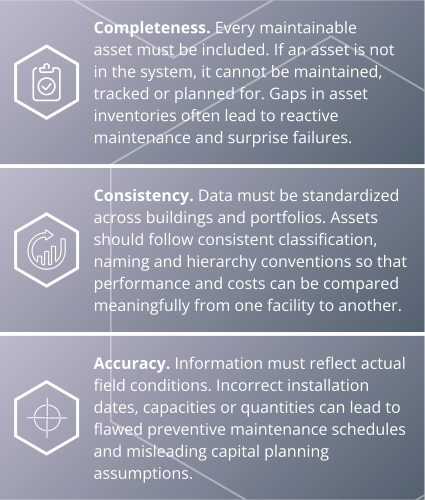 Equally important is relevance. FMs need data that supports their operational objectives, rather than unnecessary fields that add complexity without value. Defining what data matters most is a critical first step in any successful data collection effort.
Why FM teams struggle to collect good data
Most facility organizations already have some asset information, but it is often scattered across spreadsheets, drawings, maintenance logs and legacy systems. Bringing that information together into a clean, reliable data set is far more challenging than it appears.
Time is one of the biggest obstacles. FMs and technicians focus on keeping buildings operational. Conducting a comprehensive asset inventory requires dedicated effort, which is difficult to sustain alongside daily responsibilities.
Consistency is another challenge. When multiple people collect data across different sites, variations in approach are almost inevitable. Differences in terminology, levels of detail and interpretation can quickly erode data quality at the portfolio level.
Finally, validation is often underestimated. Existing records may be outdated, incomplete or inaccurate. Verifying asset information across multiple sources can be more time-consuming than starting from scratch, particularly when documentation does not reflect field conditions.
These realities explain why many CMMS implementations struggle. The system may be configured correctly, but the underlying data does not support the FM team’s goals.
A structured approach to asset data collection
Successful asset data collection is not a single task; it is a structured process that aligns data gathering with operational outcomes. A disciplined approach typically includes five interconnected phases:
Define the purpose
 Asset data can support many objectives: preventive maintenance, capital planning, compliance, sustainability initiatives or portfolio analysis. FMs must clearly define why the data is being collected and how it will be used. Clarifying the purpose helps determine which assets to include, which data fields are required and what level of detail is appropriate. This prevents wasted effort and ensures the resulting dataset supports real decision-making.
Standardize the framework
 Standardization is essential for consistency, especially across multi-site portfolios. Establishing a common asset hierarchy and classification structure allows data from different facilities to be aggregated and compared.
Using recognized industry frameworks or internal standards helps ensure that assets are categorized logically and consistently. This step is critical for enabling portfolio-wide reporting and analysis within a CMMS.
Collect the data
 Field data collection is where strategy meets execution. Best practices include documenting asset locations, capturing nameplate information, assigning unique identifiers through barcodes or QR codes, and taking representative photographs.
Modern data collection tools can improve efficiency and accuracy by incorporating geolocation, predefined data fields and validation checks. These tools reduce manual errors and help ensure consistent data capture across sites.
Analyze & validate
 Once collected, data must be reviewed, organized and validated. This step ensures that information aligns with the defined purpose and is suitable for use in a CMMS environment.
Analysis can reveal gaps, inconsistencies or anomalies that require correction before the data is loaded into a live system. Addressing these issues early prevents downstream problems and builds confidence in the dataset.
Take action
 The goal of asset data collection is action. Clean, reliable data enables FMs to prioritize maintenance, forecast capital needs and allocate resources more effectively.
When data is presented through dashboards or integrated directly into a CMMS, it becomes accessible to a wide range of stakeholders — from technicians to senior leadership — supporting informed, data-driven decisions.
Turning data into operational and strategic value
High-quality property-level data transforms how FM teams operate. Preventive maintenance programs become more effective because schedules are based on accurate asset inventories and life cycle information. FM teams can anticipate equipment failures rather than react to them.
From a capital planning perspective, reliable data allows FMs to move beyond rough estimates and develop defensible, long-term forecasts. Understanding expected and remaining useful life across assets helps prioritize investments and justify budgets.
At the portfolio level, standardized data enables benchmarking and comparative analysis. Facility leaders can identify trends, assess risk and align maintenance strategies across diverse property types and locations.
Perhaps most importantly, quality data builds trust. When stakeholders know that CMMS reports reflect reality, the system becomes a credible tool for decision-making rather than a source of frustration.
The role of professional data collection
Given the complexity of asset data collection, many organizations choose to engage professionals with specialized expertise. Engineers, architects and trained data specialists bring a level of rigor and consistency that is difficult to achieve internally, particularly for large or complex portfolios.
Professional data collection teams use standardized methodologies and purpose-built tools to capture information efficiently and accurately. Their experience helps avoid common pitfalls, such as over-collecting irrelevant data or failing to align datasets with CMMS requirements.
While engaging outside support represents an upfront investment, the long-term benefits often outweigh the cost. A well-executed data collection effort can prevent costly maintenance oversights, improve capital planning accuracy and extend the useful life of critical assets.
A foundation for long-term CMMS success
FMs are under increasing pressure to do more with less, optimize budgets, reduce risk, support sustainability goals and deliver reliable building performance. CMMS platforms are powerful tools in this effort, but they cannot succeed without quality data.
Property-level asset data is the foundation on which effective maintenance management is built. Investing the time and resources to collect that data enables FM teams to move from reactive operations to proactive, strategic management.
For organizations seeking to maximize the value of their CMMS, the message is clear: start with the data. When property-level data is accurate, consistent and aligned with operational goals, the technology can finally deliver on its promise.

Grace Jones is a national client manager at Partner Engineering and Science Inc., where she ensures that owners, occupiers and managers of commercial real estate have the data and insights required to meet their portfolio objectives. Her expertise spans environmental science, sustainability and engineering assessments across a diverse range of facilities.
Read more on Facility Technology & Data Management , Real Estate and Quality or related topics Analytics , Building Systems and Asset Management
Explore All FMJ TopicsRelated articles
-

Artificial Intelligence in FM
The stakeholder’s perspectiveBy Dr. Jake Smithwick & Dr. Kenneth Sullivan & Nneka Ubi05.01.2024 -

Don’t Drop the Ball
How a CMMS can make or break an FM organization’s successBy Michael Carmean09.17.2024 -

Beware of Growing Cyberthreats
Why it’s time for stronger facility cybersecurityBy Andrew Harris & Eric Headington10.30.2024