
 Membership
 Network
 Regional Sites & Affiliates


 Events
 Participate
 Resources

 Training
 Credentials
 Government


 Content Channels
 Tools
Tools


 Business Overview





Four Lanes for Clearer Facility Condition Records
Separating observation, attribution, uncertainty & authority

The problem becomes more pronounced when records move across shifts, contractors, languages, software systems and regional operating practices. The International Organization for Standardization describes information management as a management process during the operational phase of assets and the exchanges of information within it.
A European Commission study on digital building logbooks examined 40 initiatives across Europe and beyond, illustrating the range of systems and actors already involved in building information. The count describes the study's research base, not a success rate for any particular record format.
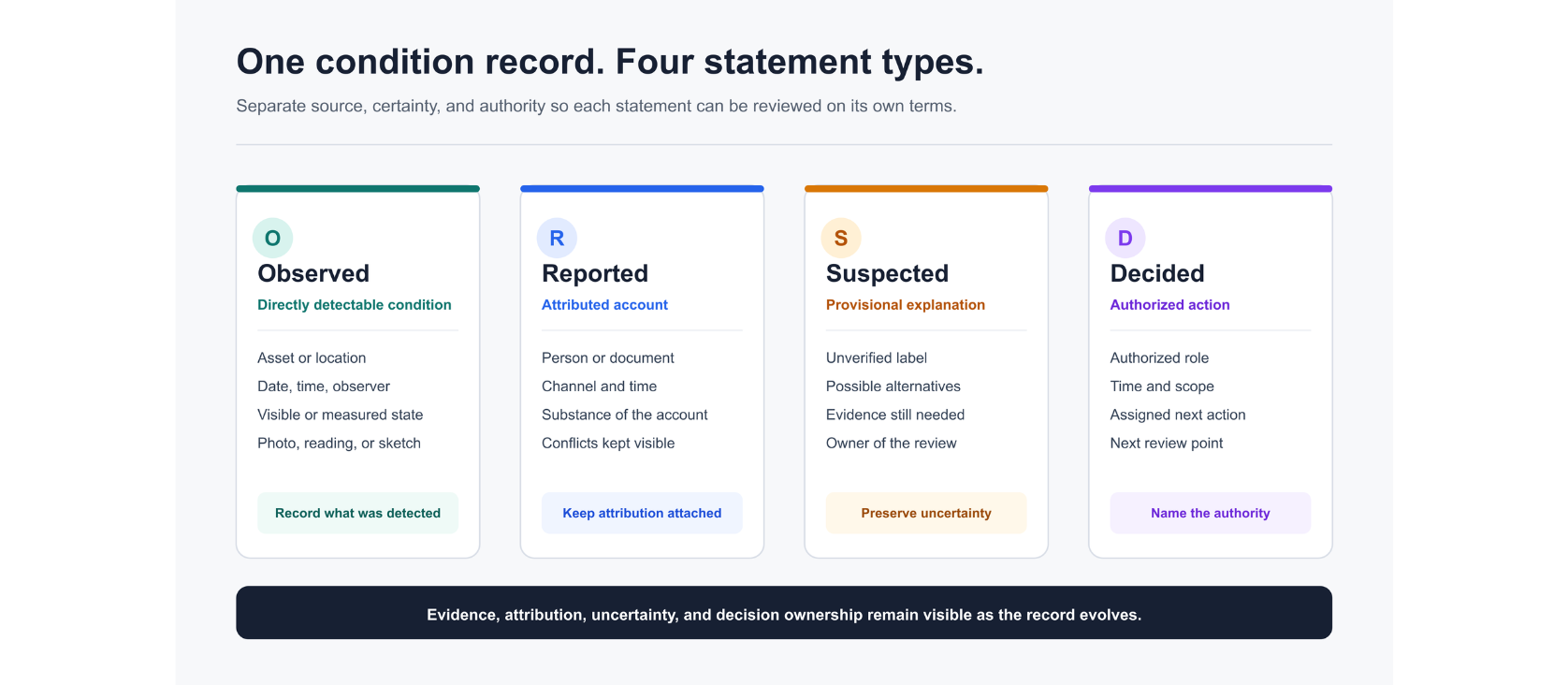
A four-lane record keeps unlike statements visibly separate: observed, reported, suspected and decided. The method does not establish truth, causation, compliance, safety, liability or return-to-service status. It creates a clearer trail for the people who hold those responsibilities.
4 lanes, 4 different jobs
Observed: The directly detectable condition
An observation records what an identifiable person or instrument directly detected. Useful entries name the asset or location, the date and local time, the observer, the visible or measurable condition, and the supporting record. Specific language is more useful than a conclusion. "The lower-right edge stood approximately 8 millimeters from the frame" preserves more information than "the panel was installed incorrectly."
Photographs, readings and sketches can support an observation, but each has a boundary. A photograph records a visible state from a particular viewpoint at a particular moment. It does not, by itself, establish what caused that state.
Reported: An attributed account
A reported statement records what another person or source communicated. The entry identifies the speaker or document, the communication method, the time and the substance of the account. Attribution prevents a second-hand statement from becoming an unattributed fact during later handoffs.
Guidance from the International Labour Organization presents a methodology for gathering information and compiling formal investigation reports.
Routine facility records are not formal investigations, but a related documentation principle remains useful: an account should retain its source and should not be treated as a direct observation.
Suspected: A provisional explanation
A suspected statement holds a possible explanation that still requires review. Words such as may, possible, working hypothesis and unverified make the status visible. The entry should also state what evidence could support or disprove the hypothesis and who owns the next review.
World Health Organization guidance for incident-reporting systems notes that incident data can be valuable when its properties are reviewed carefully and conclusions are drawn with caution. Although that guidance comes from health care rather than facilities, the same limit on early causal certainty is useful in the design of a careful handoff record.
Decided: An authorized action or disposition
A decision records what an authorized role directed, when the direction was made, its scope and the next review point. The authorized role will differ by organization, asset, contract and jurisdiction. A technician may document a condition while a duty manager assigns follow-up work and a separate specialist determines a technical decision.
The decision lane should not absorb a causal claim that the decision-maker did not make. It also should not imply that an assigned inspection is a certification or that a work order settles responsibility.
A condition note before & after separation
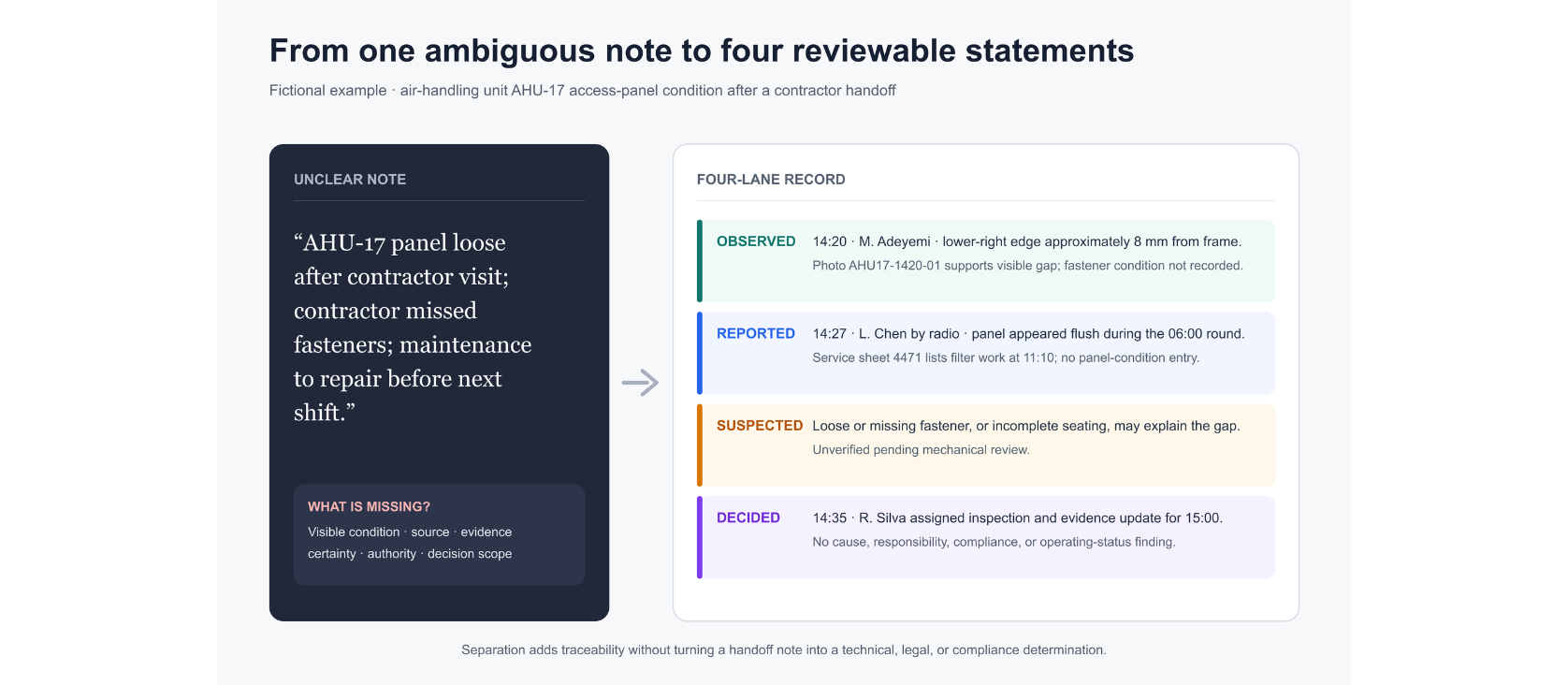
Consider a fictional air-handling unit (AHU) after a contractor handoff. An unclear note reads:
AHU-17 panel loose after contractor visit; contractor missed fasteners; maintenance to repair before next shift.
The note appears concise, but its certainty is impossible to audit. The visible condition is not described. The contractor's involvement is treated as proof of cause. The source of the repair instruction is missing. No reader can tell whether the last phrase is a request, a prediction or an authorized decision.
The same event becomes more usable when divided into four lanes:
- Observed — At 14:20 local time, technician M. Adeyemi saw the lower-right edge of AHU-17 access panel standing approximately 8 millimeters from the frame. Photograph AHU17-1420-01 shows the visible gap. Fastener condition was not recorded.
- Reported — At 14:27, shift supervisor L. Chen stated by radio that the panel appeared flush during the 06:00 round. Service sheet 4471 records filter work completed at 11:10 but contains no panel-condition entry.
- Suspected — A loose fastener, a missing fastener or incomplete seating may explain the gap. The possibilities remain unverified pending mechanical review.
- Decided — At 14:35, duty manager R. Silva assigned a panel inspection and evidence update to the mechanical team for 15:00. The record makes no finding about cause, responsibility, compliance or equipment operating status.
The structured version is longer, yet each sentence has a defined owner and level of certainty. A later reviewer can challenge one lane without rewriting the others. New evidence can close a hypothesis while preserving the original observation and account.
Building the method into daily handoffs
A useful rollout begins with a small record template and role agreement rather than a new software project.
- Define the trigger. The organization identifies which conditions require a four-lane record, such as post-maintenance discrepancies, damage handoffs, recurring faults or unresolved contractor observations.
- Make the source trail visible. Each lane carries an author or source, a time with local time zone or Coordinated Universal Time (UTC) offset, an asset identifier and links to supporting photographs, readings, work orders or statements.
- Permit an empty lane. Missing information should remain visibly missing. A blank decision lane is more honest than an instruction inferred from context. "No hypothesis recorded" is clearer than a guess inserted to complete a form.
- Map decision authority. A short role map identifies who may assign inspection, approve work, change operating status, close an action or make any regulated determination. Local law, contracts and organizational policy remain controlling.
- Use explicit states. Terms such as open, awaiting evidence, reviewed, superseded and closed show how a record changes without deleting its history.
- Review the handoff, not only the asset. A receiving shift or contractor checks whether observations are specific, reports are attributed, hypotheses remain provisional, and decisions name an authorized owner.
Structured fields and narrative serve different needs. Fields support sorting, comparison and completeness checks. Short narrative preserves context, ambiguity and sequence. ISO guidance on asset data emphasizes managing data so that it serves defined asset management and organizational objectives; the form should therefore fit the decision it supports rather than collect details without purpose.
Record changes need the same discipline as first entries. New evidence should not silently overwrite the wording that earlier reviewers saw.
A correction or amendment can identify the original entry, explain the reason for the change, name the person making it, and preserve the local time and time-zone reference. Where a system lacks formal version history, a dated amendment is safer than editing the earlier statement in place. The observed lane can then remain a record of the condition at one moment while later evidence updates the suspected or decided lane.
Before wider rollout, two or three reviewers can classify the same small sample independently and compare where their choices differ. Disagreement may reveal an unclear definition, a missing authority rule or a form that pushes users toward conclusions. The exercise is a calibration check, not a measure of individual performance. Repeating it after a workflow, contractor or language change helps keep the four labels consistent without treating them as a rigid substitute for professional judgment.
Measuring record quality without inventing a benchmark
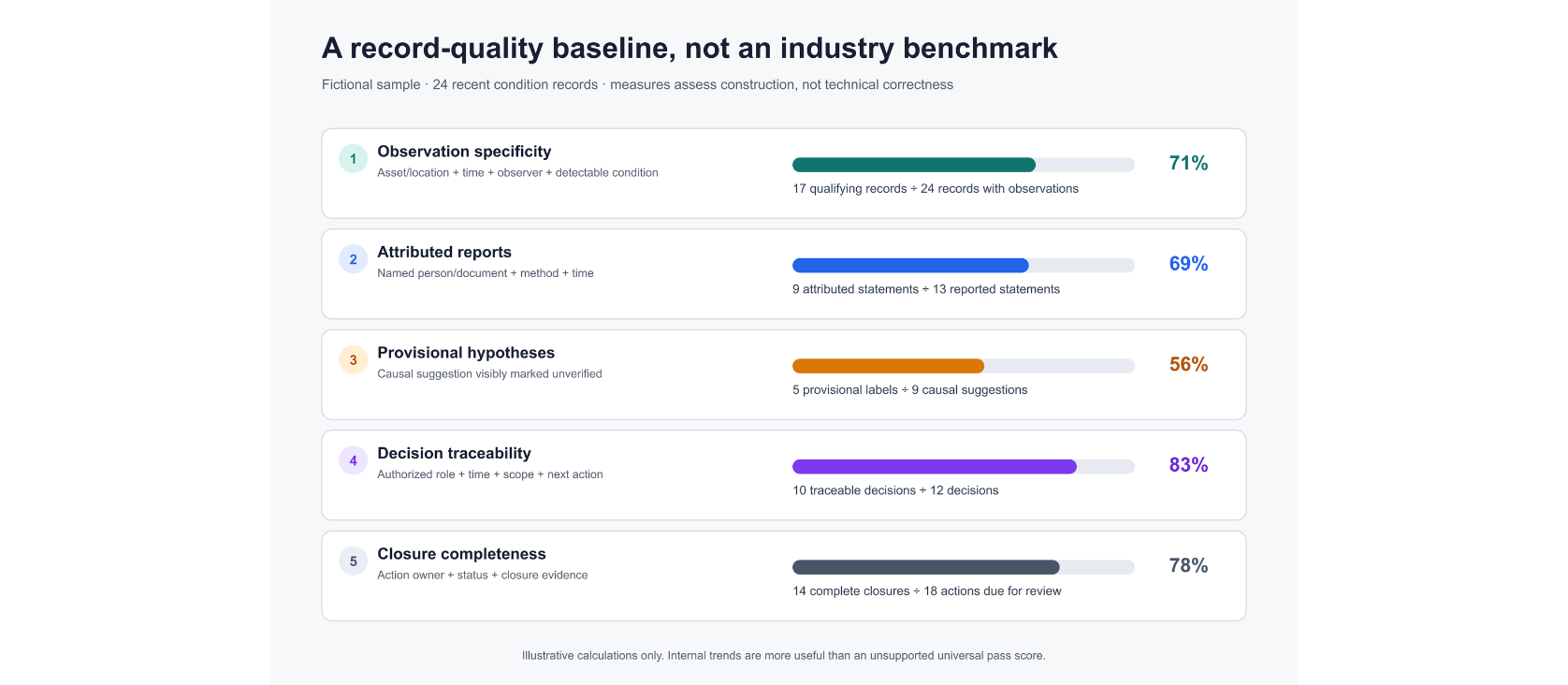
A data-driven review can begin with a sample of recent records. These five measures assess record construction, not technical correctness or operational outcomes:
- Observation specificity rate: records with asset or location, time, observer and detectable condition divided by records containing an observation.
- Attributed-report rate: reported statements naming a person or document, method and time divided by all reported statements.
- Provisional-hypothesis rate: causal suggestions explicitly marked as unverified divided by all causal suggestions.
- Decision-traceability rate: decisions naming an authorized role, time, scope and next action divided by all decisions.
- Closure-completeness rate: required actions with an owner, status and closure evidence divided by all required actions due for review.
For example, a fictional baseline sample of 24 records might find 17 specific observations (71 percent), nine attributed statements among 13 reports (69 percent), five clearly provisional hypotheses among nine causal suggestions (56 percent), 10 traceable decisions among 12 decisions (83 percent), and 14 complete closures among 18 actions due for review (78 percent). Those figures are illustrative calculations, not industry benchmarks.
The first comparison should be internal: team against its own baseline, record type against record type, or one handoff period against another. A low result points to a record-design or coaching question. It does not prove poor maintenance, negligence or noncompliance. A periodic sample can also reveal whether missing attribution clusters around one form, workflow, language transition or contractor interface.
Clear source trails, bounded conclusions
The four lanes clarify the source trail: what was detected, who supplied an account, which explanation remains open, and who authorized the next action. They do not replace a technical inspection, a risk assessment, a compliance review, a causal investigation or a contractual process.
That boundary is especially important across regions. Definitions of a record, retention period, personal data, competent person and decision authority vary. Each organization must align the method with local requirements and avoid collecting sensitive information without a defined purpose and access rule.
A clear condition record allows uncertainty to remain visible without becoming inaction. Facts can stay factual, accounts can stay attributed, hypotheses can stay provisional, and decisions can stay accountable. That separation gives facility teams a more stable handoff while preserving the limits of what the record can prove.
Meta: Improve facility condition records with a four-lane method that separates observations, reports, suspected causes and authorized decisions, strengthening documentation, accountability, data quality and shift-to-shift handoffs across FM operations teams.

Satyajeet Singh is a software developer with more than 15 years of experience designing digital systems for complex operational workflows. He holds a bachelor of engineering degree in computer science and engineering. His work focuses on translating facility, equipment and field-operation processes into clear, reviewable digital records.
References
- International Organization for Standardization, ISO 19650-3:2020 — Information management using building information modelling — Part 3: Operational phase of the assets, public abstract and committee overview: Official source.
- European Commission, Study on the development of a European Union framework for digital building logbooks — Final report (2021): Official source.
- International Labour Organization, Investigation of occupational accidents and diseases: A practical guide for labour inspectors (2015): Official source.
- World Health Organization, Patient safety incident reporting and learning systems: technical report and guidance (2020): Official source.
- International Organization for Standardization, ISO 55013:2024 — Asset management — Guidance on the management of data assets, public abstract and technical-committee material: Official source.
An optional, free, ungated browser-local four-lane worksheet creates printable, comma-separated values (CSV), and JavaScript Object Notation (JSON) records without uploading worksheet contents. Open the four-lane condition-record worksheet. The worksheet does not determine safety, compliance, cause, liability, or operating status.
Read more on Facility Operations , Communication and Project Management or related topics Data strategy and information management , Maintenance Processes and Operations
Explore All FMJ Topics