
 Membership
 Network
 Regional Sites & Affiliates


 Events
 Participate
 Resources

 Training
 Credentials
 Government


 Content Channels
 Tools
Tools


 Business Overview





From Co-Pilot to Autonomous Execution
What AI really means for FM operations

Artificial intelligence has dominated boardroom conversations for the past three years. In facility management, the discussion often centers on predictive maintenance, anomaly detection and energy optimization.
But prediction was only the first phase.
Today’s deeper operational shift is less about what AI can forecast and more about what it can execute.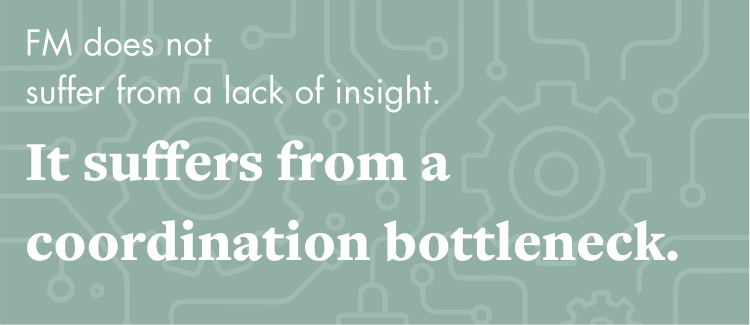
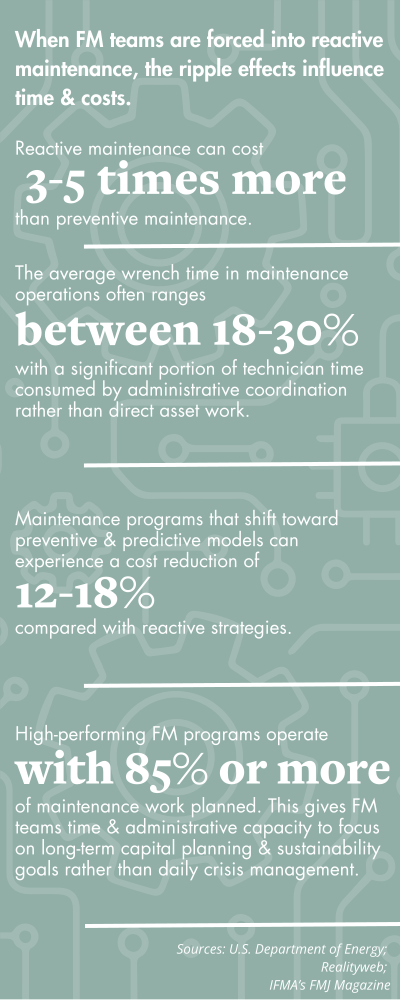
FM teams manage expanding portfolios, aging assets, stricter compliance standards and higher service expectations. According to the U.S. Department of Energy (DOE), reactive maintenance can cost three to five times more than preventive maintenance. Meanwhile, industry research from Reliabilityweb shows that average wrench time in maintenance operations often ranges between 18 percent and 30 percent, with a significant portion of technician time consumed by administrative coordination rather than direct asset work.
The constraint is not awareness. It is workflow friction.
The coordination problem behind performance gaps
Most operational delays in FM today are procedural rather than technical.
A service request arrives. It must be interpreted, prioritized, assigned, validated and tracked. An alert flags an anomaly. It must be reviewed, contextualized, scheduled, and reconciled with ongoing work. An invoice is submitted. It must be checked against scope, contract and completion documentation.
Even in well-digitized organizations using computerized maintenance management systems (CMMS), enterprise resource planning (ERP) systems and building management systems (BMS), the flow of work depends heavily on human handoffs.
Information is available. Execution stalls.
This gap explains why predictive insights often fail to translate into measurable impact. Awareness improves, but without embedded coordination support, teams absorb the burden of turning insight into action.
The next phase of AI in FM addresses that gap directly.
From co-pilot to embedded execution
Early discussions positioned AI as a co-pilot – a system that supports decision-making while professionals retain control. Agentic AI allows organizations to move beyond a passive supporting role for humans toward partial or full automation of coordination-heavy tasks.
Rather than simply surfacing insights, these systems take defined actions within guardrails. They structure incoming service requests, apply prioritization logic, assign vendors, validate documentation, reconcile invoices and escalate exceptions automatically.
This shift is not about replacing professionals. It is about automating rules-based administrative effort so teams can focus on safety, quality and performance decisions.
The distinction is subtle but significant. A co-pilot informs. An embedded agent executes rules-based coordination tasks inside existing workflows.
Human accountability remains intact. Decisions tied to safety, compliance and risk prioritization are not delegated. But the repetitive administrative effort required to move work forward begins to decline.
Importantly, this evolution does not require organizations to rip and replace existing CMMS or ERP platforms. Modern AI agents operate as an orchestration layer, integrating with current systems of record rather than replacing them. For many organizations, this lowers adoption risk and accelerates time to impact.
 Where the operational impact is measurable
AI’s practical value in FM is emerging most clearly in coordination-heavy areas.
1. Service intake, dispatch & vendor coordination
Incomplete or inconsistently categorized service requests introduce downstream delays. Embedded AI can structure incoming requests using natural language processing, attach asset history automatically, apply prioritization logic and route work to the appropriate internal team or external vendor.
Dispatch decisions, historically dependent on manual review, can incorporate asset criticality, technician skill sets, contract service level agreements (SLAs), and workload balancing in real time.
The result is fewer back-and-forth clarifications, reduced reassignment, faster vendor coordination and improved response predictability.
2. Maintenance planning
Predictive maintenance systems generate early signals. But signals without context can overwhelm planners. By embedding asset criticality, maintenance history and workload patterns into the triage process, AI can surface high-impact issues without increasing alert fatigue.
This supports the DOE’s long-standing recommendation that maintenance programs shift toward preventive and predictive models, which are associated with cost reductions of 12 to 18 percent compared to reactive strategies.
3. Financial validation & revenue protection
Administrative validation is one of the least visible but most time-consuming aspects of FM operations. Invoice discrepancies, scope mismatches and incomplete documentation introduce approval delays and financial leakage.
Embedded AI can compare work orders, contracts and completion records automatically. Exceptions surface early, reducing cycle times and improving transparency between owners and service providers.
4. Compliance & reporting automation
Compliance challenges rarely stem from missed inspections. They stem from fragmented documentation and manual reporting effort.
FM teams spend significant time assembling compliance packs, validating records, reconciling SLA performance and compiling monthly reports across disconnected systems.
Agentic AI can automate much of this coordination. It validates inspection records, flags missing evidence, cross-checks requirements and generates structured compliance and performance reports automatically, surfacing exceptions before audits or client reviews.
Instead of building reports from scratch each month, teams review system-generated outputs and focus on resolving real gaps.
The impact is straightforward: reduced administrative burden, faster reporting cycles and stronger governance without additional headcount.
5. Work validation & proposal automation
Field execution increasingly relies on visual documentation: site photos, inspection images, completion evidence. Yet validating those submissions remains manual.
Agentic AI can review uploaded photos for completeness, match them against work order requirements, flag discrepancies, and ensure required documentation is attached before closure.
Similarly, proposal generation for corrective work can be partially automated by pulling asset history, contract rates, and scope templates into structured drafts, thereby reducing turnaround time and administrative effort.
These capabilities reduce rework and improve financial accuracy without increasing headcount.
Global comparisons: A common constraint
The coordination bottleneck is not region-specific.
 Despite regional differences, the pattern is consistent: administrative coordination consumes disproportionate effort relative to technical execution.
Organizations that embed AI inside workflows, rather than adding it as a reporting layer, report reductions in manual effort, faster service cycles and more consistent audit outcomes. The most advanced deployments are not defined by new systems, but by smoother transitions between existing ones.
Leadership implications: Oversight in an AI-embedded environment
As AI moves from insight generation to embedded execution, leadership oversight evolves.
Instead of tracking individual tasks, managers increasingly review patterns and exceptions. Governance shifts from monitoring activity to validating outcomes.
Explainability becomes critical. Leaders must understand why an AI agent prioritized a request or flagged an invoice. Transparency builds trust and maintains accountability.
Roles also evolve. Manual coordination tasks decline, while higher-value activities increase – vendor performance optimization, life cycle analysis, strategic planning and continuous improvement.
Importantly, accountability remains human-led. AI strengthens governance by enforcing consistency, not by displacing responsibility.
A practical framework: 5 Steps to embedding AI in core FM workflows
For organizations evaluating AI integration, a structured approach reduces risk.
Step 1: Map coordination friction
Identify workflows where delays stem from handoffs rather than technical constraints. Service intake, invoice validation, and compliance documentation are common starting points.
Step 2: Prioritize rules-based processes
Begin with tasks governed by clear rules and repeatable logic. AI performs best where consistency is required.
Step 3: Integrate, do not replace
Leverage AI as an orchestration layer that connects existing systems. Avoid rip-and-replace strategies that disrupt stable systems of record.
Step 4: Establish governance & explainability standards
Define escalation paths, review mechanisms, and transparency requirements. Leaders must understand how AI-generated actions occur.
Step 5: Measure operational outcomes
Track metrics tied to coordination efficiency:
-
-
Mean time to resolution
-
Invoice approval cycle time
-
Percentage of preventive versus reactive work
-
Administrative hours per work order
-
Improvements in these indicators reflect execution gains, not just visibility gains.
Defining mature FM operations
Leading FM organizations will not be distinguished by the number of dashboards they operate, but by how smoothly work progresses across systems and teams.
In mature environments:
-
Service requests move without overnight stagnation
-
Preventive work increases without alert overload
-
Invoice discrepancies are identified before escalation
-
Compliance documentation is complete by default
-
Portfolio insights require minimal manual assembly
The defining question for facilities leaders is no longer whether AI can predict failure.
It is whether AI can help execute consistently.
Prediction improved awareness. Embedded execution improves operational efficiency and measurable outcomes.
The AI hype cycle may focus on generative capabilities and automation headlines. But in facilities management, the real transformation is quieter and more operational.
It is the reduction of coordination friction.
 FM has always depended on disciplined execution. AI’s next chapter strengthens that discipline, not by replacing professionals, but by reducing the invisible effort that slows them down.

Raj Subramanian is the Co-founder and Chief Product Officer at Facilio, where he leads the development of AI-driven platforms for modern facility operations. His work focuses on using AI, IoT, and data to help organizations run large portfolios of buildings more efficiently.
References
Top image via Getty Images.
Read more on Facility Technology & Data Management and Facility Operations or related topics Operations , Maintenance Processes and Data strategy and information management
Explore All FMJ TopicsRelated articles
-

Artificial Intelligence in FM
The stakeholder’s perspectiveBy Dr. Jake Smithwick & Dr. Kenneth Sullivan & Nneka Ubi05.01.2024 -

Don’t Drop the Ball
How a CMMS can make or break an FM organization’s successBy Michael Carmean09.17.2024 -

Beware of Growing Cyberthreats
Why it’s time for stronger facility cybersecurityBy Andrew Harris & Eric Headington10.30.2024