
 Membership
 Network
 Regional Sites & Affiliates


 Events
 Participate
 Resources

 Training
 Credentials
 Government


 Content Channels
 Tools
Tools


 Business Overview





From Complaints to Performance Metrics
Introducing OPSi v2 for sustainable portfolios

Over the past two decades, green and healthy building certifications such as LEED, WELL, Fitwel and others have transformed how organizations design and operate facilities. They have given owners, tenants and communities a common language for sustainability, health and wellness in the built environment.
Yet every facility professional knows a hard truth: once the certification plaque is on the wall, the real work begins.
Systems drift out of tune. Loads change. Tenants move in, departments grow, teams rearrange spaces and new technologies arrive. Occupants complain about hot and cold spots, glare, noise or stale air. Utility bills fluctuate with weather, usage and operational strategies. Recertification may happen every three years, but discomfort and inefficiency show up every week.
What many leaders are now asking is a deceptively simple question:
 That is the question the Operational Sustainability Index (OPSi) was created to answer. And it is the question that the next evolution — OPSi v2 — aims to answer at portfolio scale, using data that most organizations already have.
A quick reminder: What is OPSi?
The original Operational Sustainability Index (OPSi) was developed to close the gap between design-phase promises and operational reality. Traditional certifications emphasize strategies and design intent. OPSi, by contrast, identifies what happens once the building is in use.
In its first generation, OPSi integrates three dimensions:
-
Indoor Environmental Quality (IEQ): Measured through field monitoring (temperature, humidity, CO2, PM2.5, etc.).
-
Energy Utility Quality (EUQ): How consistently and efficiently energy systems perform across seasons.
-
User Satisfaction: How building occupants actually feel about their environment and comfort.
The result is a multidimensional score that helps owners and FMs answer:
“Is this building delivering the healthy, efficient experience we think it is?”
OPSi has proven powerful at the single-building or small portfolio scale for which intensive monitoring and surveys are feasible. But for large corporate or institutional portfolios — tens, hundreds or thousands of buildings — deploying new sensors and repeated surveys everywhere can be costly, slow and intrusive.
That’s where OPSi v2 comes in.
Complaints as data: Work orders as a behavioral sensor
Most organizations already operate a computerized maintenance management system (CMMS) or similar work-order platform. Every day, occupants submit tickets:
-
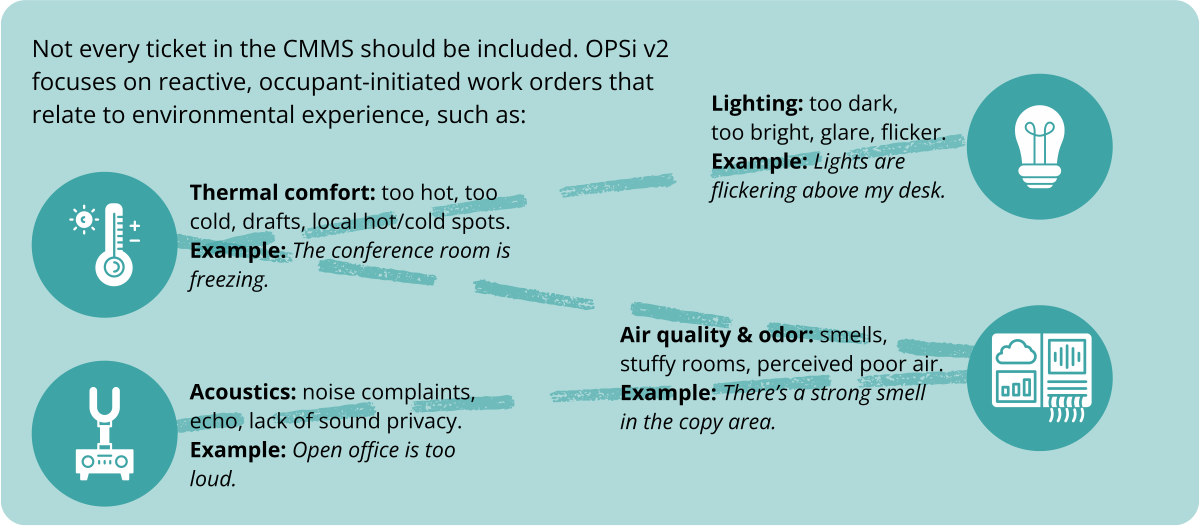
“Conference room is freezing.”
-
“Open office is too loud.”
-
“There’s a strong smell in the copy area.”
-
“Lights are flickering above my desk.”
To facility teams, these are reactive work orders. To a data-minded sustainability professional, they represent something else: a behavioral sensor network.
Each IEQ-related complaint is a signal that:
-
An occupant was uncomfortable enough to stop work and take action;
-
The issue was not caught by preventive maintenance or monitoring; and
-
The building’s systems, layout or operations may not be fully aligned with human experience.
OPSi v2 leverages this reality by treating occupant-initiated IEQ work orders as a proxy for lived environmental quality, especially in large portfolios where deploying physical sensors or running frequent surveys is not practical across every building.
Introducing OPSi v2: A complaint-adjusted operational sustainability index
Conceptually, OPSi v2 combines two elements:
-
EUQ: A normalized indicator of how reliably and efficiently a building’s energy systems perform across heating and cooling seasons, relative to expected patterns for its climate and type.
-
Complaint Factor: A normalized indicator derived from reactive, occupant-initiated work orders related to IEQ (thermal comfort, air quality and odor, lighting, acoustics, etc.), adjusted for building size or headcount.
 Rather than present a complex formula, it is more useful to think in terms of how each piece is built.
Step 1: Define which work orders “count”
Not every ticket in the CMMS should be included. OPSi v2 focuses on reactive, occupant-initiated work orders that relate to environmental experience, such as:
 Preventive maintenance tasks, asset-tracking tickets, security incidents or issues discovered only by facility staff are excluded. The idea is to isolate the moments when occupants felt the building environment was not supporting them.
Step 2: Normalize complaints by scale
A portfolio with 1 million square feet and 5,000 occupants will naturally have more tickets than a small office. To compare fairly, complaint volume must be normalized, for example:
-
Complaints per 10,000 ft² per year, and/or
-
Complaints per 100 full-time equivalent (FTE) occupants per year.
The facility team can then define what “high,” “moderate” and “low” complaint rates look like across their portfolio and convert this into a simple 0.0 or 0.1–1.0 Complaint Factor, where:
-
1.0 = exceptionally few IEQ complaints for the building’s size and use,
-
0.0 or 0.1 = unacceptably high IEQ complaint burden
Step 3: Calculate EUQ
Where the Complaint Factor reflects how the building feels to people, EUQ reflects how it behaves energetically.
EUQ is based on energy use intensity (EUI) across heating and cooling seasons. The goal is to understand whether a building’s energy performance is:
-
Reasonably balanced and predictable for its climate and type, or
-
Highly variable, inefficient or out of step with regional norms.
Practically, this means:
-
Segmenting utility data into heating-dominant months and cooling-dominant months, based on the building’s climate zone.
-
Calculating seasonal EUI (kBtu/ft² or kWh/m²) for each period.
-
Comparing those seasonal EUIs to typical patterns for similar buildings in the region, using internal portfolio history and/or public datasets (such as those published by the U.S. Energy Information Administration).
The result is a normalized EUQ score where:
-
1.0 = strong, stable, efficient energy performance across seasons,
-
0.0 or 0.1 = poor or highly inconsistent performance relative to benchmarks.
Step 4: Combine EUQ & the Complaint Factor into OPSi v2
Once EUQ and the Complaint Factor are established on a comparable 0–1 scale, OPSi v2 is calculated as a combined operational score for each building, typically in the 0–100 range for ease of communication.
For example:
OPSi v2 = EUQ × Complaint Factor × 100
This simple structure ensures that both energy performance and occupant experience matter. A building cannot score highly on OPSi v2 if it is efficient but uncomfortable, or comfortable but wasteful.
Annual, not every 3 years
Most certification frameworks renew on multiyear cycles, often every three years for recertification. OPSi v2, by design, is an annual metric.
In a single year, a facility or portfolio team can:
-
Pull one year of utility data,
-
Extract and classify one year of IEQ-related reactive work orders,
-
Normalize, score and compare buildings across the portfolio.
This makes OPSi v2 a kind of annual operational check-up that keeps performance visible between certification cycles and provides early warnings when a building starts drifting away from its “as-certified” intent.
Not just for certified buildings
Equally important, OPSi v2 does not require a building to be certified at all. Any facility with basic utility data and a functioning work-order system can calculate OPSi v2.
That means non-certified buildings can begin to measure operational sustainability and comfort without waiting for a full certification project; and certified buildings can use OPSi v2 as an operational complement to LEED, WELL or Fitwel, asking: “We know our design and policies met the standard at a point in time. What is this building’s OPSi v2 today?”
This framing is particularly helpful for owners and operators managing mixed portfolios where only some assets are certified.
How facility & project managers can use OPSi v2
Once calculated, OPSi v2 opens several practical applications.
1. Portfolio benchmarking
By scoring each building annually, leaders can quickly see:
-
which sites consistently deliver strong operational sustainability and comfort,
-
which sites are chronic under-performers, and
-
where “middle of the pack” assets might benefit from targeted interventions.
This supports more informed capital planning, operational focus and strategic divestment or repositioning decisions.
2. Prioritizing interventions
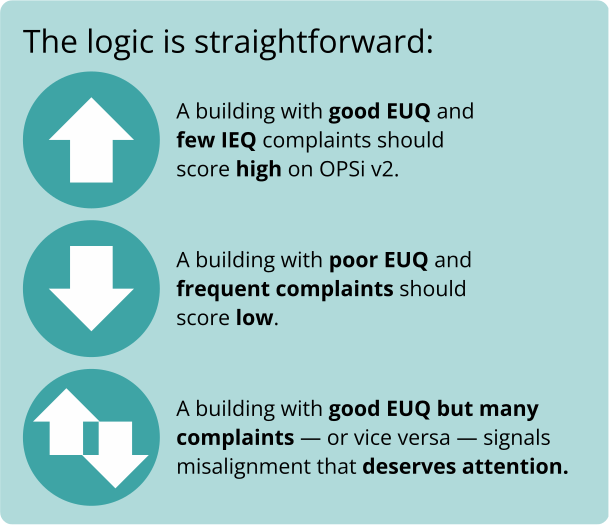
Because OPSi v2 is composed of EUQ and IEQ complaints, it naturally points to next steps:
-
A building with low EUQ but a good Complaint Factor may need retro-commissioning, control upgrades or envelope improvements.
-
A building with frequent IEQ complaints but reasonable EUQ may need zoning adjustments, layout changes, acoustical treatments or revised setpoints.
-
A building that is low on both dimensions may justify a comprehensive performance and capital review.
In each case, OPSi v2 helps facility and project managers focus limited resources where they will have the greatest impact.
One powerful side effect of OPSi v2 is that it gently shifts teams from a reactive to a proactive mindset. Because the Complaint Factor explicitly reflects how often occupants feel compelled to open IEQ-related tickets, it rewards facilities that identify and resolve issues before people are uncomfortable enough to complain. High-performing teams start to ask: “What patterns are we seeing in comfort and system performance that we can address upstream so complaints never occur?” Over time, this encourages more frequent inspections, better use of trend logs and analytics, and tighter coordination between operations, projects and workplace teams. OPSi v2 becomes not just a score, but a quiet incentive structure that favors preventive, human-centered FM.
 3. Building the business case
FM professionals are often asked to justify investments in terms that resonate with leadership: risk, cost, experience and brand. OPSi v2 provides a simple narrative:
-
“This building has a low operational sustainability score because it combines poor energy performance with a high volume of comfort complaints.”
-
“If we address these issues, we expect to see fewer tickets, better occupant satisfaction and reduced energy cost, all of which will lift OPSi v2 over the next year or two.”
This kind of story is much easier to tell than a stack of disjointed charts.
4. Supporting project delivery & handover
For project managers, especially those delivering major fit-outs or renovations, OPSi v2 offers a way to set post-occupancy performance expectations with the client and track whether new or renovated space is actually meeting those expectations after the grand opening.
A project may be on time and on budget, but if it enters operation with chronic hot/cold complaints and rising energy bills, the long-term story is not a success. OPSi v2 encourages thinking beyond practical completion.
From plaque to practice
Green and healthy building certifications are vital. They set the bar, align stakeholders and drive the industry forward. But they are not the whole story.
By turning everyday work orders and utility data into a structured operational index, OPSi v2 offers facility and project managers a practical way to track sustainability and comfort year over year, compare buildings across large portfolios, prioritize interventions and keep the focus on what truly matters: how buildings perform for people and the planet in real life.

Dr. Oluwafemi “Femi” Awolesi is an expert in sustainable facility management, focusing on operational sustainability metrics that connect building performance with occupant experience. He is the developer of the Operational Sustainability Index (OPSi), a Fitwel Ambassador, and a member of the U.S. Green Building Council (USGBC). Dr. Awolesi works with JLL, supporting high-performing corporate facilities and advancing health, comfort, and sustainability in the built environment.
Read more on Project Management , Quality and Occupancy & Human Factors or related topics Occupant Services , Project Management and Quality Improvement
Explore All FMJ Topics