
 Membership
 Network
 Regional Sites & Affiliates


 Events
 Participate
 Resources

 Training
 Credentials
 Government


 Content Channels
 Tools
Tools


 Business Overview





From Dashboards to Governed Autonomy
A practical semantic AI maturity model for FM operations

Facility managers face rising expectations to improve performance, reduce energy use and increase resilience. Hybrid work patterns have altered occupancy profiles. Energy volatility affects budgets across both developed and emerging markets. Aging infrastructure increases maintenance risk. Executive leadership increasingly expects data-driven performance improvement.
Technology investments reflect this urgency. Building automation systems generate continuous streams of operational data. Internet of Things sensors monitor occupancy and environmental conditions. Integrated workplace management systems (IWMS) centralize work orders and asset records. Connected portfolio intelligence platforms (CPIP) aggregate portfolio performance and environmental reporting metrics.
Yet measurable transformation remains limited.
According to IFMA’s 2025 FM Technology Adoption Report, nearly 60 percent of FM leaders identify data silos as the primary barrier to effective artificial intelligence deployment. JLL’s 2025 Global State of Facilities Management Report indicates that although many organizations are piloting AI-enabled analytics, fewer than 1 in 10 describe results as transformative.
 Fragmented naming conventions, incomplete integration and inconsistent commissioning of digital systems prevent artificial intelligence platforms from scaling reliably across portfolios.
Without digital trust, analytics remain observational rather than operational.
Semantics as operational infrastructure
Semantics provides structured, machine-readable definitions of assets, systems, spaces and relationships, clarifying how equipment functions and connects across operations.
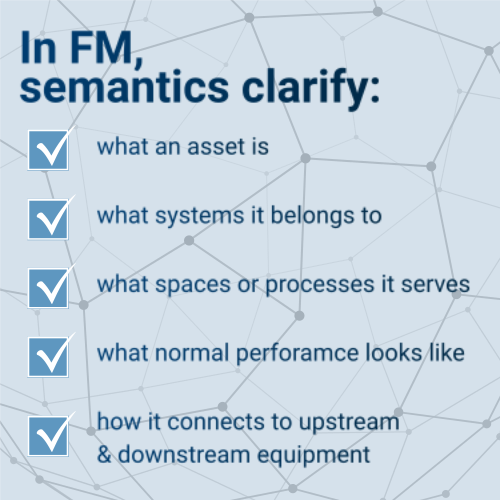 Traditional point naming may support localized troubleshooting, but it rarely scales across portfolios or integrates cleanly with IWMS or CPIP platforms. Open semantic frameworks such as Project Haystack, Brick Schema and REC (RealEstateCore) provide structured vocabularies that standardize how assets, systems and spaces are defined across platforms. Emerging standards such as the proposed ASHRAE 223P aim to further formalize semantic interoperability for building automation systems, complementing these frameworks for broader global adoption. These models move facility data beyond custom naming conventions toward reusable, portfolio-scale capabilities that remain interoperable across automation systems, digital twins and enterprise platforms.
For example, in a campus environment, semantic alignment between building automation systems and maintenance platforms allows a detected fault on an air-handling unit to automatically reference affected zones, confirm redundancy conditions and generate a validated work order within the maintenance system. Without semantics, the same event produces an alert requiring manual interpretation.
Semantics transforms data visibility into operational intelligence.
Why AI stalls in CPIP & IWMS environments
CPIP and IWMS platforms provide aggregation and reporting across portfolios. However, many deployments emphasize analytics layering before digital structure is fully validated.
As a result, AI initiatives in FM often plateau when analytics are applied without structured semantic context and validated digital baselines. Verdantix’s 2025 Green Quadrant similarly observes that many CPIP implementations struggle to deliver step-change efficiency when foundational digital alignment is incomplete.
Common patterns include detection without diagnosis, alert fatigue, nonexecutable recommendations and the absence of a learning loop.
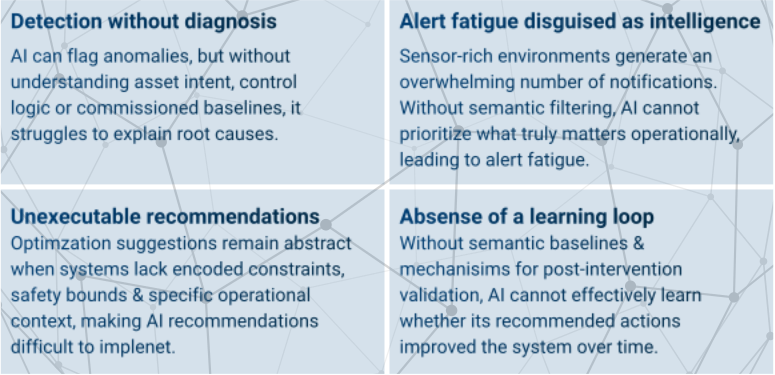 Common AI stalls in FM.
These patterns reveal a deeper issue: digital infrastructure is assumed rather than engineered. Without a defined trust boundary and governance structure, AI systems amplify inconsistency rather than resolve it.
This infrastructure gap typically manifests in four structural conditions:
-
Aggregation without intent: Platforms federate signals but lack encoded system intent that governs how assets are designed to operate.
-
Sensor density does not equal actionable intelligence: Monitoring improves but leads to alert fatigue without contextual filtering.
-
Energy focus as partial proxy: Optimization is strong but lags deeper asset health insights.
-
Dashboards vs. workflow integration: Insights remain passive without FM tool embedding.
AI performs reliably only when time-series telemetry, asset relationships, spatial context and maintenance workflows are aligned through a validated semantic layer that serves as a shared operational model across systems.
Smart commissioning & digital validation
Traditional commissioning verifies that physical systems meet design intent. However, digital representations of those systems are rarely validated with equal rigor.
Smart commissioning (Cx) validates semantic models, asset identity alignment, data quality thresholds and integration pathways linking automation, maintenance and analytics systems. Treating these elements as formal commissioning deliverables reduces downstream friction and stabilizes advanced analytics initiatives.
Research from the National Institute of Standards and Technology indicates that structured digital validation can reduce commissioning-related data defects by 30-50 percent. Reducing defects at handover prevents downstream analytics errors and artificial intelligence instability.
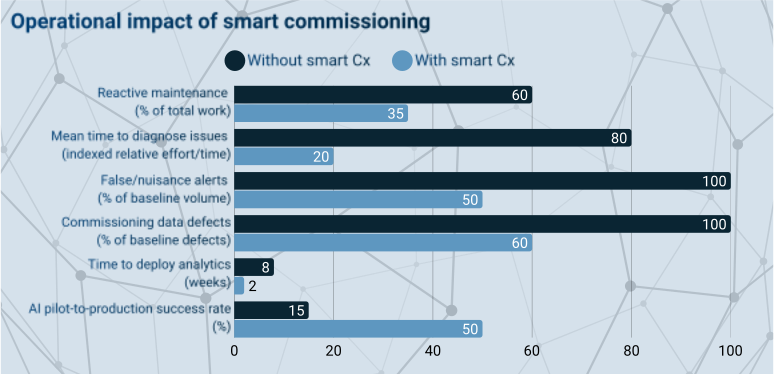 Operational impact of Smart Cx (digital validation of semantic and system integrity).
Reductions in reactive maintenance, faster diagnostics, lower nuisance alerts and higher AI adoption success by validating digital readiness alongside physical systems (data from aligned portfolios).
A semantic-AI maturity model for facilities operations
Portfolios typically evolve through five maturity levels, progressing from basic visibility to reliable AI-supported performance. Validating digital and semantic foundations alongside physical systems reduces reactive workload, accelerates diagnostics and improves AI deployment success.
Each level builds technical and organizational trust.
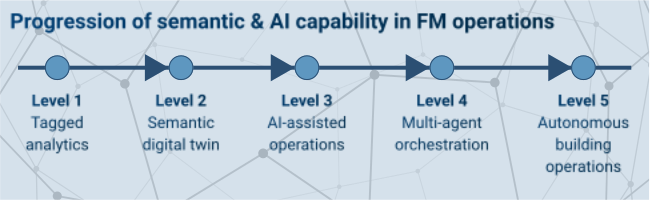 Progression of semantic and AI capability in FM operations (linear diagram showing Levels 1-5 with key characteristics).
From basic tagging to governed autonomy, guiding organizations through maturity levels:
Level 1: Tagged analytics
-
Basic tags enable limited fault detection; human interpretation required.
Level 2: Semantic digital twin
-
Unified models make data discoverable and portable.
-
Operational improvement includes reduced duplication and improved reporting accuracy.
Level 3: AI-assisted operations
-
Portfolios at this level frequently report 15-25 percent reductions in reactive workload, faster diagnostics and fewer nuisance alerts.
-
AI copilots and predictive tools leverage context and assist technicians, while human oversight remains central.
Level 4: Multi-agent orchestration
-
Agents negotiate actions within shared models. Energy, comfort and reliability objectives are managed using shared semantic models across systems.
-
Organizations report improved cross-building reuse of analytics models and measurable energy stabilization across portfolios.
Level 5: Governed autonomy
-
Closed-loop optimization operates within policy-constrained envelopes, with human oversight for exceptions.
-
FM professionals establish operational constraints, monitor system behavior and intervene when required.
-
This level emphasizes resilience and continuous performance validation rather than fully automated control.
-
Most facilities portfolios operate between Levels 1 and 2. Progression requires intentional sequencing rather than technology expansion alone.
Retrofit strategy for existing building portfolios
New construction projects can embed semantic models during design and commissioning. Existing buildings present greater challenges.
Common retrofit barriers include:
-
inconsistent point naming across legacy systems.
-
limited data export capability in older automation platforms.
-
incomplete or outdated documentation.
-
misalignment between digital models and installed equipment.
-
organizational silos between facilities, controls and information technology teams.
Addressing these barriers requires structured digital audits and incremental remediation. Smart commissioning provides a framework for validating digital infrastructure before advanced analytics are deployed.
A practical approach includes conducting digital inventories, normalizing naming, aligning automation with maintenance hierarchies, prioritizing critical systems and phase validation.
In Europe, this supports Green Deal compliance. In the U.S., it strengthens energy audit readiness.
 Smart Cx: Extending the commissioning baseline
ASHRAE Guideline 0 provides the foundation for traditional commissioning. Smart Cx extends it to validate digital readiness.
Smart Cx verifies:
-
semantic models and relationships
-
asset identity alignment
-
data quality and observability
-
integration pipelines
-
operational workflows
Measuring operational impact
Organizations implementing structured semantic alignment and Smart Cx report directional improvements in key operational indicators.
Common outcomes include:
-
decreased unplanned maintenance activity
-
faster mean time to diagnose system faults
-
significant reduction in nuisance or false alerts
-
shorter deployment cycles for analytics initiatives
-
higher rates of successful ai pilot-to-production transition
For example, a university portfolio implementing structured digital validation across academic buildings reported measurable energy reduction and improved diagnostic speed. A health care system aligned automation and maintenance asset models to automate validated work orders, improving technician efficiency and response prioritization, consistent with NIST-aligned comparisons. These results stem from structured digital readiness rather than artificial intelligence deployment alone.
These gains stem from improved data integrity and system alignment, not AI deployment alone.
Instructional guidance for FM leaders
Facilities leaders seeking to advance AI-enabled operations can follow a structured approach.
1. Conduct a digital readiness assessment
Evaluate semantic consistency, asset alignment and integration completeness across systems. Identify gaps in naming standards, model relationships and workflow integration.
2. Expand commissioning scope
Incorporate digital validation into commissioning and retro-commissioning programs. Require verification of semantic integrity and system alignment as part of acceptance criteria.
3. Align governance between FM & IT
Establish shared data standards, change management procedures and integration oversight. Digital maturity requires cross-functional collaboration.
4. Prioritize high-impact use cases
Select applications with measurable operational value, such as automated fault detection linked to maintenance workflows or energy optimization in high-load facilities.
5. Sequence AI deployment
Deploy advanced analytics and AI tools only after semantic alignment and data validation are complete. Attempting to scale AI without structured readiness often results in stalled initiatives.
Structured progression reduces risk and increases measurable return.
The importance of human oversight
AI-enabled FM must remain human governed. Life safety, regulatory compliance and occupant well-being require clear boundaries and oversight mechanisms.
Governed autonomy includes defined operational envelopes, override procedures, audit trails and continuous validation of performance outcomes. Semantic alignment ensures that automated decisions remain transparent and explainable.
The objective is not technology replacement of FM professionals. The objective is augmentation supported by trusted digital infrastructure; semantics ensure transparency.
Conclusion
FM organizations are investing heavily in analytics, digital twins and AI. However, fragmented data structures and limited digital commissioning frequently undermine these efforts.
A semantic-AI maturity model provides a practical roadmap from basic visibility to reliable, AI-supported performance. By prioritizing semantic data alignment and extending commissioning into the digital domain, FM teams can reduce reactive workload, accelerate diagnostics, improve energy performance and enhance resilience.
AI does not fail in FM operations because it lacks sophistication. It falters when applied to unstructured and unvalidated digital environments.
Digital trust is a prerequisite to unlock AI value. FM leaders who invest in semantic readiness today position their portfolios for measurable, sustainable performance improvement tomorrow.

Daniel Stonecipher is a technology and facilities operations strategist specializing in digital transformation across the built environment. With more than 25 years of experience spanning design, construction, corporate real estate and executive technology leadership, he has led large-scale initiatives across higher education, healthcare and enterprise portfolios in North America and internationally. His work focuses on aligning building systems, semantic data architecture and smart commissioning practices to improve operational reliability, resilience, and scalable artificial intelligence adoption in facilities management.
References
Top image by Getty Images.
ASHRAE. (2019). Guideline 0: The commissioning process. American Society of Heating, Refrigerating and Air-Conditioning Engineers.
Brick Schema Consortium. (2024). Brick Schema version 1.4: A semantic ontology for building systems. Brick Schema Project.
Digital Twin Consortium. (2024). Digital twins for the built environment. OMG Digital Twin Consortium.
International Facility Management Association. (2025). FM technology adoption report. IFMA.
JLL. (2025). Global state of facilities management report. Jones Lang LaSalle.
McKinsey & Company. (2024). Scaling AI beyond pilots in asset-intensive operations. McKinsey & Company.
National Institute of Standards and Technology. (2023). Interoperability and semantic modeling in smart buildings. NIST.
Project Haystack Organization. (2025). Haystack 5: Semantic tagging for building data. Project Haystack.
RealEstateCore Consortium. (2024). RealEstateCore ontology version 4.0. RealEstateCore.
Stonecipher, Daniel. The Semantic AI Maturity Model for Facilities Operations and Building Systems: A Framework for Digital Trust and Governed Autonomy (Version 1.28, January 2026). Available at: https://trustboundaries.dstonecipher.net/whitepaper
Verdantix. (2025). Green quadrant: Connected portfolio intelligence platforms. Verdantix.
WEF & PwC. (2024). Industrial IoT: The role of digital twins in facilities management. World Economic Forum.
Read more on Facility Technology & Data Management and Facility Operations or related topics Building Systems and Facility Technology
Explore All FMJ TopicsRelated articles
-

Artificial Intelligence in FM
The stakeholder’s perspectiveBy Dr. Jake Smithwick & Dr. Kenneth Sullivan & Nneka Ubi05.01.2024 -

Don’t Drop the Ball
How a CMMS can make or break an FM organization’s successBy Michael Carmean09.17.2024 -

Beware of Growing Cyberthreats
Why it’s time for stronger facility cybersecurityBy Andrew Harris & Eric Headington10.30.2024
