 Membership
 Network
 Regional Sites & Affiliates


 Events
 Participate
 Resources

 Training
 Credentials
 Government


 Content Channels
 Tools
Tools


 Business Overview





From the Ground Up
Combating bacteria & pathogens within occupied spaces
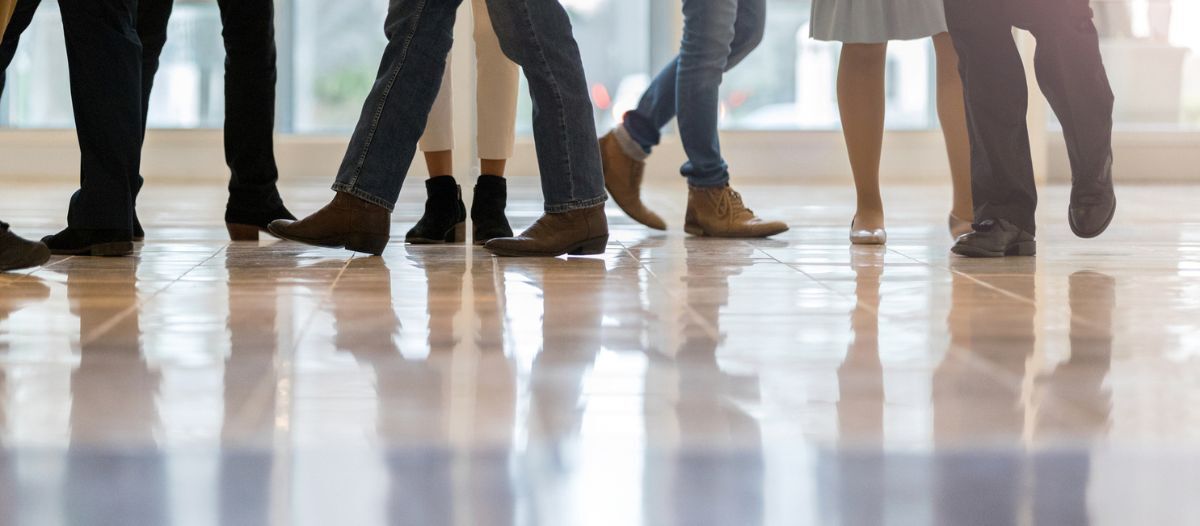
Harmful bacteria flourish in areas with heavy foot traffic. Grocery stores, restaurants, schools, retail stores and hospitals all show the presence of dangerous bacteria such as E. coli, salmonella, listeria, staphylococcus aureus and more. A study also revealed that harmful bacteria, including feca bacteria, was present in every grocery store that scientists tested. Further studies demonstrated that 40 percent of E. coli and other related bacteria strains transfer from surfaces to hands. The effects of these dangerous bacteria can be devastating — nausea, vomiting, dehydration and even death can occur in people of all ages, especially those with low immune systems, such as the elderly and young children. However, scientists have discovered better flooring choices can substantially reduce harmful bacterial growth and exposure.
Flooring the way to safety
Floors are uniquely important in shared spaces — they are in contact with and used by everyone within that space. Vinyl and concrete are two of the most popular flooring types for shared spaces, primarily due to their durability. But how does each surface stand up to a post-COVID-19 scrutinized look at its impact on public health? Though both surfaces do well against everyday wear and tear and can mask damage, the spread of COVID-19 has demonstrated a need for more careful thought about how societies build and maintain occupied spaces. While durability is important, a floor’s impact on public health must also weigh heavily in the design process if communities hope to avoid additional outbreaks. Because floors can encourage or cease the spread of infections and disease, it is of utmost importance to support public health and a functioning society with safe, clean floors.
Testing, testing
Identifying the most bacteria-resistant floors requires a look into the porosity and permeability of the floors themselves. Porosity is a measure of the volume of voids in concrete. Permeability is the rate of flow of moisture through [a surface] under a pressure gradient. Voids through which moisture can move must be interconnected and of a certain size. Discontinuous pores and pores with narrow entrances retard the flow of moisture. Therefore, [a surface] that is more porous tends to be more permeable.”
Bacteria thrive on porous and permeable surfaces — the more porous the floor, the more open gaps and spaces available for bacteria to occupy. Relatedly, a permeable floor surface allows liquids and microbes to pass through and into the surface, sometimes becoming trapped to create bacteria or elements that encourage the growth of bacteria. While porous or permeable flooring may not be a concern within homes or other small spaces, larger community spaces must avoid porous or permeable flooring to minimize exposure to dangerous bacteria.
As two of the most popular flooring choices, scientists tested both concrete and vinyl in a controlled bacterial growth environment. The scientists then analyzed the samples, investigating each surface’s porosity and permeability and identifying the amount of bacterial growth on each surface type. Concrete quickly emerged as the more porous and permeable of the two. Concrete’s permeability allowed water and other elements to seep through the surface and create a thriving environment for bacteria. The research teams also investigated a common assumption that polishing concrete with increasing grit will reduce its porosity; however, this proved to be a misconception that has not been demonstrated in any lab tests. Though notoriously durable, the study revealed concrete’s weakness: low resistance to bacteria. Regardless of its grit, concrete’s porous and permeable nature creates an environment poised for bacterial growth and the spread of sickness and disease.
A vinyl victory
In comparison, the tests revealed that vinyl was far more resistant to bacteria than concrete. The surface was not only less porous, but it also absorbed significantly less water than concrete at any grit. When compared to float, 200-, 400- and 800-grit concrete samples, vinyl reduced absorption by 62, 67, 54 and 61 percent, respectively.
Some designers are reluctant to use vinyl flooring because of a misunderstanding of the surface’s benefits. Vinyl is emerging out from an old reputation of being synonymous with linoleum, a flooring type once considered cheap and undesirable. Indeed, vinyl does offer many of the same positives as linoleum in terms of durability, affordability and versatility, but technological advancements have moved vinyl far above and beyond linoleum, even placing it firmly into the luxury flooring category due to its enhanced performance, detailed embossing and quality aesthetics. Today, luxury vinyl rivals all other flooring types, making it a major contender with various color and pattern options (both natural and digital). The result is a surface that not only boosts public health and demonstrates high durability, but also easily complements a spectrum of design preferences.
The worldwide wake-up call: A healthy future through flooring
Though perhaps the presence of bacteria in large, occupied spaces does not surprise some, the impact of COVID-19 has revealed a pressing need to support public health and minimize the levels of these bacteria. In a post-COVID-19 environment, societies are called to seriously evaluate their shared spaces and their effect on public health. The difference between concrete and vinyl’s resistance to bacteria is a worldwide wake-up call. Polished concrete flooring is used across sectors, industries and countries. As a result, the floors of some of the most cherished shared spaces — schools, hospitals and food suppliers among them — are poised to threaten public health. Even if the floors are cleaned thoroughly, a surface’s porosity cannot be altered; therefore, bacterial growth will continue despite any cleaning team's best efforts. The results could be catastrophic with the rampant spread of harmful bacteria and disease.
Public health and wellness rely on the cleanliness of occupied spaces. Utilizing flooring with minimal permeability is imperative to maintain human safety by preventing bacterial spread and growth. To preserve the safety of these spaces, bacterial growth and exposure must be minimized. While regular cleaning remains necessary, a floor’s porosity and permeability are major factors behind its ability to boost and preserve public health. Both vinyl and polished concrete flooring types have enjoyed popularity due to high durability levels; however, concrete fails to match vinyl’s resistance to bacteria. Of the most popular flooring surfaces on the market, vinyl stands out as the safest and best choice to preserve community health and wellness.

David Dembowitz is the senior vice president of sales for Mohawk Group. With more than 21 years of industry experience, his extensive background in the flooring industry includes sales, strategic account management, segment marketing and product development.
References
Morris, M. A. (2010). Molecular detection of fecal-bacterial contamination on grocery shopping cart handles within the Sacramento region. Sacramento State ScholarWorks.
Rusin, P., Maxwell, S., & Gerba, C. (2002). Comparative surface-to-hand and fingertip-to-mouth transfer efficiency of gram-positive bacteria, gram-negative bacteria, and phage. Journal of Applied Microbiology.
Westbrook, M., Bennett, H., & Belkowitz, J. (2020). An Analysis on Bacterial Growth on Vinyl and Polished Concrete.
Read more on Facility Operations and Risk Management or related topics Project Management , Occupant Health and Risk Management
Explore All FMJ Topics