
 Membership
 Network
 Regional Sites & Affiliates


 Events
 Participate
 Resources

 Training
 Credentials
 Government


 Content Channels
 Tools
Tools


 Business Overview





Good AI Comes From Good Data
Without data discipline, even the smartest AI is bound to fail

The biggest reason AI may fail in maintenance and asset management has nothing to do with technology.
That may sound surprising at a moment when companies everywhere are investing heavily in AI as part of their digital transformation efforts — and for good reason. The promise is real: smarter decisions, fewer breakdowns, more efficient operations, and maintenance teams equipped to solve problems before they become costly failures.
 And yet, recent research shows that across many organizations, an older challenge remains. The data AI depends on — the work histories, asset records, failure codes and maintenance notes gathered day after day — is often incomplete, inconsistent or completely missing.
This is not a new lesson. For decades, maintenance leaders have used maturity models that map the journey from reactive maintenance to preventive, then predictive, and ultimately prescriptive strategies. But for many organizations, those higher stages remain out of reach. Prescriptive maintenance, especially, is still more aspiration than standard practice.
While AI may represent the promise of what comes next, progress still depends on something more fundamental: the discipline to capture the work being done every day, and the data that work creates.
Data: The real AI bottleneck
Organizations that make real progress along the maintenance maturity curve, moving from reactive maintenance to preventive, predictive and eventually prescriptive strategies, tend to have one thing in common: strong data discipline.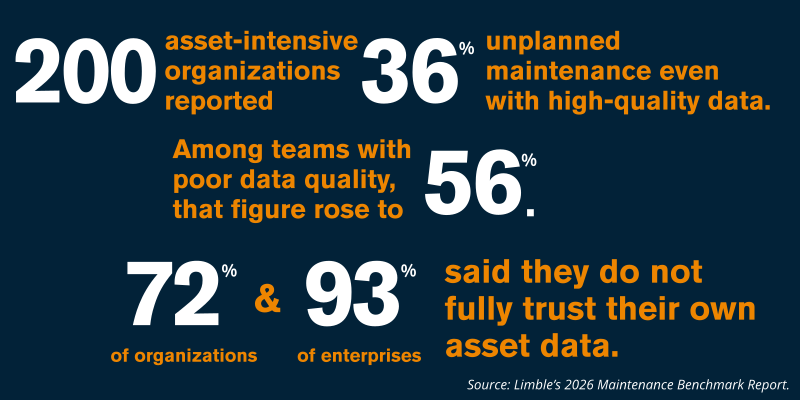
The numbers make that clear. In a Limble survey of more than 200 asset-intensive organizations across industries, teams with high-quality data reported 36 percent unplanned maintenance. Among teams with poor data quality, that figure rose to 56 percent. Just as telling, 72 percent of organizations, and 93 percent of enterprises, said they do not fully trust their own asset data.
Those figures are more than statistics. They tell a story. They show that disciplined execution is supported by reliable data, and reliable data leads to better decisions. And they raise an important question:
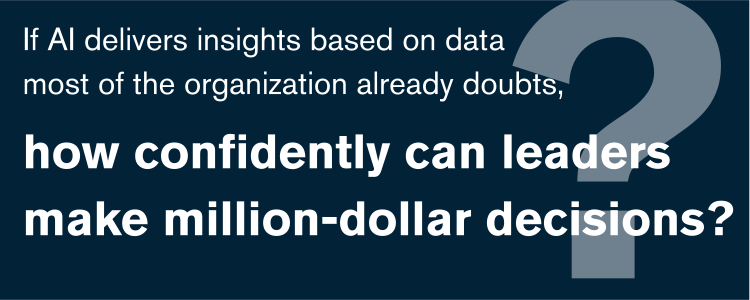 Because the more advanced stages of maintenance maturity rely on foundational elements, such as accurate asset records, work histories and maintenance logs teams can trust. Without those inputs, AI systems have very little of value to analyze. Even the most sophisticated algorithms cannot make up for records that were never captured in the first place.
The signals AI depends on
AI is remarkably good at recognizing patterns across large volumes of information, both structured (quantitative) data and the messy, unstructured (subjective) notes people leave behind. In maintenance environments, that information often lives in technician work orders, asset histories, inspections and service records.
But for many organizations, that history is still fragmented. Even today, companies are moving from spreadsheets, paper logs, whiteboards and disconnected systems into modern CMMS platforms for the very first time. In many cases, years of maintenance knowledge exist in these formats that are difficult to search, analyze or scale.
Furthermore, systems can only learn from what has been captured in a usable way. Organizations build a truly valuable maintenance history when technicians consistently record four simple things:
-
the asset they worked on,
-
the problem they encountered,
-
the cause of the issue,
-
and the corrective action taken.
That may sound basic. But in many operations, those four details contain the story of why assets fail, why downtime repeats itself, and where performance begins to slip.
Large language models are particularly effective at reading those histories at scale and finding patterns that may not be obvious to even experienced teams. They can identify recurring failures tied to a specific component, vendor part, operating condition or maintenance practice. They can help reliability leaders ask whether a different supplier, replacement part or preventive strategy might produce better outcomes.
But those insights do not appear by magic. They emerge only when the underlying maintenance data is complete, standardized and worthy of trust.
People & culture: Where the real work begins
Capturing this kind of data requires more than installing modern software. It requires leadership, clarity and a culture in which documenting work is understood as part of the job, not as paperwork to be avoided at the end of a long shift.
One maintenance leader said, “Technicians just want to sit in the breakout rooms all day, and technology can’t help that.” This remark pointed to a deeper truth:
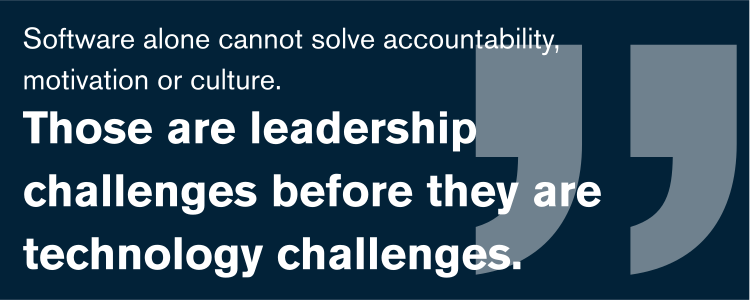 When technicians consistently record what asset they worked on, what issue they found and how it was resolved, something important begins to happen. Every completed work order becomes more than a closed task. It becomes knowledge the organization can use to improve planning, strengthen scheduling, manage inventory more effectively, and prevent the same failure from happening again. Ultimately, and research has shown this as well, it becomes fundamental to building cross-functional trust and elevating maintenance and asset management from a cost center to a true business partner.
Many organizations are making progress by setting clearer expectations in technician job descriptions, providing training on documentation standards, reinforcing accountability through performance metrics, and providing easy-to-use CMMS mobile applications. Others go a step further, creating peer accountability systems wherein crews review data completeness as part of their daily or weekly operating rhythm.
None of this is about asking technicians to do busywork. It is about helping teams see that accurate documentation serves them, too. It leads to fewer repeat failures, smoother handoffs, better planning and smarter decisions. And when people understand the purpose behind the process, consistency tends to follow.
Before investing in AI
When evaluating an AI investment, organizations should begin with a simple truth: the greatest opportunities are often the most practical ones. In maintenance, the best uses of AI are rarely flashy dashboards or futuristic promises. More often, they are tools that make the workday easier.
They summarize work orders, help technicians quickly find the right page in an equipment manual, surface similar past repairs during troubleshooting, automate repetitive documentation tasks, and recommend likely failure codes or replacement parts based on prior history.
The goal is not to force technicians to use “AI tools.” It is to remove friction from the work they are already doing. In the best implementations, technicians may not even realize AI is involved; they simply experience faster workflows, less administrative work and better access to the information they need.
Start with the foundation before building an investment.
Conduct a data audit. Take an honest look at the quality of in-hand asset records, work order histories, failure codes, preventive maintenance data and technician adoption. AI can only learn from what already exists.
Treat data discipline as a strategic initiative. This is not simply an IT project or an administrative cleanup exercise. It is an operational capability that affects reliability, planning, budgeting and trust across the business. Leaders should make clear that data quality is everyone’s responsibility.
Pick the problems AI can solve today and build toward the rest. Focus first on practical use cases that deliver immediate value, such as faster documentation, troubleshooting support, smarter search and workflow automation. Use those early wins to build toward more advanced predictive and prescriptive capabilities over time.
The organizations earning real ROI from AI are rarely the ones chasing the newest tools first. They are the ones that got the foundation right: the right people, the right processes and a culture in which capturing high-quality data is part of how the work gets done every day. Get that right, and the value of AI becomes much easier to realize.

Jason Penkethman is Chief Product and Technology Officer at Limble, where he leads the company’s global product and engineering organizations. In this role, he is responsible for accelerating innovation, enhancing the customer experience, and advancing the capabilities of Limble’s modern maintenance and asset management platform. Penkethman brings extensive experience building and scaling high-performing product and engineering teams across global markets. He has a strong track record of driving product transformation, delivering customer-centric solutions and aligning technology strategy with business growth.
References
Images via Getty Images.
Read more on Facility Technology & Data Management or related topics Data strategy and information management and Asset Management
Explore All FMJ TopicsRelated articles
-

Artificial Intelligence in FM
The stakeholder’s perspectiveBy Dr. Jake Smithwick & Dr. Kenneth Sullivan & Nneka Ubi05.01.2024 -

Don’t Drop the Ball
How a CMMS can make or break an FM organization’s successBy Michael Carmean09.17.2024 -

Beware of Growing Cyberthreats
Why it’s time for stronger facility cybersecurityBy Andrew Harris & Eric Headington10.30.2024
