
 Membership
 Network
 Regional Sites & Affiliates


 Events
 Participate
 Resources

 Training
 Credentials
 Government


 Content Channels
 Tools
Tools


 Business Overview





In Action
Addressing asset management with VBIS

Developed to meet the increasing challenge faced by building owners and facility managers to readily access digital asset information, Virtual Buildings Information System (VBIS) is supporting new construction handover to operations processes, as well as digital transformation within existing property portfolios enabling the better utilization of new digital technologies for operational efficiencies and improvement.
Asset management challenges
VBIS helps FMs readily access asset information to make informed decisions to efficiently operate their facilities.
These challenges include:
-
Inconsistent asset classification
-
Project information handover
-
Accessing up-to-date information from multiple information sources (interoperability)
-
Data structuring to support technology adoption such as analytics and asset management systems/platforms
-
Communicating requirements to stakeholders and suppliers
Challenges can be further exacerbated by facilities often employing several information applications or platforms, each catering to specific functions. Each application can contain components of information related to specific assets. This makes it difficult to quickly locate accurate information when it is needed leading to impacts on productivity, cost and risk.
VBIS was designed to be implemented at any stage of the asset life cycle.
The VBIS standard
VBIS is a freely available standard for classifying and connecting asset data sources and systems. The standard was developed in Australia with significant support from the Victorian State Government and is featured in the 2020 Victoria State Government’s Digital Asset Strategy and in the Queensland State Government’s Data and Information Guideline.
Using an ecosystem approach, the VBIS standard facilitates the standardization of asset categorization particularly suited to unified searching of FM databases and linking a range of asset-centric FM applications such as asset registers, service systems, life cycle analysis systems, O&M manuals, virtual reality systems and emerging cloud-based facilities.
It allows means of communication between 3D models, 2D drawings, FM systems and other asset management systems acting as repositories of project data in a standardized and consistent way. Key aspects of VBIS are:
-
A standard four-level asset object classification coding (tagging) convention to standardize in the way data is labeled or tagged and the introduction of logical parent/child relationship for data, independent of its use.
-
A VBIS syntax that permits a call to a website and pass search parameters for the site to initiate a search and display results. The syntax works with VBIS tags as well as any other asset data parameters such as barcodes, equipment designations or other classification standards.
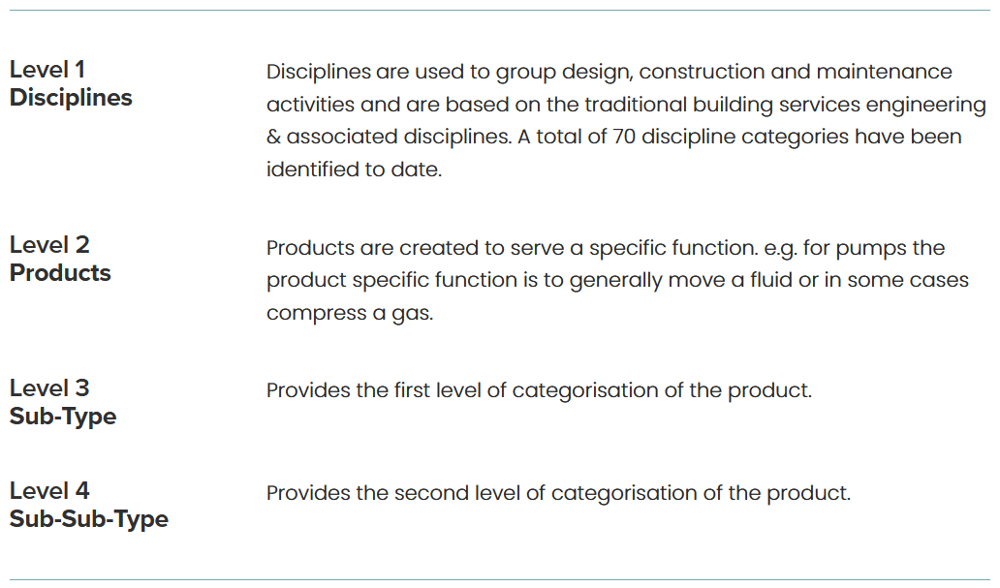 Figure 1: The four-level VBIS classification structure.
Asset classification in new construction
As infrastructure projects move through the design stages, from concept design to preliminary design, detailed design to construction, asset information is progressively gathered and enriched. While designers and construction contractors can build up knowledge of the facility during construction, it is often expected that building owners and facility operations service providers can understand all the details of the building within few training sessions and with minimal mobilization time on site.
With projects becoming increasingly complex, use of building information modeling (BIM) within the design and construction process has similarly increased.
Using the VBIS asset classification tags, asset types can be incorporated into the BIM model ready for export at the completion of the project. With the four-level asset classification tagging structure, FMs can quickly extract a digital asset list that can be used to procure ongoing maintenance contracts by utilizing the first level of the VBIS tags which identify the asset discipline.
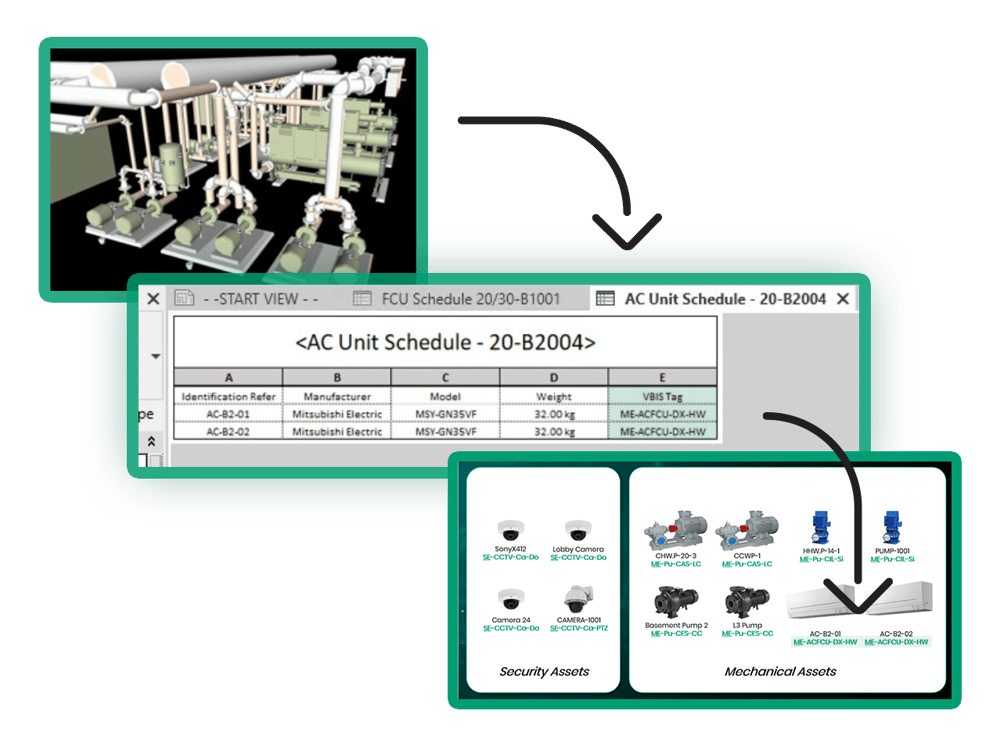 Figure 2: Example of schedules exported from a BIM model with a VBIS tag for digital asset lists.
This information can also then be used to help establish an asset management system (AMS) or computerized maintenance management system (CMMS), with the level of asset identification granularity required to accurately schedule maintenance task requirements.
The asset lists available through VBIS will also ensure accurate asset registers are provided for maintenance planning and procurement.
Improving the handover transition
Using the VBIS linking syntax to connect to asset information within the BIM model allows facility stakeholders to start the learning process within the BIM environment during design and construction. This supports effective planning and efficient transition from construction to operation.
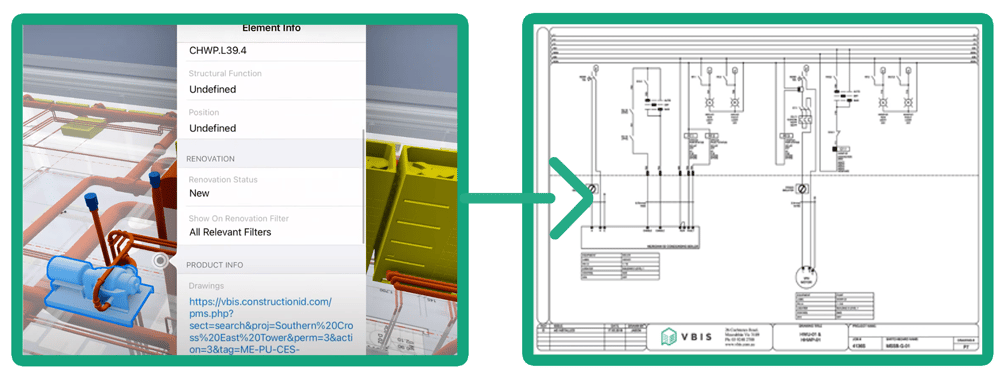 Figure 3: Example of using the VBIS linking syntax within a BIM model to access asset information.
Asset classification in existing property portfolios
The drivers of success in FM for the operation of a building differ from those for construction stakeholders. The primary drivers for construction relate to achieving satisfying time, cost and quality goals. In construction all assets are new, and the key consideration is tracking design, supply, installation, commissioning and handover of the asset.
Success drivers for FM relate to establishing value from assets to maintain the quality of the user’s environment. In existing facilities, assets are often installed at different times, aging at different rates, and many cases, will require multiple replacement during the facility’s life. The availability of consistent, complete and accurate asset information can make a significant difference in addressing these challenges. A fit-for-purpose asset classification system is fundamental in effectively providing this information and should enable:
-
Assigning assets into groups based on common characteristics.
-
Maintenance planning.
-
Life cycle analysis.
-
Information and knowledge transfer.
Adoption of the VBIS classification standard can assist to provide the tools to address these requirements.
Classifying existing assets
The first step to ensuring accurate and efficient operational and capital planning is to ensure assets are captured and recorded in a consistent way to facilitate structured planning and analysis.
It is important that the optimum level of detail is captured, to make certain critical assets are captured without burdening the process with detail that is not useful.
The use of VBIS asset classification tags supports this by introducing multiple levels of granularity to assist with ease of adoption. This can also reduce the costs to capture assets as detail can be built over time.
For example:
-
ME-Chr is a Mechanical Chiller (Level 2)
-
ME-Chr-AC is Mechanical Chiller that is Air Cooled (Level 3)
-
ME-Chr-AC-Ce is a Mechanical Chiller that is Air Cooled and Centrifugal (Level 4)
The example considers the level of information that may be available at the time within the organization, in which the tags can then be initially adopted as two or three levels while creating the necessary structure and process to work toward full level adoption of the VBIS tags.
Ultimately, having the full level adoption of the tags will provide the right level of detail required for accurate whole-of-life analysis of asset performance, helping with capital and operational analytics and decision making.
As assets are captured and classified, maintenance tasks can then be reviewed and aligned to specific equipment types. This information can be used by procurement to ensure contractors tendering for works understand the specific types of assets being maintained.
For example, belt-driven fans will have different maintenance taskings to variable speed drive fans.
This level of identification granularity allows for the ready comparison of scheduled tasks and activities across the portfolio.
The consistency provided by VBIS tagging also better supports performance benchmarking of similar assets across portfolios of similar asset types.
Information sharing
As FMs reduced site interaction time as part of risk mitigation strategies during the pandemic, there has been a new and increasing demand for easy communication and sharing of asset-related information with stakeholders.
The VBIS syntax provides for the robust and resilient interoperability of systems within a common data environment (CDE) by facilitating embedded search and display instructions in CDE applications. As computer systems and applications evolve and new functionality and systems are made available, the VBIS syntax ensures easy transition and adoption of new systems using a common search and display instruction that is not tied to any specific application.
A good example of where this syntax has been deployed to facilitate better collaboration and information sharing, is via 360-degree models and providing quick linking to relevant information. This approach model allows for measurements to be done remotely, provides context to assist with work planning, and facilitates easy access to up-to-date information using the VBIS linking syntax standard.
The advantage of the VBIS syntax is that it provides a search and display call to an application that will only require modification to the domain name at most in the future but will always call and display the current version of the document named, displaying it according to the functionality of the application being called.
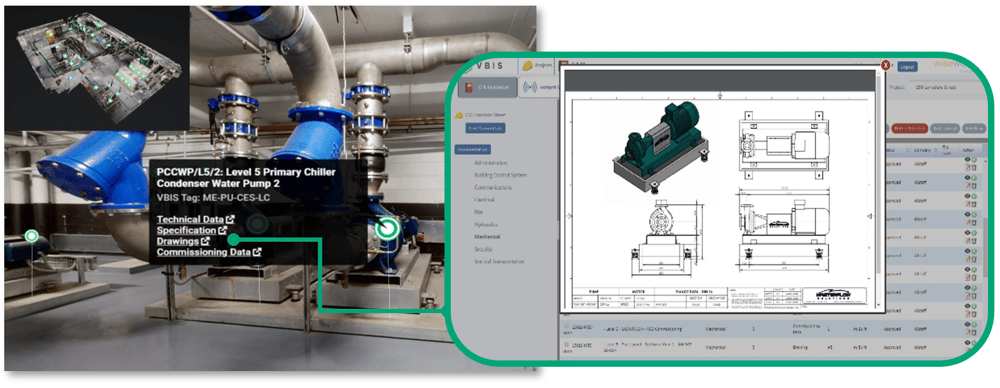 Figure 4: Linking asset information to contextual 360-degree models
VBIS realized outcomes
The VBIS standard provides a cornerstone for enterprise-level asset management systems, providing targeted outcomes that reduce risk and improve operations by enabling:
-
Consistent baseline information (asset register) to ensure accuracy in maintenance and life cycle planning.
-
Enhanced asset analysis and performance tracking.
-
Ability to share relevant details with contractors visiting the site,such as exact location of assets, wayfinding and all asset information is available prior to arriving at site.
-
Risk mitigation by making risk assessment, permit and compliance requirements available for contractors and mapped to the areas and assets as applicable in the facility.
-
Reduce time taken to conduct jobs and reduce time on site. The contractor is aware of the exact requirement through the visualization and site information. They know exactly what to expect and complete reviews and relevant paperwork before attending site.
-
Streamline new staff and contractor induction requirements and site familiarization.
FMs rely on accurate information for planning and to keep assets running effectively. VBIS supports these objectives by providing an open classification and connection standard that is system agnostic and can be adopted to work with all commercial software applications.
For more information on the VBIS standard, live demonstrations of the application of the VBIS linking syntax and list of vendors who have adopted the VBIS standard to become VBIS enabled, please visit https://vbis.com.au

T.K. Wang has more than 15 years of industry experience with a focus on building automation and technologies. During this time, he has taken on roles in engineering, project management, operations management and account management, predominantly in the health care and commercial buildings sectors. He has implemented new technology solutions with a focus on stakeholder outcomes. Most recently he is involved in asset management in consulting delivering services for VBIS.
References
Top image via Getty Images.
Additional images courtesy of TK Wang.
Read more on Facility Technology & Data Management and Facility Operations or related topics Facility Technology and Operations and Maintenance Planning
Explore All FMJ TopicsRelated articles
-

Artificial Intelligence in FM
The stakeholder’s perspectiveBy Dr. Jake Smithwick & Dr. Kenneth Sullivan & Nneka Ubi05.01.2024 -

Don’t Drop the Ball
How a CMMS can make or break an FM organization’s successBy Michael Carmean09.17.2024 -

Beware of Growing Cyberthreats
Why it’s time for stronger facility cybersecurityBy Andrew Harris & Eric Headington10.30.2024