
 Membership
 Network
 Regional Sites & Affiliates


 Events
 Participate
 Resources

 Training
 Credentials
 Government


 Content Channels
 Tools
Tools


 Business Overview





In, On & For
Better access capability for a building’s 3 populations
Every AI conversation starts with model capability, compute and data quality. All of it matters. None of it is what stops AI at the front door of most buildings. That is connectivity. AI started as a tool for people at desks. It is moving into operational work, field work and the places where that work happens. The quality of the model is irrelevant if the person or machine cannot reach it. In-building network access was designed around desk use and never revisited for the others.
The connectivity gap is not new, and the record on that is a decade old. Industry estimates have put the share of wireless data traffic originating or terminating indoors at 70 to 80 percent for more than 10 years. Research CommScope commissioned in 2015 found roughly 2 percent of commercial buildings had a dedicated in-building cellular system. Neither number was a secret, and neither prompted much change.
What has changed is the cost of ignoring it. A dead zone in a plant room was an annoyance, which is the honest reason nobody fixed it. AI does not change the physics. It changes what falls into the hole.
Three populations
Walk any complex building and count who is actually there. Three populations show up every time, separated by one small word.
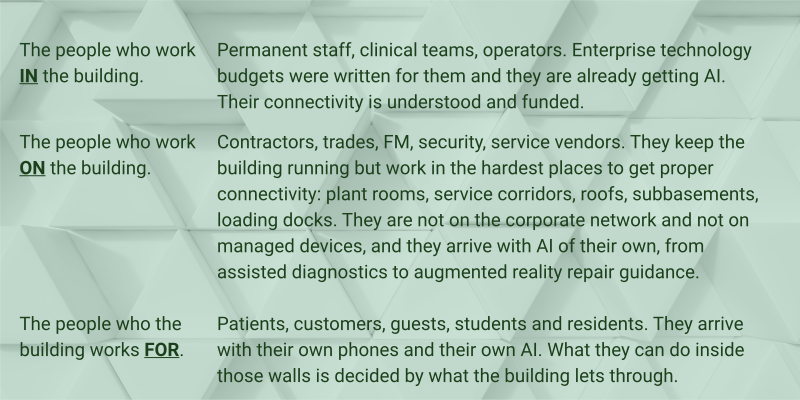 Most building networks are designed around the first population. Wi-Fi covers that group well because that group is what it was designed around. Serving the other two means provisioning people that the building may not employ, forever.
AI is not a desk job
The first wave of AI landed in the easiest possible place. Copilots and summarizers, delivered to people sitting still. Connectivity looked solved because the work never moved. It moves now, and much of that work is not in an office.
Hospitals need coverage for all three populations at once: point-of-care diagnostics, ambient documentation, the vendor servicing the chiller, and the patient expecting to participate in their own care. Commercial properties carry building automation, tenant operational tools, and everyone who walks through the lobby, on infrastructure rarely scoped around them.
Industrial sites run AI where the coverage is worst, from autonomous mobile robots to machine vision. Picture the vibration analyst who comes in twice a year on the packaging line. Their diagnostic tool streams sensor data to a model, compares it against a fleet baseline and returns a bearing recommendation before they leave the floor. The analyst is standing between a conveyor and a concrete wall, 40 feet from the nearest access point, on a network they will never hold credentials for. When signal is lost, the findings are documented, typed up in the parking lot, and the model gets none of it.
The requirement is not set by the employee roster. It is set by everyone who is in the building.
Where Wi-Fi breaks
There is a line in almost every technology plan that nobody writes down: inside the building, Wi-Fi handles it. That held true when the heaviest thing on the network was email on a managed laptop. Wi-Fi can be engineered to do much more than that, and increasingly the limits are architectural rather than something another access point solves.
It requires membership. Staff are straightforward. Provisioning contractors, vendors and guests adds credential issuance, guest management and segmentation that must be maintained indefinitely.
Coverage breaks in real buildings. Concrete, steel, low-emissivity glazing and metallized insulation all cut signals before it reaches tenant space, and the rooms that suffer most are the ones nobody designed around. A building does not have to be trying to block signal for the breaks to emerge.
Shared spectrum is contested by design. Unlicensed bands are shared with everything else in range; and on a full hospital floor or a busy plant, that competition arrives exactly when the workload is heaviest.
Multitenant properties compound it. Most arguments about in-building Wi-Fi assume the building has one network, with one owner, covering the whole property. Retail, residential and office tenants each run their own, and the property's maintenance team belongs to one of them. Few tenants have a reason to cover a basement or a mechanical room, and the owner's business case was developed for people who pay rent rather than the people who keep the building standing. So, the maintenance team troubleshoots the failure in the one room with no signal, which is also the room where things break.
None of this makes Wi-Fi bad technology. It makes it a technology built for a different job: managed devices, one organization and a reasonably friendly space. That job still exists. It is no longer the whole job.
Bring cellular inside
The first issue is not which wireless technology to buy. It is which people and workflows the building must support. Once that is clear, the network architecture becomes a design decision rather than a technology preference.
The answer is not simply more access points. It is putting cellular inside the building where the use case requires it, and there are three common approaches to consider. These approaches are not interchangeable, and the choice decides which populations get served.
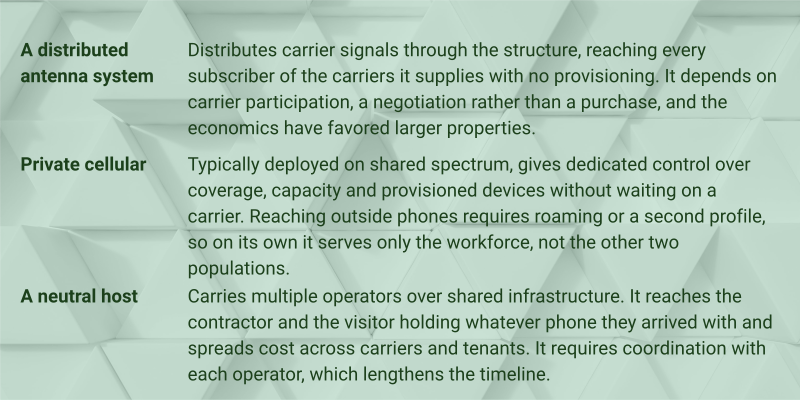
A building serving all three populations often needs more than one of these options.
What cellular changes in the architectures that carry public carrier traffic, is the membership assumption. The building does not have to make every user a member of its own network. A contractor or a visitor can connect without joining it, so the contractor's field app works in the plant room, and the patient's health app works in the basement radiology suite.
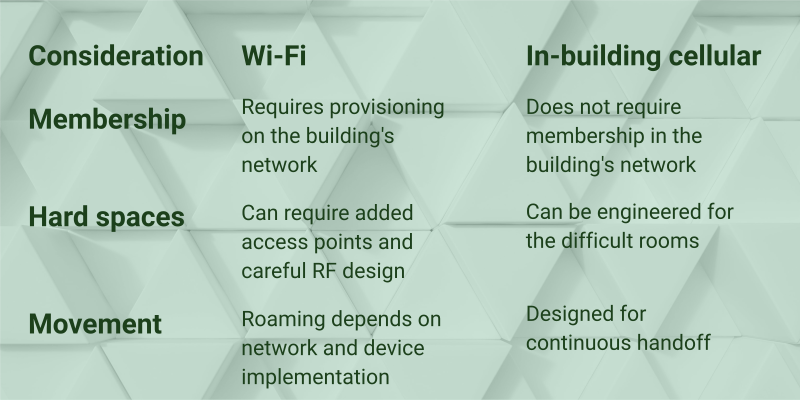
Most buildings run both. The question is which layer carries the traffic that must work for everyone.
The cost of leaving it alone
In-building cellular is not free, and it is not fast to deploy. It requires a radio design against the actual building rather than a heat map, carrier coordination, a spectrum decision (for private connection) and a timeline of months. Adding access points is cheaper on Tuesday and available on Friday.
The capital question is separate from the engineering question. A network-as-a-service structure moves the system to operating expense, with the operator carrying the equipment. That shifts responsibility for maintenance, recertification and eventual refresh.
Here is the part that decides it. Those access points do not solve the credential problem, and that is what makes serving two of the three populations harder. The organization can repeatedly spend less money and never close the gap because it is architectural.
There is precedent for treating a signal as something you build rather than assume. Emergency responder radio coverage systems are required by code in many jurisdictions, coordinated with the local authority having jurisdiction and subject to recurring testing. If a building has one, the building owners have accepted the premise: they engineered a signal into the structure because its absence was unacceptable, and it was agreed to prove on a schedule that it still works. The question is which other signals have crossed that line.
Taking it upstairs
Facility teams see this before anyone else yet rarely control the budget for it. The complaints arrive as dropped calls and dead spots are logged as nuisance tickets and seldom reach the conversation where capital is allocated to fix it. The three people who must agree hold different pieces: the FM team has the coverage data and no budget authority, the owner has the capital and no visibility into a plant room, and the tenant has the complaint and no standing to specify infrastructure.
It is better to enter the conversation with those broken pieces instead of a request for better wireless, which sounds like a line item somebody else already owns. Identify the four worst rooms by name, the number of steps a contractor takes to get online, and the gap between who is in the building at peak and who the network is provisioned for. Those are leasing conversations and capital conversations. A coverage map is neither.
The tenant does not phrase it as a network problem. They phrase it as its people cannot work in the building.
By the end of this decade, in-building cellular coverage should become a routine part of lease negotiations and acquisition diligence, similar to HVAC capacity and power. Operational amenities arrive on a diligence list in one direction: a condition for one large tenant, then a question on a form, then a line item nobody remembers adding. Nothing comes off.
5 questions
 Run these before anyone delivers a proposal.
1. Where does coverage fail? Name the four worst rooms.
2. What steps must a contractor take to get online? If the answer involves a front desk, a form or a rotating password, that friction scales with every AI tool vendors bring.
3. Can the connection survive a walk? Start something on floor three, walk to floor seven, and see whether it survives.
4. Which AI-enabled tools already depend on a connection? Inventory what is deployed, piloting and arriving with vendors. That is the demand curve.
5. Who is on the network at peak, and who is not? Count all three populations on the busiest hour. The gap between that and the provisioned users is the problem.
The building is the network
The people diagnosing, maintaining, operating, occupying and visiting a building are all becoming participants in AI-assisted work, and they notice where the building stops supporting them. Wi-Fi was the right answer for a different set of applications and a different idea of who the network had to serve.
The question is no longer whether the building has connectivity. It is who the connectivity was built for. FM is responsible for delivering it to them.

Brian Zrimsek is an Industry Principal at Airtower Networks, an in-building wireless infrastructure company that designs, deploys and operates public safety, cellular and managed Wi-Fi systems for commercial real estate, health care, hospitality, multifamily and government properties. He has more than 35 years of experience in enterprise technology, including 20 in commercial real estate and proptech.
References
Top image via Getty Images.
Read more on Facility Technology & Data Management , Facility Operations and Communication or related topics Operational Technology , Operational and Capital Budgeting and Communication Management
Explore All FMJ TopicsRelated articles
-

Artificial Intelligence in FM
The stakeholder’s perspectiveBy Dr. Jake Smithwick & Dr. Kenneth Sullivan & Nneka Ubi05.01.2024 -

Don’t Drop the Ball
How a CMMS can make or break an FM organization’s successBy Michael Carmean09.17.2024 -

Beware of Growing Cyberthreats
Why it’s time for stronger facility cybersecurityBy Andrew Harris & Eric Headington10.30.2024
