
 Membership
 Network
 Regional Sites & Affiliates


 Events
 Participate
 Resources

 Training
 Credentials
 Government


 Content Channels
 Tools
Tools


 Business Overview





In the Know
Asset health monitoring as risk intelligence
Facility management is operating in an era of heightened accountability. Operational continuity, regulatory compliance, energy performance and asset longevity are no longer confined to FM departments; they are increasingly visible by the C-suite. Infrastructure performance now intersects with enterprise risk management, sustainability reporting and organizational resilience.
Yet in many organizations, oversight of critical assets still relies on periodic inspections, manual reporting and reactive documentation cycles. This structural visibility gap creates exposure that extends beyond equipment failure to financial risk, compliance vulnerability and reputational impact.
Aging infrastructure compounds the challenge. Across both developed and emerging markets, commercial, health care and municipal buildings are operating well beyond their original design life. Deferred capital investments, constrained budgets and workforce transitions further strain oversight capacity.
Numerous infrastructure assessments have identified aging asset portfolios across both public and private sectors, increasing the likelihood of performance variability and system stress.
While preventive maintenance programs remain essential, periodic checks alone cannot provide continuous insight into evolving asset conditions. The result is a decision-making environment shaped more by historical data than by current performance signals.
The visibility gap & its financial consequences
Unplanned downtime remains one of the most significant cost drivers in FM operations. Industry research across industrial and commercial sectors indicates that reactive interventions often cost several times more than planned or condition-based approaches due to emergency labor, expedited materials and operational disruption and secondary impacts.
In health care settings, even short disruptions to environmental control systems can affect clinical operations. In municipal facilities, water or energy anomalies can interrupt essential services. In commercial real estate portfolios, tenant dissatisfaction tied to system instability can impact occupancy and revenue.
Beyond direct costs, the absence of continuous visibility limits risk forecasting. Without early performance indicators, organizations are often forced into decision-making without time to properly strategize. Capital allocation becomes reactive rather than strategic. Insurance and audit discussions rely on incomplete documentation. Sustainability reporting may reflect aggregate data rather than condition-based insight.
The common thread across these challenges is not merely equipment performance, but visibility. Without continuous awareness of asset behavior, leadership teams are constrained in their ability to anticipate disruption, allocate capital intelligently or communicate infrastructure risk transparently.
From monitoring to risk intelligence
Asset health monitoring addresses this gap by providing continuous visibility into equipment behavior, environmental conditions and utility performance indicators. Rather than waiting for failure or inspection intervals, FM teams gain access to real-time or near-real-time data that reveals performance deviations as they develop. In practice, this form of real-time infrastructure monitoring strengthens operational risk management by reducing information latency between performance deviation and executive awareness.
Continuous tracking of parameters such as vibration levels, temperature fluctuations, humidity stability, pressure variations and abnormal energy patterns enables early identification of emerging conditions. These signals may indicate mechanical stress, environmental instability or system inefficiencies long before failure occurs.
The distinction between monitoring and maintenance is critical. Maintenance involves physical intervention, repair or service activity. Monitoring involves observation, condition awareness and data interpretation.
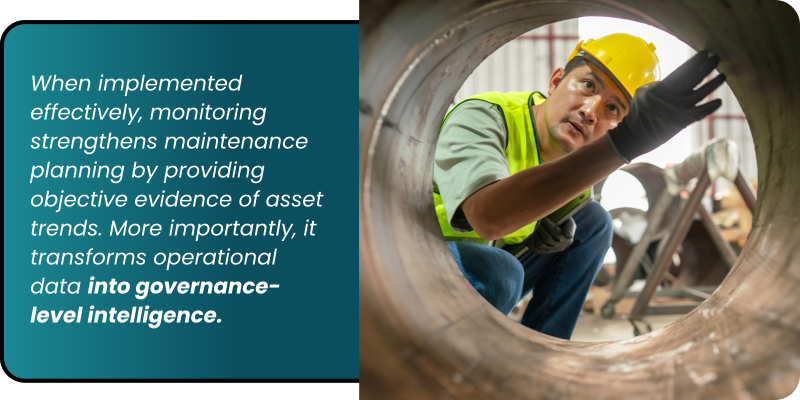 Organizations that integrate monitoring into leadership reporting structures gain a broader perspective on infrastructure performance. Instead of reporting solely on completed work orders or inspection results, FM leaders can communicate on leading indicators of risk. This includes documenting environmental stability in critical spaces, demonstrating continuity of utility performance or validating compliance thresholds in real time.
Monitoring data becomes intelligence when it is contextualized, benchmarked and aligned with organizational risk priorities.
Governance & executive oversight
Enterprise governance increasingly demands visibility into operational risk. Boards and executive committees routinely assess financial exposure, compliance obligations and resilience preparedness. However, infrastructure risk is often discussed only after an incident occurs.
Asset health monitoring introduces leading indicators into governance conversations. Instead of reporting on past disruptions, FM leadership can present measurable trends in asset performance, frequency of deviations and response time metrics. This shifts oversight from reactive assessment to proactive stewardship.
For example, tracking environmental stability in sensitive environments can provide assurance during accreditation reviews. Monitoring utility performance patterns can support sustainability disclosures and carbon reduction initiatives. Documenting anomaly detection timelines can strengthen resilience narratives in stakeholder communications.
When infrastructure data is structured into governance dashboards, it elevates FM from operational support to a strategic leadership partner.
 Global relevance across sectors
The need for asset visibility transcends geography and sector. Health care systems must safeguard patient environments and comply with environmental standards. Municipal utilities must maintain reliability while meeting regulatory obligations. Commercial portfolios are under increasing pressure to demonstrate energy efficiency and sustainability alignment.
In rapidly urbanizing regions, infrastructure expansion can outpace workforce growth, making continuous visibility essential for maintaining oversight at scale. In mature markets, demographic workforce shifts and retiring skilled trades increase reliance on data-driven condition awareness.
Increased frequency of extreme weather events in many regions further reinforces the need for visibility. Extreme temperature swings, flooding events and power disruptions place additional strain on infrastructure systems. Continuous monitoring provides documented insight into how assets perform under stress conditions, supporting post-event analysis and resilience planning.
Across global contexts, continuous asset visibility represents a scalable strategy for strengthening oversight without proportionally increasing staffing levels.
Data-driven decision making & capital planning
FM budgets are increasingly scrutinized. Capital expenditure decisions must compete with enterprise-wide priorities. Asset health monitoring provides objective performance evidence to support these decisions.
Rather than relying solely on age-based replacement schedules, organizations can prioritize investments based on documented performance trends. Assets exhibiting recurring deviations may warrant earlier intervention. Conversely, systems demonstrating stable performance may justify extended life cycle planning.
Monitoring metrics that support strategic decision-making include:
-
Frequency and duration of environmental deviations
-
Recurring anomaly patterns across asset categories
-
Utility performance irregularities
-
Time between detection and resolution
-
Performance trends relative to compliance thresholds
When aggregated and analyzed, these metrics provide a defensible foundation for capital planning, insurance discussions and risk disclosures.
Reactive models vs. Visibility-driven models
Traditional facilities oversight models rely heavily on scheduled inspections, preventive task lists and post-event reporting. While structured maintenance programs are essential, they often emphasize completion of tasks rather than condition-based intelligence. In reactive models, deviations are typically identified after performance thresholds are exceeded or occupants report discomfort.
A visibility-driven model operates differently. Instead of focusing solely on task completion, it emphasizes continuous condition awareness. Deviations are identified at early stages, when corrective action can be more controlled and less disruptive. The emphasis shifts from responding to failure toward understanding system behavior over time.
This shift produces measurable differences:
-
Reduced frequency of emergency interventions
-
Improved predictability in capital planning cycles
-
More stable environmental performance in regulated spaces
-
Greater transparency in compliance documentation
Importantly, visibility-driven models do not eliminate preventive maintenance programs. Instead, they enhance them by aligning service activity with documented performance evidence. Preventive schedules remain foundational, but they are supplemented by condition-based insight.
The practical distinction lies in information latency. In reactive systems, performance information reaches decision-makers after disruption occurs. In visibility-driven systems, information is available while there is still time to act strategically.
Integrating asset visibility with sustainability and compliance
Sustainability performance is increasingly embedded within FM strategy. Energy efficiency targets, emissions reporting requirements and environmental disclosures require reliable data. Asset health monitoring contributes to these objectives by identifying inefficiencies at the equipment level.
For example, persistent temperature drift in climate-controlled environments may indicate inefficiencies in HVAC systems. Abnormal utility consumption patterns may reveal leaks, load imbalances or performance degradation. By identifying these trends early, organizations can reduce energy waste and improve system efficiency before costs escalate.
From a compliance perspective, documented performance records provide assurance during inspections and audits. Continuous environmental monitoring can validate that temperature, humidity or pressure parameters remain within acceptable thresholds. Utility anomaly documentation can support environmental compliance reporting. In regulated sectors, the ability to demonstrate consistent performance stability strengthens audit readiness.
Maturity levels of asset health monitoring
Organizations often progress through identifiable stages of monitoring maturity: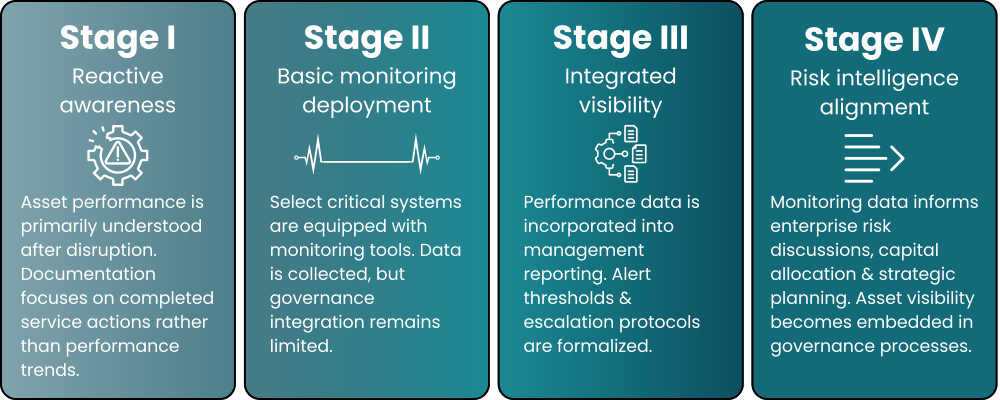
Measuring the impact of continuous visibility
To evaluate effectiveness, facilities organizations can track key performance indicators such as:
-
Reduction in emergency work orders
-
Decrease in environmental deviation events
-
Improved response time to performance anomalies
-
Variance reduction in utility consumption
-
Increased audit readiness confidence
These indicators provide measurable evidence that asset visibility contributes to operational resilience and financial stability.
A practical framework for implementation
Implementing asset health monitoring as risk intelligence requires structure and clarity.
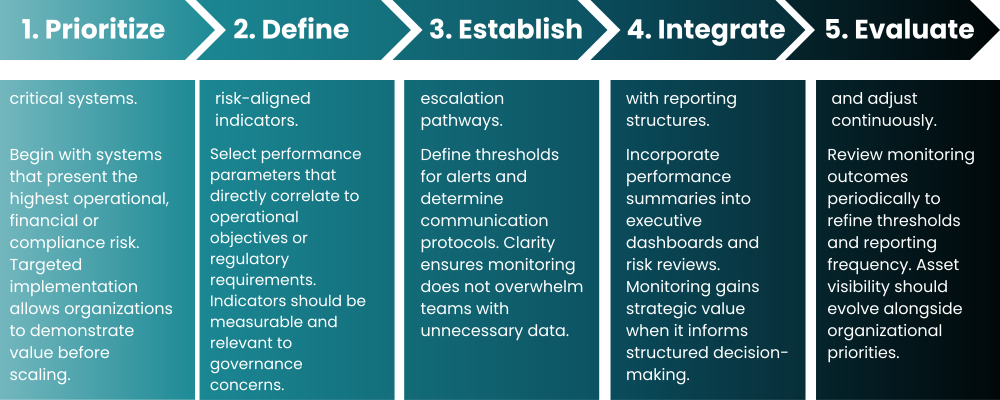 This framework embeds visibility into existing governance structures rather than treating monitoring as a standalone initiative.
Redefining stewardship of the built environment
As expectations for transparency and resilience increase, infrastructure oversight is becoming inseparable from organizational accountability. Stakeholders seek assurance that critical systems are not only maintained but continuously understood. Asset health monitoring provides a pathway to meet this expectation by bridging operational data and governance insight.
Continuous visibility transforms infrastructure from a reactive cost center into a managed risk portfolio supported by measurable evidence. Organizations that embrace this shift are better positioned to respond to disruption, justify capital investments with confidence and communicate infrastructure performance with clarity.
In an environment defined by uncertainty, continuous asset visibility is increasingly recognized not merely as a technical enhancement, but as a foundational component of modern risk intelligence and responsible FM leadership.

Angela Cabrera is the Founder and CEO of Alegna Technologies, Inc., a U.S.-based company specializing in IoT-AI enabled predictive maintenance solutions for healthcare, government, education, and critical infrastructure. She leads initiatives that combine smart sensors with hundreds of smart solutions, IoT platforms, and 80+ different types of smart sensors AI-driven for advanced data strategies to reduce critical equipment downtime, extend equipment life, improve compliance and daily operational efficiency. Cabrera collaborates with research institutions such as Georgia Tech and Georgia Southern University to accelerate innovation in FM. She has been recognized by Engineers Outlook, IAOTP and Marquis Who’s Who for her leadership in advancing smart infrastructure.
References
Top image via Getty Images.
Read more on Facility Technology & Data Management , Real Estate and Facility Operations or related topics Asset Management , Data strategy and information management and Operations and Maintenance Planning
Explore All FMJ TopicsRelated articles
-

Artificial Intelligence in FM
The stakeholder’s perspectiveBy Dr. Jake Smithwick & Dr. Kenneth Sullivan & Nneka Ubi05.01.2024 -

Don’t Drop the Ball
How a CMMS can make or break an FM organization’s successBy Michael Carmean09.17.2024 -

Beware of Growing Cyberthreats
Why it’s time for stronger facility cybersecurityBy Andrew Harris & Eric Headington10.30.2024
