Membership
 Network
 Regional Sites & Affiliates


 Events
 Participate
 Resources

 Training
 Credentials
 Government


 Content Channels
 Tools
Tools


 Business Overview





Innovating for Success
Sustainable energy buildings
A smart energy-savings system that cuts electricity and operating costs can elevate an FM’s status and bring their energy cost savings contributions to the forefront of an organization’s success. As electricity continues to become the dominant energy source in America and non-renewable sources are phased out, facilities can meet this challenge head on and make energy reduction an essential element of their workforce development and training. By sharing their sustainable energy success stories, FMs become leaders in a zero net energy future and contribute to their organization’s triple bottom line (TBL), balancing social, environmental and financial factors.
Many building and property managers today are asked: “What are we doing in our buildings to be more sustainable?” Whether it’s determining current status toward being more sustainable, or how to save money in a building’s operations by being more energy efficient, or achieving a building rating system certification, the answers on how to effectively manage facilities and properties using sustainable practices were not always on hand and easily accessible — until now.
An in-depth study performed by IFMA members revealed that most FMs have implemented a variety of sustainable practices. However, the majority have not implemented a master plan, but rather selectively choose different sustainable practices. Many are familiar with the term "green design," but were not as familiar with the LEED rating system or environmentally preferable purchasing. The FMs in this study consider projects to be sustainable if they:
-
Use a minimal level of energy to operate.
-
Have a lower total environmental impact.
-
Have fewer harmful emissions.
-
Contain products that are easily recycled.
-
Use products manufactured in an environmentally friendly way.
-
Have products made from recycled products.
What is a sustainable energy buildings plan?
A sustainable energy buildings plan (SEBP) optimizes energy storage systems (ESS) and efficient energy management in support of the primary purpose of the organization. A SEBP has the potential to manage energy resources in a manner consistent with all that is green, zero net energy and high performance. The idea of sustainable energy is not just about doing something that is environmentally or people-friendly. It’s also about making facilities last, perform at a level that meets the needs of the organization, managed in a manner that is consistent with the mission, vision and values of the organization, and most of all, lowering energy usage.
Energy-saving performance characteristics include energy efficiency, low reliance on natural resources, low-carbon and a healthier indoor environment. The term "high-performance" fits well into the FM’s lexicon because it describes an outcome that facility and property managers have been seeking since long before buildings were termed "green." Their goal has always been to optimize performance while saving energy.
Starting a SEBP
The challenge of successfully incorporating energy-saving practices is often found within the organizational culture. Change is not easily accepted and "business as usual" seems to be the motto when new ideas or methods are introduced. However, in any organization, at any point in time, change is necessary and will more than likely require a gradual, result-driven integration.
Today, sustainable energy management is not the sole responsibility of one department; it must become a part of the organizational culture. At all levels within an organization, there are lessons to be shared with regard to the synergy between sustainability and energy management. In order to develop a successful SEBP, the following needs to happen:
-
Identify the impact of existing facilities on the TBL.
-
Understand total cost of ownership , return on investment and life cycle costing (LCC).
-
Determine if the organization’s mission statement includes corporate social responsibility (CSR), which is the commitment to contribute to economic development while improving the quality of life of the workforce, their families, the community and society at large.
-
Align the facility and property management strategies with the organization’s commitment to the TBL and CSR efforts.
-
Create a strategy for delivering sustainable energy management.
-
Secure senior management buy-in and/or a policy champion to make it happen.
-
Create a process for measuring and monitoring energy, resources, use and savings.
-
Develop a change management strategy and communications plan to engage the workforce in sustainable energy management.
In the past, daily grid demand ramped up in the morning, peaked from noon into the early afternoon as temperatures and air-conditioning usage increased; then gradually decreased as the day progressed. Though there is some additional nuance to the scheduling, California’s utilities have long scheduled on-peak hours — during which rates were the highest — from around 11 a.m. to about 6 p.m. Off-peak hours, meanwhile, were generally applied through the other hours of the day.
For utilities, time of use (TOU) rates helped increase revenue to cover the high costs of delivering power when demand was high. For energy consumers, this created an incentive to minimize reliance on the grid for power during on-peak hours. This has long been a significant part of the value of on-site solar photovoltaics (PV) for the state’s large energy consumers. The hours when solar generation is at its highest levels happen to coincide with the on-peak hours, enabling large energy users to rely on their on-site solar power and avoid exposure to several hours of high on-peak rates every day.
However, the rise of solar power generation in the state — both behind-the-meter (BTM) and at the utility scale — has disrupted the dynamics of the supply mix supporting California’s electric grid. Utilities are adapting to these new realities with changes to their TOU rate schedules, which will have a significant impact on the business case for behind-the-meter solar PV and ESS.
California’s utilities respond to the duck curve
For utilities, electricity is generally more expensive and complex to deliver when demand is high. To help cover these costs, California’s utilities have traditionally imposed TOU rates, which created a daily schedule that applies different prices for power-based, on-demand trends on the grid. When demand is highest, prices are highest under TOU rates.
From 2007 to 2017, utility-scale solar power generation in California grew from 557 GWh to 24,353 GWh, according to the U.S. Energy Information Administration. This rapid increase has created several serious challenges for the state’s utilities, which rely largely on natural gas generation to supply the majority of power on the grid.
Solar production increases in the late morning hours and peaks around noon before tailing off in the late afternoon and early evening. This reduces demand for natural gas during the midday hours when utilities traditionally imposed higher, on-peak TOU rates. Then, as solar power generation diminishes in the late afternoon hours, utilities face a spike in demand for power from natural gas.
California’s Independent System Operator illustrated this trend in the graph below, now commonly known as the duck curve.
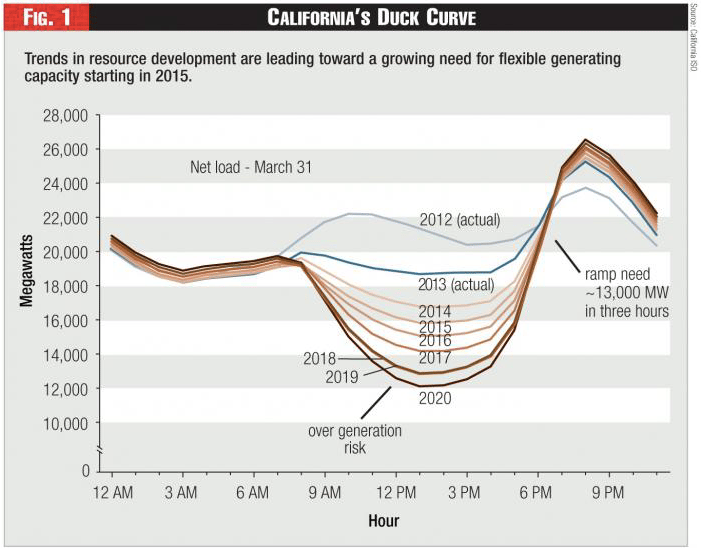 The duck curve creates several challenges for utilities. The first is accommodating the late-afternoon spike in demand. This often requires a reliance on natural gas peaker plants, which can generate power quickly but are expensive to operate on a regular basis. Compounding the cost problem is that much of this early evening spike in demand falls outside the traditional on-peak hours when utilities could expect to make up the high cost of delivering power.
In addition to the high costs, the reduction in midday demand has depressed a traditional source of revenue for natural gas generators, while high levels of solar production have decreased electricity prices, sometimes leading to negative prices. For utilities, TOU rates helped increase revenue to cover the high costs of delivering power when demand was high.
In response, California’s utilities have begun adjusting their TOU rate schedules to account for the duck curve. San Diego Gas & Electric shifted on-peak hours for its summer season to 4-9 p.m., from its previous schedule of 11 a.m.-6 p.m. Pacific Gas & Electric and Southern California Edison) implemented the same types of schedules for on-peak hours in 2019.
Under these new schedules, the utilities apply on-peak rates when demand for natural gas spikes in the late afternoon to early evening hours, helping them adapt to the economic realities of the duck curve. For the state’s large energy consumers, meanwhile, the shift disrupts the economics of behind-the-meter solar PV and energy storage.
The impact of new TOU rate schedules on solar PV & energy storage
Under the new TOU rate schedules, peak production for a solar PV system will occur largely during the new off-peak hours at midday. This undercuts the value of stand-alone solar PV as a source for off-grid power to avoid on-peak rates.
To illustrate the impact of the shift in TOU rates on a stand-alone solar PV system, analyzed was a 2-MW solar PV system installed at an office building with US$1.2 million in annual energy spend, 7 GWh of annual energy usage, and a peak load of 1.6 MW. The latest TOU rate schedules reduce the value of the solar PV system by 19 percent over a 20-year period.
However, combining solar PV with energy storage can enable large energy users to use their self-generated power more strategically. If customers can charge anESS with their on-site solar PV assets during off-peak hours, they can transition their facility onto that low-cost energy during on-peak hours. Distributed energy resources (DER) optimization software facilitates this process, charging the ESS with power generated via solar PV and automatically transitioning the facility’s load onto the on-site capacity available to reduce consumption from the grid when on-peak rates are applied.
Looking at the same building analyzed above, adding a 500 kW/1 MWh ESS with the existing on-site solar PV actually makes up the value that the system would have lost as a result of the new TOU rate schedules. That equates to a difference of about US$1.9 million.
The shift in TOU rate schedules will also affect the business case for stand-alone energy storage. Again, DER optimization software plays an important role in managing these costs, automatically charging the batteries at times when power prices are lowest and deploying the power during on-peak hours.
To understand the impact on energy storage, calculated was the value of a 630 kW/1 MWh stand-alone ESS for a food-processing facility with annual energy spend of about US$650,000, annual usage of 3 GWh, and a peak load of 1 MW. For this facility, the new TOU rate schedules would increase the value of an ESS by 16 percent, resulting in more than US$3.1 million in total value over a 20-year period.

Corey Lee Wilson is a California native and founded the IFMA Inland Empire Chapter in 2013 where he was president from 2013-19. He is the president of CLW Enterprises, and project manager for MicroNOC Inc. He holds a BS in Economics from California State Polytechnic University Pomona, is an IFMA FMP, LEED AP O+M Specialty, CMAA CCM, and a member of the USGBC-LA Chapter. He is an energy savings consultant that facilitates cost-effective and efficient energy reduction and battery backup systems that reduces energy usage that lowers operational costs.
References
Top image via Getty Images. Graphic courtesy of Corey Lee Wilson.
Read more on Facility Operations and Sustainability or related topics Energy , Sustainable Facility and Operational and Capital Budgeting
Explore All FMJ Topics