Membership
 Network
 Regional Sites & Affiliates


 Events
 Participate
 Resources

 Training
 Credentials
 Government


 Content Channels
 Tools
Tools


 Business Overview





Keeping Pace
Reducing deferred maintenance amid staffing shortages
Facility professionals are confronting the dual challenge of underfunded infrastructure and an aging building stock. In education, these challenges become critical. Discussions about deferred maintenance often center on inadequate budgets or outdated systems, but another force is quietly making the situation worse: staffing shortages.
As veteran facility leaders retire and turnover rises, educational institutions, districts and independent schools are watching decades of institutional knowledge walk out the door. Recruiting replacements with the same depth of expertise is increasingly difficult, leaving smaller, less experienced teams to manage growing backlogs.
Computerized maintenance management systems (CMMS) are emerging as a practical safeguard. A CMMS is software designed to centralize work orders, streamline preventive maintenance and capture the knowledge, data and trends needed to run facilities efficiently. For schools facing shrinking teams and expanding responsibilities, this tool can mean the difference between staying ahead of breakdowns or falling further behind.
The problem: Staffing & retention as a facility risk
Across the skilled trades sector, the pipeline of experienced tradespeople is tightening. A recent Industry Trends Survey shows that retirement is accelerating, even as fewer new workers are entering the field. At the same time, competition from private industry draws away qualified candidates with higher wages and more predictable hours.
In school systems, the effects are visible in rising turnover. FM teams often struggle to fill vacant positions quickly, leaving gaps that force remaining staff to take on more tasks. When experienced custodians, electricians or maintenance managers retire, they often take with them decades of know-how about the quirks of each building, the timing of seasonal upkeep and the shortcuts that keep systems running smoothly.
The loss of this institutional knowledge fragments workflows and slows response times. Backlogs build as tasks pile up faster than staff can resolve them. A school district that once relied on a seasoned professional to identify and prioritize issues may now depend on newer employees who lack the same perspective.
As the list of overdue tasks grows, so do liability concerns, along with financial and operational risks. A missed inspection can lead to a safety incident. A postponed repair can evolve into a major capital expense. Each delay compounds costs and erodes the reliability of the learning environment.
When knowledge is lost, these risks escalate. Buildings become harder to manage, compliance slips and equipment deteriorates more quickly. What could have been addressed through timely preventive maintenance becomes a costly emergency repair. Over time, the cycle of deferred maintenance accelerates, leaving schools with deteriorating facilities and limited options.
The solution: Using a CMMS to capture & scale knowledge
To counter these risks, FMs are relying more on CMMS platforms. By digitizing and standardizing procedures, these platforms ensure that knowledge remains in the system even when staff changes. A modern CMMS allows teams to prioritize and assign tasks quickly, set preventive maintenance schedules, streamline communication and cut down on manual steps.
Consider a typical scenario. Without a CMMS, a technician may rely on outdated paper logs or word-of-mouth to determine which equipment needs service. With a CMMS, the technician receives a mobile notification with step-by-step instructions, real-time asset history and the ability to close out the work order on site. Even if staffing is in flux, the system keeps work moving and ensures transparency across the department.
Practical applications for FM leaders
The benefits of a CMMS extend beyond recordkeeping. They directly support the most pressing workforce challenges facing schools.
-
Accelerating onboarding. New hires no longer must rely on memory transfer from a departing colleague. Standardized, documented tasks stored in the system provide clear instructions from day one. Stored institutional knowledge gives them access to the expertise of past staff, helping bridge skills gaps. Step-by-step workflows reduce the learning curve and build confidence faster. A single source of truth ensures consistency across all locations.
-
Reducing turnover risks. When knowledge resides in a system rather than in individuals, the impact of departures is softened. Even if multiple team members leave, critical processes remain intact.
-
Improving efficiency. A CMMS enables teams to prioritize work orders when staff numbers are low, keeping essential tasks from being overlooked. With centralized communication and real-time updates, leaders can manage their departments confidently. Transparency improves, duplication decreases and administrators gain visibility into workloads.
Impact on operational continuity & safety
When properly implemented, a CMMS helps districts and educational facilities maintain continuity even with fewer or less experienced staff. Work orders remain visible, preventive schedules continue and reporting keeps leadership informed.
Safety also improves. Preventive maintenance tools minimize unexpected breakdowns, while documentation and compliance records reduce liability risks. With robust reporting, facilities leaders can quickly demonstrate workload, justify budget needs and highlight the most important performance indicators.
These benefits extend beyond individual schools or districts. Staffing shortages and knowledge gaps are global concerns across the FM industry. A CMMS provides a framework for resilience that can be applied in diverse contexts, ensuring that essential services remain stable despite workforce challenges.
Mini-guide: Setting up a CMMS for knowledge retention
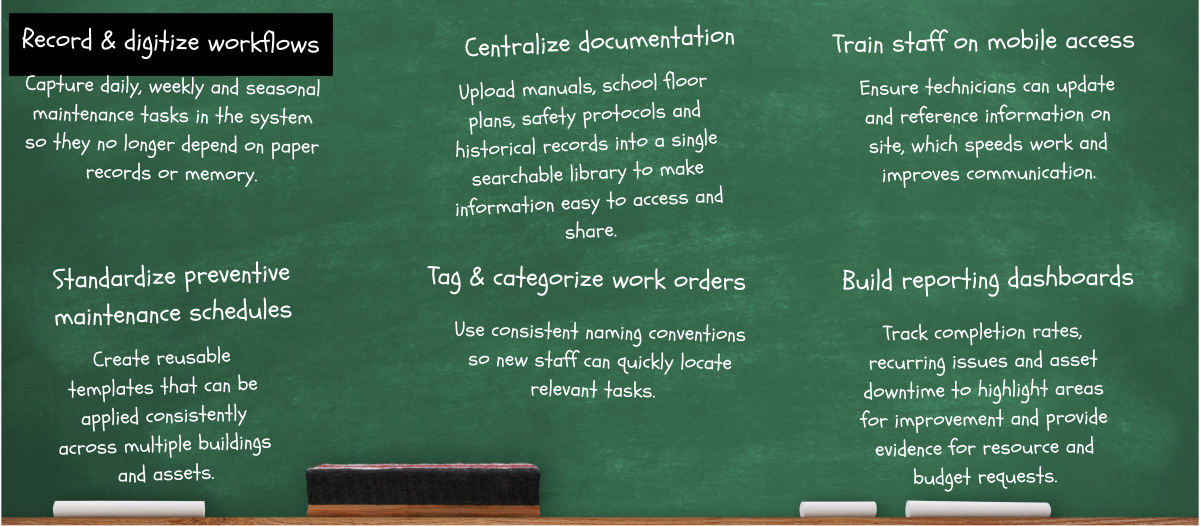
To make the most of a CMMS, FMs should approach implementation in deliberate stages. A phased strategy ensures that critical knowledge is captured and shared, rather than lost in the transition. Key steps include:
Building a retention-proof FM operation
Looking ahead, districts must plan not only for today’s shortages but also for tomorrow’s. A CMMS can serve as the foundation for a retention-proof operation by embedding forward-looking practices into daily routines. By weaving data, training and collaboration into regular operations, districts can build a framework that is resilient to turnover and prepared for long-term needs.
The data captured in a CMMS provides valuable insight into staffing patterns, allowing leaders to forecast needs and refine recruitment plans. Training can be integrated directly into workflows so that learning takes place as tasks are completed, reducing the time it takes new employees to get up to speed.
Collaboration also improves when teams share a centralized communication platform, enabling them to coordinate not only within their own team but also with other departments, such as partnering with IT on lock systems or working with event coordinators on room setups ahead of events. In addition, reporting dashboards highlight performance indicators, giving leaders the ability to justify departmental requests and demonstrate the impact of their work to stakeholders.
These strategies create a future-ready framework. Instead of reacting to turnover, FM leaders can build resilient systems that carry knowledge forward and prepare staff to step into new roles more quickly.
The time to act is now
Deferred maintenance has long challenged schools, but the added strain of staffing shortages has created a new crisis. Retirement and turnover are eroding institutional knowledge, leaving gaps that accelerate backlogs and make buildings harder to manage.
The solution lies in capturing what staff members know before it disappears. A CMMS provides the structure to preserve that knowledge, improve efficiency and sustain safe learning environments even when teams are stretched thin.
For FM leaders, the message is clear: acting now to implement a CMMS is not simply about adopting new technology; it is about protecting institutional knowledge, reducing risks and building the resilient operations that schools need to thrive.

Chris Burns is a Senior Product Manager at Incident IQ responsible for their facilities family of product offerings including work order management, asset management, preventative maintenance, parts & inventory, facilities event management and more. Prior to joining Incident IQ, Christopher spent nearly 10 years supporting K-12 schools in VMware’s End User Computing division as an Apple MDM Product Line Manager and K-12 Subject Matter Expert for their Global Support & Services team.
Read more on Facility Operations and Facility Technology & Data Management or related topics Building Systems , Facility Technology and Training
Explore All FMJ Topics